Undergrad Characterization of External Direct Sum - Cooperstein

  • Thread starter Thread starter Math Amateur
  • Start date Start date
  • Tags Tags
    Direct sum Sum
Click For Summary
SUMMARY

The discussion centers on Bruce N. Cooperstein's book, "Advanced Linear Algebra (Second Edition)," specifically Section 10.2, which addresses the characterization of a vector space ##V## as the direct sum of subspaces ##V_1, \ldots, V_n## through properties (a) and (b). Peter explains that if there exist maps ##\epsilon_k':V_k\to V'## and ##\pi_k':V'\to V_k## satisfying these properties, then the vector space ##V'## is isomorphic to ##V##. The isomorphism is defined by the mapping $$\vec v'\mapsto\sum_{k=1}^n\epsilon_k\pi_k'(\vec v')$$ and its inverse, demonstrating a linear bijection between the two spaces.

PREREQUISITES
  • Understanding of vector spaces and their properties
  • Familiarity with linear mappings and isomorphisms
  • Knowledge of direct sums in linear algebra
  • Basic proficiency in mathematical notation and expressions
NEXT STEPS
  • Study the concept of direct sums in linear algebra
  • Learn about linear isomorphisms and their properties
  • Explore the implications of properties (a) and (b) in vector space theory
  • Review examples of vector space mappings and bijections
USEFUL FOR

Students of advanced linear algebra, mathematicians focusing on vector space theory, and educators seeking to deepen their understanding of direct sums and isomorphisms.

Math Amateur
Gold Member
MHB
Messages
3,920
Reaction score
48
I am reading Bruce N. Coopersteins book: Advanced Linear Algebra (Second Edition) ... ...

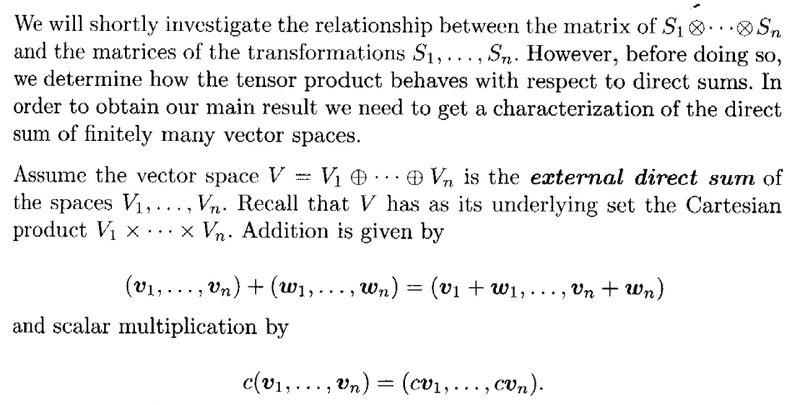
In Section 10.2 Cooperstein writes the following, essentially about external direct sums ... ...
?temp_hash=392d5fdda952d6030121f7ddfed2887c.png

?temp_hash=392d5fdda952d6030121f7ddfed2887c.png

Cooperstein asserts that properties (a) and (b) above "characterize the space ##V## as the direct sum of the spaces ##V_1, \ ... \ ... \ , V_n##"

Can someone please explain how/why properties (a) and (b) above characterize the space ##V## as the direct sum of the spaces ##V_1, \ ... \ ... \ , V_n##?Help will be appreciated ...

Peter
 

Attachments

  • Cooperstein  - External DIrect Sum - Pages 359-360     ....        ....png
    Cooperstein - External DIrect Sum - Pages 359-360 .... ....png
    34.5 KB · Views: 937
  • Cooperstein  - External DIrect Sum - Pages 359-360   - PART 2  ....        ....png
    Cooperstein - External DIrect Sum - Pages 359-360 - PART 2 .... ....png
    20.8 KB · Views: 906
Physics news on Phys.org
What he is saying is that, if we have a vector space ##V'## and for ##k=1,...,n## we have maps ##\epsilon_k':V_k\to V'## and ##\pi_k':V'\to V_k## that satisfy (a) and (b) then ##V'## is isomorphic to ##V## (which is the direct sum of ##V_1## to ##V_n##).

The isomorphism from ##V'## to ##V## is the map:

$$\vec v'\mapsto\sum_{k=1}^n\epsilon_k\pi_k'(\vec v')$$

and its inverse is the map

$$\vec v\mapsto\sum_{k=1}^n\epsilon_k'\pi_k(\vec v)$$

It is straightforward, if somewhat laborious, to show that this map is a bijection and that it is linear.
 
  • Like
Likes Math Amateur
HI Andrew ... reflecting on your post ...

Still trying to follow you ... but having some difficulty ...

Peter
 
I am studying the mathematical formalism behind non-commutative geometry approach to quantum gravity. I was reading about Hopf algebras and their Drinfeld twist with a specific example of the Moyal-Weyl twist defined as F=exp(-iλ/2θ^(μν)∂_μ⊗∂_ν) where λ is a constant parametar and θ antisymmetric constant tensor. {∂_μ} is the basis of the tangent vector space over the underlying spacetime Now, from my understanding the enveloping algebra which appears in the definition of the Hopf algebra...

Similar threads

Replies
1
Views
1K
  • · Replies 2 ·
Replies
2
Views
2K
Replies
2
Views
1K
  • · Replies 5 ·
Replies
5
Views
2K
Replies
2
Views
1K
  • · Replies 5 ·
Replies
5
Views
3K
Replies
5
Views
3K
  • · Replies 28 ·
Replies
28
Views
4K
  • · Replies 13 ·
Replies
13
Views
3K
  • · Replies 4 ·
Replies
4
Views
2K