Calculating Amplitude in Standard Model

Click For Summary
SUMMARY

The forum discussion centers on the calculation of amplitude in the Standard Model, specifically regarding the contributions from three diagrams at the lowest order. The user presented an amplitude formula involving Higgs bosons and fermions, which was confirmed to be mostly correct. However, it was noted that the third term in the amplitude calculation requires an additional factor of λ in the numerator to accurately represent the Higgs boson exchange. This correction is crucial for the proper evaluation of the amplitude.

PREREQUISITES
  • Understanding of Standard Model particle interactions
  • Familiarity with quantum field theory concepts
  • Knowledge of Higgs boson properties and interactions
  • Proficiency in calculating Feynman amplitudes
NEXT STEPS
  • Study the role of the Higgs boson in particle physics
  • Learn about Feynman diagrams and their contributions to scattering amplitudes
  • Explore the implications of the Higgs mechanism in the Standard Model
  • Investigate the calculation of amplitudes involving multiple particles and interactions
USEFUL FOR

Particle physicists, quantum field theorists, and students studying the Standard Model who are interested in calculating and understanding particle interactions and amplitudes.

ultrapoci
Messages
1
Reaction score
0
Homework Statement
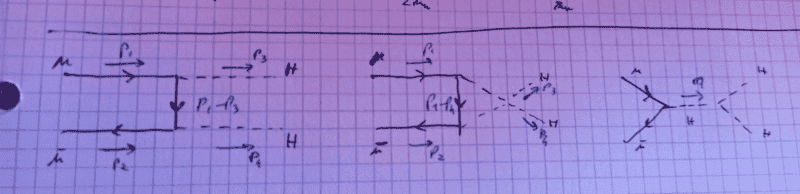
Draw the Feynman diagrams contributing to the process ##\mu^+ \mu^- \rightarrow H + H## at the lowest electroweak order and calculate the squared amplitude
Relevant Equations
Vertex of the Feynman diagrams between two fermions and the Higgs boson is ##i\frac{m}{v}##, and the triple interaction vertex of the Higgs boson is ##i \lambda v## where ##m## is the muon's mass, ##v## is the vacuum expectation value of the Higgs boson, and ##\lambda## is its coupling constant.
Hi! I'd like to ask you if my calculation of the amplitude on the mentioned process in the Standard Model is correct. The three diagrams contributing at lowest order should be
1637926237606.png

where in the middle one the two Higgs boson are NOT forming a quartic interaction vertex.
My attempt at calculating the (not yet squared) amplitude is this: $$A = \bar{v}(p_2) \left( \frac{im}{v} \frac{i}{\gamma^\mu(p_1-p_3)_\mu} \frac{im}{v} + \frac{im}{v} \frac{i}{\gamma^\mu(p_1-p_4)_\mu} \frac{im}{v} + \frac{im}{v} \frac{i}{q^2 - M_H^2 +i\Gamma_H M_H} i \lambda v \right) u(p_1)$$ Is this right?
 
Physics news on Phys.org
Thanks!Yes, that is correct. However, note that the third term should include a factor of $\lambda$ in the numerator (i.e., it should be $\frac{im\lambda}{v}\frac{i}{q^2 - M_H^2 +i\Gamma_H M_H}i\lambda v$). This is because this term corresponds to the exchange of a single Higgs boson between the two fermions, and thus the vertex should include a factor of $\lambda$.
 

Similar threads

  • · Replies 2 ·
Replies
2
Views
3K
Replies
1
Views
2K
  • · Replies 1 ·
Replies
1
Views
2K
Replies
2
Views
2K
  • · Replies 1 ·
Replies
1
Views
2K
Replies
1
Views
2K
  • · Replies 1 ·
Replies
1
Views
3K
Replies
58
Views
6K
  • · Replies 1 ·
Replies
1
Views
2K
  • · Replies 1 ·
Replies
1
Views
2K