Checking My Understanding of a Magnetic Circuit: Help Appreciated!

Click For Summary

Homework Help Overview

The discussion revolves around understanding a magnetic circuit involving Kirchhoff's laws and Faraday's law of electromagnetic induction. The original poster presents equations related to current flow in a circuit influenced by a magnetic field and seeks clarification on their setup and reasoning.

Discussion Character

  • Exploratory, Conceptual clarification, Mathematical reasoning, Assumption checking

Approaches and Questions Raised

  • Participants discuss the application of Kirchhoff's junction and loop rules in the context of a magnetic circuit. There are inquiries about the direction of induced current and the effects of changing magnetic fields. Some participants suggest using Lenz's law to determine current direction and question the implications of certain resistor values in the equations.

Discussion Status

The discussion is ongoing, with participants providing insights and suggestions for further exploration. Some express confidence in the original poster's approach while noting potential sign errors. There is a mix of agreement and clarification on the application of laws and principles involved.

Contextual Notes

Participants mention specific resistor values and their implications, as well as the use of software for solving equations, indicating a preference for computational assistance in handling the complexity of the problem.

jisbon
Messages
475
Reaction score
30
Homework Statement
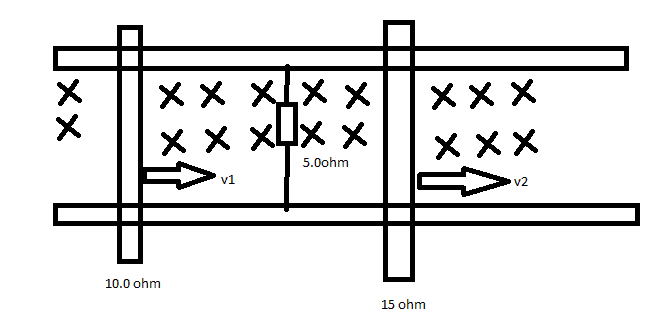
Two parallel rails with negligible resistance are 10.0 cm apart and are connected by a 5.00 resistor. The circuit also contains two metal rods having resistances of R = 10.0Ω and 15.0 Ω sliding along the rails. The rods are pulled to the right at constant speeds 4.00 m/s and 2.00m/s, respectively. A uniform magnetic field of magnitude 0.0100 T is applied perpendicular to the plane of the rails. Determine the magnitude and direction of the current in the 5.00 Ωresistor
Relevant Equations
I'm not totally sure on this.
So I was checking this question out, and I saw that someone did discuss about a similar question before on this forum here:

https://www.physicsforums.com/threads/did-i-get-it-right-by-coincidence.487088/
Since this is a different question, I would like to ask if anyone here could help me check my equation from my understanding (or at least what I thought), here is the diagram:
1564746167766.png

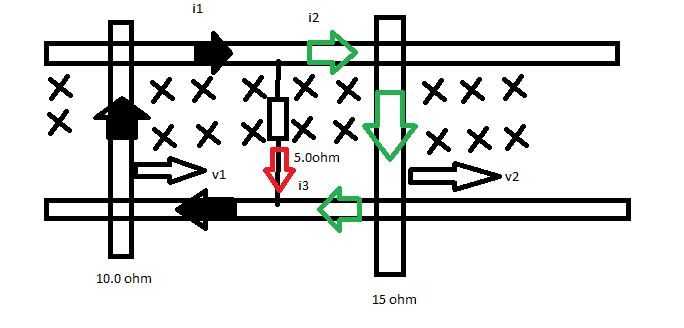
So applying junction rule,

1564746336360.png


Black arrow = I1
Green arrow = I2
Red arrow = I3
I1= I2+ I3

Now applying the other rule aka the loop rule:

My left loop will be:

-I1(10) - I3(5) - BLV1 = 0

?

My right loop will be:

I2(15)-I3(5)-BVL2 = 0

?

I'm not entirely sure how the loop goes about when there's a magnetic field (only dealt with them in normal circuits), so any assistance will be greatly appreciated. Cheers!
 
Last edited by a moderator:
Physics news on Phys.org
EDIT:
Actually, I see nothing wrong with what you attempted to do but I don't use the KCL law so there may be a sign error or two but otherwise it looks fine. Did you compute I1, I2 & I3?
EDIT2 - I ran the computations and at least if the 15 ohm → ∞ and v2=0 the answer came out right.
 
Last edited:
rude man said:
EDIT:
Actually, I see nothing wrong with what you attempted to do but I don't use the KCL law so there may be a sign error or two but otherwise it looks fine. Did you compute I1, I2 & I3?
EDIT2 - I ran the computations and at least if the 15 ohm → ∞ and v2=0 the answer came out right.
Sorry, but what do you mean if 15 ohm → ∞ ? Not sure about that. Oh and v2= 2.00m/s
 
scottdave said:
It is the changing magnetic field which induces a voltage. See this - http://hyperphysics.phy-astr.gsu.edu/hbase/electric/farlaw.html
Yep, I saw the part where faraday's law states that a changing magnetic field will produce voltage, hence EMF=BLV , however, I'm still unclear for the direction. If magnetic field is pointing in and rods are moving to the right, will it mean that the current will go clockwise direction using right hand grip rule? Thanks
 
jisbon said:
Sorry, but what do you mean if 15 ohm → ∞ ? Not sure about that. Oh and v2= 2.00m/s
I just solved a simpler problem as a quick reality check, with no 15 ohm resistor present. I could do the same for the 10 ohm & then use superposition. So could you. :smile:
 
jisbon said:
Yep, I saw the part where faraday's law states that a changing magnetic field will produce voltage, hence EMF=BLV , however, I'm still unclear for the direction. If magnetic field is pointing in and rods are moving to the right, will it mean that the current will go clockwise direction using right hand grip rule? Thanks
Use Lenz's law. Which polarity of current applies a resisting force to the motion?
 
rude man said:
Use Lenz's law. Which polarity of current applies a resisting force to the motion?
I'm assuming the motion refers to the movement of the rods being pulled to the right? So if I use right hand rule , magnetic field points in, force points towards right, current points up (aka clockwise?) and Lenz's law states that an induced electromotive force (emf) always gives rise to a current whose magnetic field opposes the change in original magnetic flux, so current will be anticlockwise?
 
BTW I suggest use of software to solve your three equations. It turned out surprisingly messy.
Also, I suggest replacing the 5ohm with R1, the 10ohm with R2 and the 15ohm with R3. Makes computation easier and allows you to do dimensional checking which should be part of every problem solving.
 
  • #10
rude man said:
BTW I suggest use of software to solve your three equations. It turned out surprisingly messy.
Also, I suggest replacing the 5ohm with R1, the 10ohm with R2 and the 15ohm with R3. Makes computation easier and allows you to do dimensional checking which should be part of every problem solving.
What software are available to use? And is my understanding correct as shown above? Would like to check that. Thanks
 
  • #11
jisbon said:
What software are available to use? And is my understanding correct as shown above? Would like to check that. Thanks
As I said I know your approach is correct and your equations probably are also except for possible sign mistakes (I'm too lazy to check). And yes, the current is clockwise.
Software: I use a very antiquated software called Derive, in its original DOS (floppy disc!) version, which means I have to execute on my XP machine. I think MathCad is a modern one but there are dozens out there that can solve simultaneous algebraic equations.
 

Similar threads

  • · Replies 4 ·
Replies
4
Views
2K
Replies
8
Views
2K
  • · Replies 1 ·
Replies
1
Views
1K
Replies
22
Views
4K
  • · Replies 9 ·
Replies
9
Views
2K
Replies
16
Views
2K
  • · Replies 1 ·
Replies
1
Views
2K
  • · Replies 1 ·
Replies
1
Views
1K
  • · Replies 4 ·
Replies
4
Views
4K
  • · Replies 5 ·
Replies
5
Views
2K