Join the discussion
Registration is free. Start your own thread to ask a follow-up.
35 replies · 6K views
Physics news on Phys.org
Science Advisor
Homework Helper
MHB
- 16,335
- 258
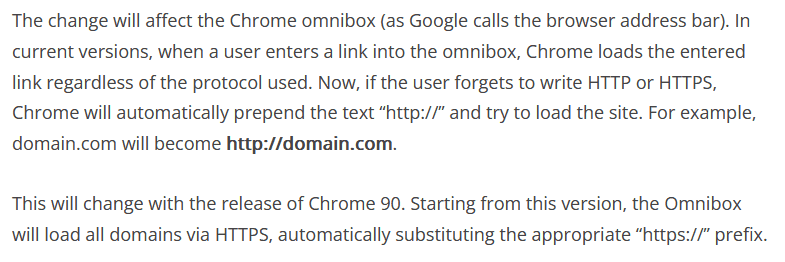
Originally Chrome prefixed a host name automatically with "http://". Apparently they only changed it since Chrome 90 (April 14, 2021). Since then they prefix with "https://" by default.
Still, I imagine that there can still be some weird cache issues floating around.
That is actually not so long ago. Which version of Chrome do you have?
Anyway, I presume you started visiting PF without prefix in such an older version of Chrome.
So perhaps the http:// prefix was still floating around in some cache somewhere. Perhaps stored automatically as part of the bookmark. If so, then editing/removing the bookmark and flushing browser history might fix it.Reference: https://howtofix.guide/chrome-will-add-https/
Still, I imagine that there can still be some weird cache issues floating around.
That is actually not so long ago. Which version of Chrome do you have?
Anyway, I presume you started visiting PF without prefix in such an older version of Chrome.
So perhaps the http:// prefix was still floating around in some cache somewhere. Perhaps stored automatically as part of the bookmark. If so, then editing/removing the bookmark and flushing browser history might fix it.Reference: https://howtofix.guide/chrome-will-add-https/
Last edited:
- 11,327
- 8,758
At one point in history, the use of the URL bar as a URL/search bar, and autocompletion of partial URLs was considered a huge privacy invasion. But now, we are so used to it, that typing an entire URL seems unduly onerous, and privacy is forgotten.
I also found some interesting stuff searching for URL autocomplete. One thing I found is that Google is changing to assume https:// rather than http:// as the new default.
Another very informative answer said :
I also found some interesting stuff searching for URL autocomplete. One thing I found is that Google is changing to assume https:// rather than http:// as the new default.
Another very informative answer said :
https://stackoverflow.com/questions/18241512/how-does-chrome-update-url-bar-completions
Well, I ended up finding some answers by having a look at the Chromium source code ; I'd imagine that Chrome itself uses this code without too much modification.
When you type something into the search/URL bar (which is apparently called the "Omnibox"), Chrome starts looking for suggestions and completions that match what you've typed. To do this, there are several "providers" registered with the browser, each of which knows how to make a particular type of suggestion. The URL history provider is one of these.
The querying process is pretty cool, actually. It all happens asynchronously, with particular attention paid to which activity happens in which thread (the main thread being especially important not to block). When the providers find suggestions, they call back to the omnibox, which appears to merge and sort things before updating the UI widget.
History provider
It turns out that URLs in Chrome are stored in at least one, and probably two, sqlite databases (one is on disk, and the second, which I know less about, seems to be in memory). This comment at the top of HistoryURLProvider explains the lookup process, complete with multithreaded ASCII art !
Sqlite lookup
Basically, typing in the omnibox causes sqlite to run this SQL query for looking up URLs by prefix. The suggestions are ordered by the number of visits to the URL, as well as by the number of times that a URL has been typed.
Interestingly, this is not a trie ! The lookup is indeed based on prefix, but the scoring of those lookups does not appear to be aggregated by prefix, like I'd imagined.
I had a little less success in determining how the scores in the database are updated. This part of the code updates a URL after a visit, but I haven't yet run across where the counts are decremented (if at all ?).
Updating suggestions
What I think is happening regarding the updating of suggestions -- and this is still just a guess right now -- is that the in-memory sqlite database essentially has priority over the on-disk DB, and then whenever Chrome restarts or otherwise flushes the contents of the in-memory DB to disk, the visit and typed counts for each URL get updated at that time. Again, just a guess, but I'll keep looking as I get time.
- 2,188
- 2,694
Currently, version 104.0.5112.101.I like Serena said:Which version of Chrome do you have?
Yes, I joined PF in 2017 or 18, probably. At that time, I did not have a laptop and browsed on my phone, which had an outdated version of Chrome because of space constraints. Later, I synced those bookmarks on my laptop.I like Serena said:I presume you started visiting PF without prefix in such an older version of Chrome.
- 20,002
- 11,122
Newest stable is 105.0.5195.54 but I doubt that is your issueWrichik Basu said:Currently, version 104.0.5112.101.
- 2,188
- 2,694
It has been around one week since I cleared the DNS cache as per the advice of @DrJohn in post #24. The major issue that I was facing — clicking on other bookmarks brought me to PF — is now gone. The issue persisted after I re-installed Chrome, but I haven't faced it till date after I cleared the DNS cache ("Amen" to that).
So, it appears that there was some issue with the cache, and flushing it did the trick. It could also be changing the DNS server to Google and Cloudflare, as advised by @pbuk. I did plenty of changes one after the other during that time, so it's a bit difficult to exactly point out which one solved the issue.
Thanks, everyone, for helping me out.
So, it appears that there was some issue with the cache, and flushing it did the trick. It could also be changing the DNS server to Google and Cloudflare, as advised by @pbuk. I did plenty of changes one after the other during that time, so it's a bit difficult to exactly point out which one solved the issue.
Thanks, everyone, for helping me out.
Similar threads
- kyphysics
- · Replies 4 ·
- Computing and Technology
- Replies
- 4