Circuit Simplification, did I do this right?

  • Context: Engineering 
  • Thread starter Thread starter Jordash
  • Start date Start date
  • Tags Tags
    Circuit
Click For Summary
SUMMARY

The discussion centers on circuit simplification techniques, specifically addressing the correct application of the Voltage Divider Rule (VDR) for calculating voltage across components. Jordan's initial simplification was deemed correct, but the conversation highlighted the importance of accurately calculating combined impedances rather than merely rearranging components. The correct formula for Vb was confirmed as Vb = V * (820 / (Z1 + 820)), emphasizing the need for proper parentheses in calculations.

PREREQUISITES
  • Understanding of circuit components and their impedance values
  • Familiarity with the Voltage Divider Rule (VDR)
  • Knowledge of combining impedances in series and parallel circuits
  • Basic circuit analysis techniques
NEXT STEPS
  • Study combined impedance calculations in series and parallel circuits
  • Learn advanced applications of the Voltage Divider Rule
  • Explore circuit simulation tools like LTspice for practical circuit analysis
  • Review textbooks or resources on AC circuit analysis and impedance
USEFUL FOR

Electronics students, circuit designers, and hobbyists looking to deepen their understanding of circuit simplification and impedance calculations.
Jordash
Messages
64
Reaction score
0
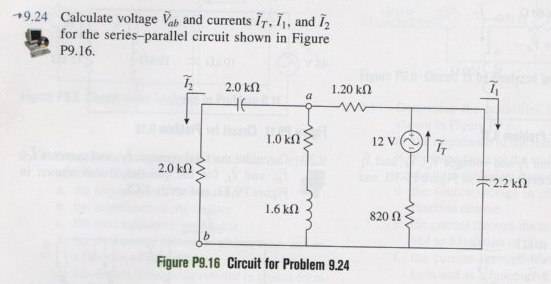
I have a circuit here:

Circuit.jpg


And I simplified it like so:

simplifiedCircuit.jpg


Did I do it correctly?

Thanks,

Jordan
 
Physics news on Phys.org
It looks right. Why are all components in ohms? That makes my head hurt.
 
I'm glad it's right, The book tries to simplify things by adding the ohms to help us realize that impedance is similar to ohms when the book get's more complicated it shows the actual capacitance. So I guess the book is kind of in "Training Wheels" mode at the moment :)
 
Oh and Quick question about Calculating Vb I know that I can use the Voltage Divider Rule to get it (I did that for Va)

For Vb would I use the total impedance of all the impedances above the 820 ohms as say Z1 and then the impedance of the 820 Ohm resistor so it would be Vb=V* (820ohms/Z1+820Ohms) <-- VDR

Is my thinking right?
 
Yes. But watch your parens: Vb = V * (820 / (z1 +820)), which is probably what you meant.
 
Oh yeah your right, thanks for catching that.
 
That isn't what they meant by simplifying the circuit, though.

You just moved the components around on the page.

You need to work out the combined impedances and the currents as asked for in the question.
 

Similar threads

  • · Replies 5 ·
Replies
5
Views
2K
  • · Replies 6 ·
Replies
6
Views
2K
  • · Replies 9 ·
Replies
9
Views
2K
  • · Replies 1 ·
Replies
1
Views
1K
  • · Replies 8 ·
Replies
8
Views
2K
  • · Replies 4 ·
Replies
4
Views
2K
  • · Replies 5 ·
Replies
5
Views
3K
  • · Replies 4 ·
Replies
4
Views
2K
  • · Replies 8 ·
Replies
8
Views
2K
  • · Replies 9 ·
Replies
9
Views
2K