Circuit - Why a more accurate value of the resistance?
Click For Summary

Homework Help Overview

The discussion revolves around understanding the accuracy of resistance measurements in circuit setups, specifically comparing two configurations involving an ammeter and a voltmeter. The subject area is circuit analysis, focusing on series and parallel connections.

Discussion Character

  • Conceptual clarification, Assumption checking

Approaches and Questions Raised

  • Participants explore why the current measurements differ between two setups, questioning the series and parallel configurations of the components involved. There is a discussion about the internal resistances of the ammeter and voltmeter and how they affect measurements.

Discussion Status

The discussion is ongoing, with participants providing insights into the definitions of series and parallel connections. Some guidance has been offered regarding the effects of internal resistances on measurements, but there is no explicit consensus on the implications of these setups.

Contextual Notes

Participants are navigating the complexities of circuit configurations and the impact of measurement tools, with some expressing confusion about the definitions and implications of series versus parallel arrangements.

vadevalor
Messages
35
Reaction score
0
Circuit -- Why a more accurate value of the resistance?

ImageUploadedByTapatalk1353944606.942928.jpg


Note: CURRENT CAN FLOW THROUGH THE VOLTMETER IN THESE CASES.
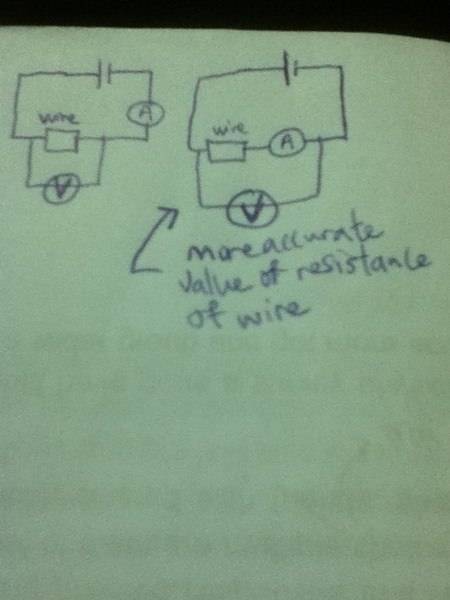
Why does the second setup as shown by the arrow in the picture give a more accurate value of the resistance of that wire?

It says the current in setup 1 on the left measured by the ammeter includes both the current through the wire and current through the voltmeter,
but for setup 2 on the right, it says this setup the ammeter will measure the current in the wire only.

They are both series circuits, so i can't get why there is a difference in currents for the 2?
 
Physics news on Phys.org


The image on the left does not have the wire and ammeter in series. They are in series on the right.

In case you are not confused enough, the ammeter has a tiny internal series resistance. The voltmeter has a large shunt (parallel) internal resistance (this is why a tiny amount of current can flow through the voltmeter). Their presence in your circuit affects the circuit. For high-quality meters, the effect is negligible (measurement error is within the meter's specified uncertainty).
 
Why is the wire and ammeter not in series? Well i see the voltmeter as a separate entity, and its a complete rectangle circuit to me :0 i understand you :P

Parallel should be like on different lines right? ( in layman's term) one on a line in a small rectangle, one on a line in a big rectangle (where rectangle is the circuit)


Two elements are in series if the node (wire) that connects them has no branches. Series elements will have the same current going through them.

Two elements are in parallel if they are both connected across 2 nodes (wires). These nodes may have branches (unlike the node joining the two series elements). Parallel elements will have the same voltage across them.
 

Similar threads

  • · Replies 2 ·
Replies
2
Views
760
  • · Replies 1 ·
Replies
1
Views
842
  • · Replies 2 ·
Replies
2
Views
2K
  • · Replies 10 ·
Replies
10
Views
1K
  • · Replies 8 ·
Replies
8
Views
2K
Replies
4
Views
2K
  • · Replies 4 ·
Replies
4
Views
2K
  • · Replies 10 ·
Replies
10
Views
2K
Replies
3
Views
2K
  • · Replies 4 ·
Replies
4
Views
4K