Circular Diffraction Patterns: What is the Correct Diameter of the Slit?

Click For Summary
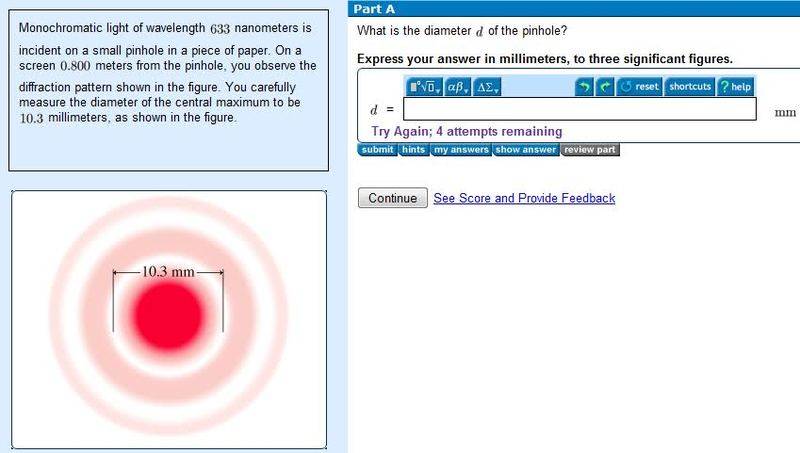
The discussion focuses on calculating the correct diameter of a slit for circular diffraction patterns using the formula D = 2.44(lambda)(L)/w. A user attempted to solve for D and arrived at a value of 0.120 mm but questioned its accuracy after receiving incorrect feedback. Another participant suggested checking previous answers for potential mistakes, particularly regarding decimal placement. The conversation emphasizes the importance of careful calculations and verification in physics problems. Ultimately, the user is encouraged to re-evaluate their calculations to ensure accuracy.
Brown Arrow
Messages
101
Reaction score
0
Circular Diffraction Patterns HELP!

Homework Statement


4rxe2s.jpg


Homework Equations


theata_1=1.22(lambda)(L)/D L distance from screen, D diameter of slit

w=2.44(lambda)(L)/D

The Attempt at a Solution


so this is what i did not sure where i went wrong maybe at rounding off...

w=2.44(lambda)(L)/D

(10.3/1000)=92.44)(633*10^(-9))(0.8)/D

solving for D i got the diameter to be the following

D=0.119962...mm

i rounded off to three significant figure

D=0.120mm is this correct b/c when i did this i got it wrong, could some one tell me where i went wrong this.
 
Last edited:
Physics news on Phys.org


Brown Arrow said:
D=0.120mm is this correct b/c when i did this i got it wrong, could some one tell me where i went wrong this.
I agree with your answer.
 
ok ill try it again and see if it works
 
before you try it a again, there's an option to check what you put as your last answer, ^ might want to check that first before using an attempt
 
it worked, before i messed up the decimal place, now correct,

Thanks for helping Doc Al
Brown arrow.
 
The book claims the answer is that all the magnitudes are the same because "the gravitational force on the penguin is the same". I'm having trouble understanding this. I thought the buoyant force was equal to the weight of the fluid displaced. Weight depends on mass which depends on density. Therefore, due to the differing densities the buoyant force will be different in each case? Is this incorrect?

Similar threads

  • · Replies 3 ·
Replies
3
Views
961
Replies
11
Views
3K
  • · Replies 11 ·
Replies
11
Views
2K
  • · Replies 5 ·
Replies
5
Views
4K
  • · Replies 3 ·
Replies
3
Views
4K
  • · Replies 2 ·
Replies
2
Views
2K
  • · Replies 4 ·
Replies
4
Views
2K
  • · Replies 4 ·
Replies
4
Views
4K
  • · Replies 18 ·
Replies
18
Views
3K
  • · Replies 5 ·
Replies
5
Views
4K