Science Advisor
- 1,406
- 1,164
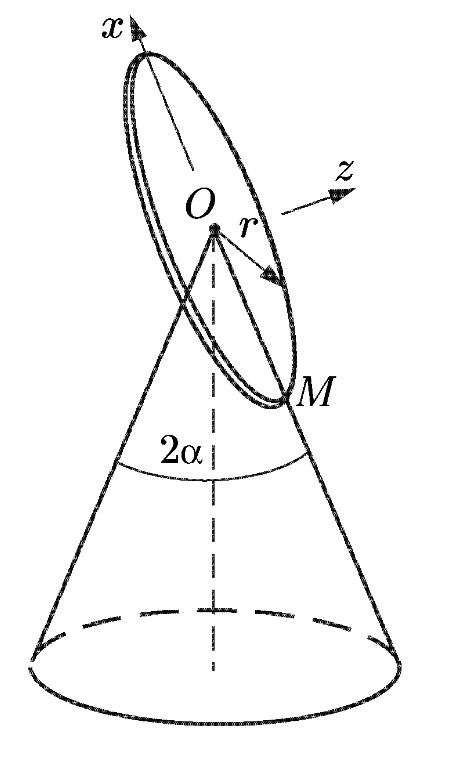
Consider a right cone with vertex ##O## and vertex angle ##2\alpha##. A coin of radius ##r## rolls around the cone without slipping being in contact with the cone along a generatrix, such that the center of the coin coincides with the vertex of the cone. Let a point ##M## lie on the coin's rim, and at the given instant, let this point be the lowest point of the coin. At the given instant, the value ##a>0 ## of point's ##M## acceleration is known; find the angular velocity of the coin at this instant.
The difference between this formulation and its classical version is that we are given the acceleration of point ##M## at a single instant, whereas in the classical version of the problem, the coin is assumed to roll around the cone uniformly, and the magnitude of ##a## is independent of time.
The beauty of the situation lies in the fact that we cannot determine all the kinematic characteristics of the coin at all; for instance, we cannot find its angular acceleration.
To solve this problem, introduce a rotating coordinate frame ##Oxyz## such that the axis ##Oz## is perpendicular to the coin's plane and the axis ##Ox## runs along the generatrix.
The angular velocity of this frame is directed along the cone's axis of symmetry:
$$\boldsymbol \omega_e=\omega_e(\cos\alpha\boldsymbol e_x+\sin\alpha\boldsymbol e_z).$$
Due to the no-slip condition, the angular velocity of the coin is directed along the generatrix:
$$\boldsymbol\omega=\omega\boldsymbol e_x.$$
The angular velocity of the coin relative to the frame ##Oxyz## is
$$\boldsymbol\omega_r=\omega_r\boldsymbol e_z.$$
This formula holds because, in the frame ##Oxyz##, the coin rotates about the axis ##Oz##.
The angular velocity addition theorem gives
$$\boldsymbol \omega=\boldsymbol\omega_e+\boldsymbol\omega_r.$$
Or, in component form:
$$\omega=\omega_e\cos\alpha,\quad \omega_r+\omega_e\sin\alpha=0.\qquad(*)$$
The angular acceleration of the coin is calculated as follows:
$$\boldsymbol\varepsilon=\boldsymbol{\dot\omega}=
\dot\omega\boldsymbol e_x+\omega(\boldsymbol\omega_e\times\boldsymbol e_x)$$
$$=\dot\omega \boldsymbol e_x+\omega\omega_e\sin\alpha\boldsymbol e_y.$$
Note that we cannot find ##\dot\omega##, but we do not need it.
In general, the acceleration formula for point ##M## on the coin has the form
$$\boldsymbol a_M=\boldsymbol a_O+\boldsymbol\varepsilon\times\boldsymbol{OM}+\boldsymbol\omega\times(\boldsymbol\omega\times\boldsymbol{OM}),\quad \boldsymbol{OM}=-r\boldsymbol e_x.$$
In our case, it reduces to
$$\boldsymbol a_M=\boldsymbol\varepsilon\times\boldsymbol{OM}
=r\omega\omega_e\sin\alpha \boldsymbol e_z,\quad(|\boldsymbol a_M|=a).$$
This formula together with (*) leads to the standard result:
$$|\omega|=\sqrt{\frac{a\cot\alpha}{r}}$$
The difference between this formulation and its classical version is that we are given the acceleration of point ##M## at a single instant, whereas in the classical version of the problem, the coin is assumed to roll around the cone uniformly, and the magnitude of ##a## is independent of time.
The beauty of the situation lies in the fact that we cannot determine all the kinematic characteristics of the coin at all; for instance, we cannot find its angular acceleration.
To solve this problem, introduce a rotating coordinate frame ##Oxyz## such that the axis ##Oz## is perpendicular to the coin's plane and the axis ##Ox## runs along the generatrix.
The angular velocity of this frame is directed along the cone's axis of symmetry:
$$\boldsymbol \omega_e=\omega_e(\cos\alpha\boldsymbol e_x+\sin\alpha\boldsymbol e_z).$$
Due to the no-slip condition, the angular velocity of the coin is directed along the generatrix:
$$\boldsymbol\omega=\omega\boldsymbol e_x.$$
The angular velocity of the coin relative to the frame ##Oxyz## is
$$\boldsymbol\omega_r=\omega_r\boldsymbol e_z.$$
This formula holds because, in the frame ##Oxyz##, the coin rotates about the axis ##Oz##.
The angular velocity addition theorem gives
$$\boldsymbol \omega=\boldsymbol\omega_e+\boldsymbol\omega_r.$$
Or, in component form:
$$\omega=\omega_e\cos\alpha,\quad \omega_r+\omega_e\sin\alpha=0.\qquad(*)$$
The angular acceleration of the coin is calculated as follows:
$$\boldsymbol\varepsilon=\boldsymbol{\dot\omega}=
\dot\omega\boldsymbol e_x+\omega(\boldsymbol\omega_e\times\boldsymbol e_x)$$
$$=\dot\omega \boldsymbol e_x+\omega\omega_e\sin\alpha\boldsymbol e_y.$$
Note that we cannot find ##\dot\omega##, but we do not need it.
In general, the acceleration formula for point ##M## on the coin has the form
$$\boldsymbol a_M=\boldsymbol a_O+\boldsymbol\varepsilon\times\boldsymbol{OM}+\boldsymbol\omega\times(\boldsymbol\omega\times\boldsymbol{OM}),\quad \boldsymbol{OM}=-r\boldsymbol e_x.$$
In our case, it reduces to
$$\boldsymbol a_M=\boldsymbol\varepsilon\times\boldsymbol{OM}
=r\omega\omega_e\sin\alpha \boldsymbol e_z,\quad(|\boldsymbol a_M|=a).$$
This formula together with (*) leads to the standard result:
$$|\omega|=\sqrt{\frac{a\cot\alpha}{r}}$$