Classical Mechanics Monographs: Re-Discovering Whittaker's 1917 Problem

  • Context: Graduate 
  • Thread starter Thread starter wrobel
  • Start date Start date
  • Tags Tags
    Classical
Click For Summary
SUMMARY

The discussion centers on the relevance of classical mechanics, specifically highlighting E. T. Whittaker's 1917 problem from "A Treatise on Analytical Dynamics." The participant argues that despite the evolution of physics into various branches, classical mechanics should not be overlooked as it contains valuable educational content. They express a desire for such classical problems to be included in modern curricula, albeit in a format that caters to contemporary students' attention spans.

PREREQUISITES
  • Understanding of classical mechanics principles
  • Familiarity with E. T. Whittaker's "A Treatise on Analytical Dynamics"
  • Knowledge of modern educational techniques in physics
  • Awareness of the evolution of physics as a discipline
NEXT STEPS
  • Research the historical context of classical mechanics in physics education
  • Explore modern pedagogical approaches to teaching classical mechanics
  • Examine other classical problems suitable for contemporary coursework
  • Investigate the impact of attention span on learning complex subjects
USEFUL FOR

Students, educators, and physicists interested in integrating classical mechanics into modern physics curricula and those looking to appreciate the historical significance of classical problems in education.

wrobel
Science Advisor
Insights Author
Messages
1,250
Reaction score
1,052
Epoch of thick textbooks in classical mechanics was ended at the edge of 19-20 century. There appear a lot of new branches of physics and classical mech. is no longer considered by physicists as a cutting-edge branch but only as an educational subject. Nevertheless, I believe that we should not completely forget this heritage.

So here is one of the beautiful problems from old textbook [A Treatise on Analytical Dynamics by E. T. Whittaker (1917)]
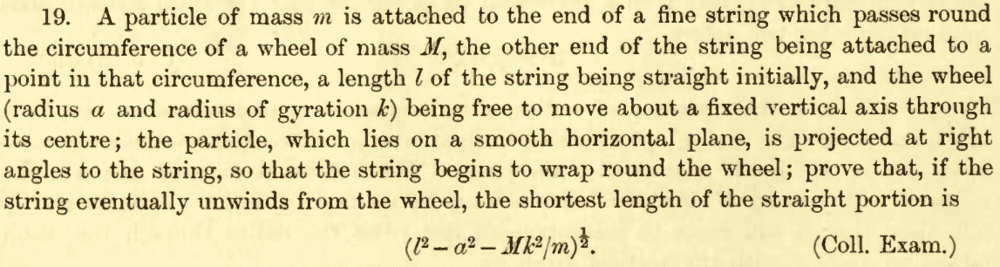
Screenshot_2019-04-01_17-34-47.png


In principle there is nothing complicated here, but the effect is not evident at least for my personal taste. I think that this problem would be looked nice in problem setss of modern courses.
 
  • Like
Likes   Reactions: kuruman
Physics news on Phys.org
Very nice problem. However, I think that if it were published in a "modern" textbook, it will have to be chopped into shorter sentences to accommodate the attention span of "modern" students.
 
  • Like
Likes   Reactions: anorlunda
I believe you. Мy English is not so good to feel such nuances :)
 

Similar threads

  • · Replies 2 ·
Replies
2
Views
2K
Replies
24
Views
8K
  • · Replies 5 ·
Replies
5
Views
5K
  • · Replies 13 ·
Replies
13
Views
10K
  • · Replies 1 ·
Replies
1
Views
4K
  • · Replies 7 ·
Replies
7
Views
4K
  • · Replies 9 ·
Replies
9
Views
4K