Clearing a wall with a golf shot

Click For Summary

Homework Help Overview

The discussion revolves around a physics problem involving projectile motion, specifically analyzing the trajectory of a golf ball as it clears a wall. Participants explore the assumptions and calculations related to the ball's maximum height and its horizontal distance traveled.

Discussion Character

  • Exploratory, Assumption checking, Conceptual clarification

Approaches and Questions Raised

  • The original poster attempts to calculate the maximum height and distance of the golf ball's trajectory, but questions the validity of their assumptions regarding the timing of the ball's peak height in relation to the wall. Other participants raise questions about the correctness of these assumptions and suggest alternative perspectives on the problem.

Discussion Status

Participants are actively engaging with the problem, questioning key assumptions and exploring different scenarios. Some guidance has been offered regarding the relationship between the ball's trajectory and its maximum height, but no consensus has been reached on the original poster's calculations.

Contextual Notes

There is a mention of an alternative method that yields a different solution, indicating potential discrepancies in the original calculations. The discussion also reflects uncertainty about the timing of the ball's peak height relative to the wall.

Oliver321
Messages
59
Reaction score
5
Homework Statement
A golfer hits his ball with speed v at an angle phi above the horizontal ground. Assuming that the angle phi is fixed and that air resistance can be neglected, what is the minimum speed v(min) for which the ball will clear a wall of height h, a distanced away? Your solution should get into trouble if the angle is such that tan phi < h / d. Explain. What is v(min) if phi = 25°, d = 50 m, and h = 2 m?
Relevant Equations
See picture below
Every trajectory follows a parabola if we neglect air resistance. So we can calculate the maximum distance in x direction s_max. Also we can determine the time it takes to hit the ground again t_max. If the ground is everywhere the same height, I can assume that at t_max/2 the height (s_y) is at a maximum. So at first i calculate the distance d at which the ball has its maximum height. I substituted this solution into s_y. Here I took the time t_max because the height has a maximum there. Now I could solve for v.

Nevertheless the solution is wrong (48 m/s). I know another way with which I get the right solution (26 m/s), but I don’t know what is wrong in my solution. Maybe you could help me!
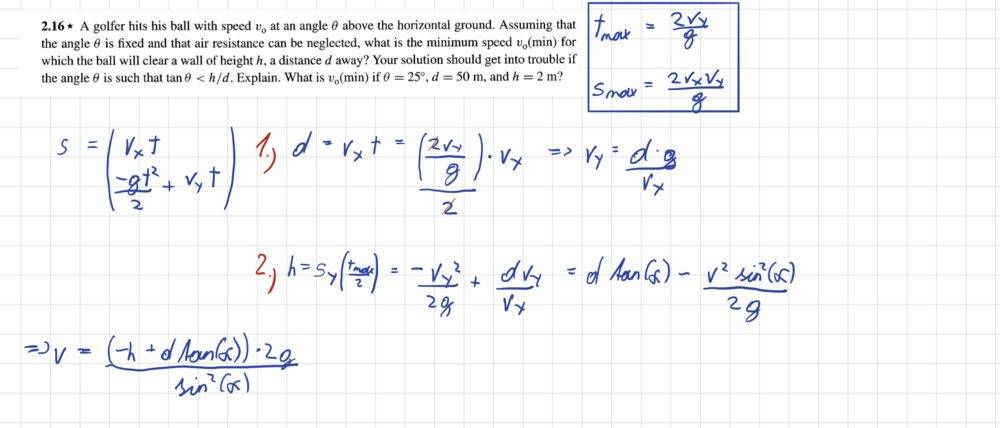
E6FD4395-443B-43B9-A328-3F12B72A899A.jpeg
 
Last edited by a moderator:
  • Skeptical
Likes   Reactions: TSny
Physics news on Phys.org
You are assuming that the ball will be at its maximum height when it passes over the wall. Is this a correct assumption?
 
  • Like
Likes   Reactions: Oliver321
TSny said:
You are assuming that the ball will be at its maximum height when it passes over the wall. Is this a correct assumption?

Thanks! I asked me this question also. But I came to the conclusion that this has to be. Because if the ball passes the wall before t_max/2, I could lower the velocitiy. So the peak would be closer to the origin and the height also decreases. But it could also be that I am wrong.
 
How about this scenario then:
242877
 
  • Like
Likes   Reactions: Oliver321 and PeroK
Oliver321 said:
Oho ok :D Thank you!

Another way to look at the problem is to compare it to the range of a projectile on an incline.
 
  • Like
Likes   Reactions: SammyS
PeroK said:
Another way to look at the problem is to compare it to the range of a projectile on an incline.
Aha! Thanks!
 

Similar threads

  • · Replies 38 ·
2
Replies
38
Views
4K
  • · Replies 1 ·
Replies
1
Views
2K
Replies
7
Views
2K
Replies
6
Views
7K
  • · Replies 11 ·
Replies
11
Views
4K
  • · Replies 3 ·
Replies
3
Views
4K
  • · Replies 2 ·
Replies
2
Views
1K
  • · Replies 11 ·
Replies
11
Views
2K
  • · Replies 5 ·
Replies
5
Views
1K
Replies
3
Views
2K