Coefficient of friction on an inclined plane

Click For Summary
SUMMARY

The discussion focuses on determining the coefficient of kinetic friction (μ) between two wooden objects on an inclined plane. The user aims to derive an equation using measurements of the angle of incline (θ), distance traveled (Δd), and time taken (Δt), without measuring mass. The key equations utilized include F_net = ma, F_f = μF_N, and Δd = V_1Δt + ½aΔt². The final derived equation for μ is μ = (2Δd/Δt²g) - sin(θ) + cos(θ), confirming the relationship between acceleration, gravitational forces, and friction on an incline.

PREREQUISITES
  • Understanding of Newton's laws of motion, specifically F_net = ma.
  • Knowledge of frictional forces and their relationship to normal forces, F_f = μF_N.
  • Familiarity with kinematic equations, particularly Δd = V_1Δt + ½aΔt².
  • Basic trigonometry, especially the sine and cosine functions related to angles of incline.
NEXT STEPS
  • Study the derivation of the coefficient of friction in various contexts, including static and kinetic friction.
  • Learn about free body diagrams and their application in analyzing forces on inclined planes.
  • Explore advanced kinematic equations and their applications in physics problems involving acceleration.
  • Investigate the effects of different materials on the coefficient of friction and how to experimentally measure it.
USEFUL FOR

Students studying physics, particularly those focusing on mechanics and friction, as well as educators looking for practical examples of applying Newton's laws and kinematics in real-world scenarios.

Will M
Messages
8
Reaction score
0
[SOLVED] Coefficient of friction on an inclined plane

Homework Statement


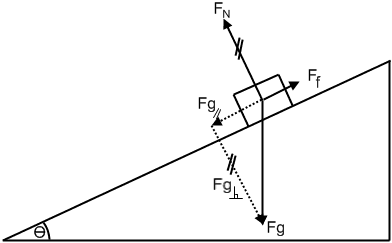
The problem I have is to determine the coefficient of kinetic friction between two wooden objects, a block and a ramp, using the fewest measurements possible. The initial velocity will be 0. I can measure the angle of incline, the distance traveled along the ramp, the time taken, but should not have to measure mass. I do not currently have any values, but should create an equation. Can I do this, and if so, am I on the right track?

Homework Equations


Fnet = ma
Ff = μFN
Δd = V1Δt + ½aΔt²

The Attempt at a Solution


ncd2jm.png


Fnet = ma

Ff - Fg║ = ma

Ff - Fg sin θ = ma

Ff - mg sin θ = ma

Ff = 2Δd/Δt² - g sin θ

μFN = 2Δd/Δt² - g sin θ

μFg┴ = 2Δd/Δt² - g sin θ

μFg cos θ = 2Δd/Δt² - g sin θ

μ = [(2Δd/Δt²) - g sin θ] / Fg cos θ

μ = [(2Δd/Δt²) - g sin θ] / mg cos θ

Note:The substitution of acceleration for 2Δd/Δt² in the 5th line is from the equation Δd = V1Δt + ½aΔt² where V1Δt evaluates to 0.
 
Physics news on Phys.org
Shouldn't it be Fg - Ff = ma since Fg is the leading force causing the acceleration and Ff is the retarding force?

Also, you can express Fn in simpler terms to cancel out the masses.
 
How would I express FN in simpler terms?
 
What component of the weight is opposing the normal force? You can express all the Fg components in terms of m, and then cancel out m.
 
Ok, I realize that since μ is a constant, it shouldn't be mass dependent. I also know that since there is no acceleration in the perpendicular direction, the normal force is opposed by, and has a magnitude equal to, the perpendicular component of the force of gravity. I've expanded this to mg cos θ but I don't have another m to cancel the mass out with.
Could you please point out the line where I've gone wrong, and what I should have done? Or am I just missing something that I should be doing after the last line?

Sorry for being clueless. :smile:
 
You know that the block has a mass m. Therefore, your applied force is mgsinX. You can figure out what the normal force is equal to in terms of mg with your free body diagram and then use this to show what the frictional force is equal to.

You also know that Fnet = ma.

Thus you can cancel mass and substitute a kinematics equation to find the distance.
 
There is no applied force, do you mean net force? Also, I'm looking for the coefficient of friction, not the force of friction, otherwise I would have stopped at the line Ff = 2Δd/Δt² - g sin θ
 
Right, there is no applied force. I meant the force that is causing the acceleration, namely the F_g (parallel) force.

You know that F_g_/_/=mgsin\theta

You know that F_f=\mu F_n

But what is Fn? How can you express this in terms of m?
 
I could express it as F_N=mgcos\theta right?

Then I could substitute it for F_N in F_f=\mu F_n

After rearranging to solve for μ, it would be \mu=F_f/mgcos\theta

Substituting the fifth line of my original solution for F_f would give me

\mu = \left(2\Delta d/\Delta t^{2} - g sin \theta\right)/mgcos\theta

Which is where I get confused. I can't think of any other way to express F_N
 
  • #10
mgcos\theta - F_f = ma

mgcos\theta - \mu F_n = ma

mgcos\theta - \mu mgsin\theta=ma

Can you solve it now?
 
  • #11
Ah, I think I see it now. Thanks! :biggrin:

Would this be correct:

mgsin\theta - \mu mgcos\theta=ma

mg(sin\theta - \mu cos\theta)=ma

g(sin\theta - \mu cos\theta)=a

\mu g +g(sin\theta - cos\theta)=a

\mu +sin\theta - cos\theta=a/g

\mu=a/g -sin\theta + cos\theta

\mu=2\Delta d/\Delta t^{2}g -sin\theta + cos\theta
 
  • #12
Your algebra is off starting with the fourth step.
 
  • #13
Yeah, I caught that when I checked it over, but thanks, because you've been a real help! :biggrin:
 

Similar threads

  • · Replies 13 ·
Replies
13
Views
1K
  • · Replies 4 ·
Replies
4
Views
3K
  • · Replies 1 ·
Replies
1
Views
1K
  • · Replies 7 ·
Replies
7
Views
2K
  • · Replies 29 ·
Replies
29
Views
2K
  • · Replies 11 ·
Replies
11
Views
4K
Replies
2
Views
2K
  • · Replies 10 ·
Replies
10
Views
9K
  • · Replies 1 ·
Replies
1
Views
2K
  • · Replies 9 ·
Replies
9
Views
7K