Gin-Su
- 4
- 0
My class was given a packet with several scenario questions. I've got the rest of them completed and this is the only one remaining.
So I know that the question involves: Momentum Conservation (2-D): Inelastic collisions, Work-energy: Conservation of energy with friction, Dynamics: Newton's Second Law, frictional force, Kinematics: 1-D and 2-D
(This is a really long question, I apologize in advance.)
This is a scenario based question where I role play as an intern for the Montreal Police Collision Investigation Unit. Basically I have to determine the initial velocity of vehicles to determine whether or not they are liable under Section 249 (3) of the Criminal Code, meaning if they are going over 30 km/hr over the limit, they face charges.
Now for the data:
Velocity indicators are defined as follows:
Mass of friction block: 9 kg
Ftension = 75.8 N
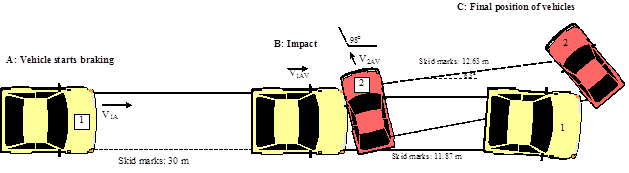
(I apologize in advance for including a picture; however I felt that it would aid in visualizing the scene.)
Fk=μk(Fn)
Fnet=ma
(1/2)v1o2+(1/2)v2o2=(1/2)v1f2+(1/2)v2f2
Pox=Pfx
m1v1o-m2v2o=m1v1fcosθ1+m2v2fcosθ2
Poy=Pfy
m1v1o-m2v2o=m1v1fsinθ1+m2v2fsinθ2]
(Others maybe?)
I actually did this initially in a completely different way using Vf2=Vo2+2(a)(Δx), which I now realize is completely wrong. (I ended up getting 95.65 hm/hr for the driver in V1, which doesn't mean anything since I am wrong.)
This was my second attempt:
75.8N=μk(88.2N)
μk=.86
Fnet=ma
-μkmg=ma
-.86(9.8)=a
-8.428 m/s2=a
This is where I have some trouble, as I am not sure where I would proceed. The angles are throwing me into a bout of confusion as this is the first time I am facing a problem like this.
(1/2)v1o2+(1/2)v2o2=(1/2)v1f2+(1/2)v2f2
So I think I should then use the x and y components.
Pox=Pfx
m1v1o-m2v2o=m1v1fcosθ1+m2v2fcosθ2
2674(v1o)-1110(v2o)=2674(v1f)cos(0)+1110(v2f)cos(6.5)
(I am not 100% sure I should be using 6.5°.)
2674(v1o)-1110(v2o)=2674(v1f)+1110(v2f)cos(6.5)
This is the point at which I am stuck. I am not sure if it's because I am using the wrong equations or if it's because I am overlooking something.
Thank you for taking the time to read this. Any help would be greatly appreciated.
So I know that the question involves: Momentum Conservation (2-D): Inelastic collisions, Work-energy: Conservation of energy with friction, Dynamics: Newton's Second Law, frictional force, Kinematics: 1-D and 2-D
Homework Statement
(This is a really long question, I apologize in advance.)
This is a scenario based question where I role play as an intern for the Montreal Police Collision Investigation Unit. Basically I have to determine the initial velocity of vehicles to determine whether or not they are liable under Section 249 (3) of the Criminal Code, meaning if they are going over 30 km/hr over the limit, they face charges.
Now for the data:
- Debris was found at a distance of 12.63 m from the red vehicle. (I am sure that this is data thrown into distract)
- Debris was also found 11.87 m from the yellow vehicle. (I am also sure that this is unneeded.)
- The yellow vehicle braked in a straight line.
- The red vehicle veered 6.5º from its initial course.
- The marks of the impact on the red vehicle show that it was heading 98º away from the yellow vehicle at the moment of collision.
- Prior the point of collision, there are skid marks over a distance of 30m.
- The speed limit is 70 km/hr.
- Mass of vehicle 1 (yellow) 2674 kg
- Mass of vehicle 2 (red) 1110 kg
Velocity indicators are defined as follows:
- V1IB: velocity of vehicle 1 before initial braking
- V1B : velocity of vehicle 1 just before impact
- V2B : velocity of vehicle 2 just before impact
- V1A: velocity of vehicle 1 just after impact
- V2A: velocity of vehicle 2 just after impact
Mass of friction block: 9 kg
Ftension = 75.8 N
(I apologize in advance for including a picture; however I felt that it would aid in visualizing the scene.)
Homework Equations
Fk=μk(Fn)
Fnet=ma
(1/2)v1o2+(1/2)v2o2=(1/2)v1f2+(1/2)v2f2
Pox=Pfx
m1v1o-m2v2o=m1v1fcosθ1+m2v2fcosθ2
Poy=Pfy
m1v1o-m2v2o=m1v1fsinθ1+m2v2fsinθ2]
(Others maybe?)
The Attempt at a Solution
I actually did this initially in a completely different way using Vf2=Vo2+2(a)(Δx), which I now realize is completely wrong. (I ended up getting 95.65 hm/hr for the driver in V1, which doesn't mean anything since I am wrong.)
This was my second attempt:
75.8N=μk(88.2N)
μk=.86
Fnet=ma
-μkmg=ma
-.86(9.8)=a
-8.428 m/s2=a
This is where I have some trouble, as I am not sure where I would proceed. The angles are throwing me into a bout of confusion as this is the first time I am facing a problem like this.
(1/2)v1o2+(1/2)v2o2=(1/2)v1f2+(1/2)v2f2
So I think I should then use the x and y components.
Pox=Pfx
m1v1o-m2v2o=m1v1fcosθ1+m2v2fcosθ2
2674(v1o)-1110(v2o)=2674(v1f)cos(0)+1110(v2f)cos(6.5)
(I am not 100% sure I should be using 6.5°.)
2674(v1o)-1110(v2o)=2674(v1f)+1110(v2f)cos(6.5)
This is the point at which I am stuck. I am not sure if it's because I am using the wrong equations or if it's because I am overlooking something.
Thank you for taking the time to read this. Any help would be greatly appreciated.