Discussion Overview
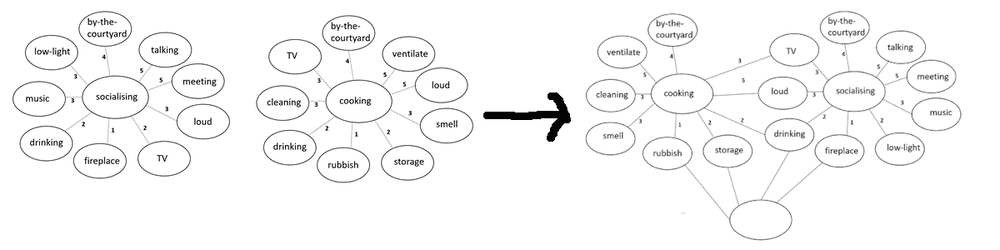
The discussion centers around the challenge of combining separate graphs into a single graph for an architectural project. Participants explore methods for generating graph homomorphisms and the implications of graph representation in the context of house design.
Discussion Character
- Exploratory
- Technical explanation
- Conceptual clarification
- Debate/contested
Main Points Raised
- One participant describes their project involving the combination of graphs representing different activities and attributes related to house design, using methods like maximum graph homomorphism and an exact algorithm.
- Another participant questions the clarity of the graph representations, suggesting that nodes should represent specific activities rather than a mix of actions, nouns, and attributes.
- A later reply emphasizes the need for a clearer definition of what each graph represents to facilitate better merging of the graphs.
- One participant asserts that merging graphs can be straightforward by forming a new graph from the union of nodes and replicating edges, while also noting the importance of eliminating duplicate nodes.
- Another participant suggests methods for combining weights of edges in the merged graph, proposing options like simple sums or more complex functions like sum of squares or square roots.
Areas of Agreement / Disagreement
Participants express differing views on the complexity of merging graphs, with some suggesting it is straightforward while others emphasize the need for careful consideration of graph definitions and representations. The discussion remains unresolved regarding the best approach to merging the graphs effectively.
Contextual Notes
Participants highlight limitations in the current graph definitions and the potential for confusion in representing activities and attributes. There is also mention of the need to clarify how to combine weights in the merged graph.
Who May Find This Useful
This discussion may be of interest to those involved in architectural design, graph theory, or anyone looking to understand the complexities of graph merging and representation in project planning.