Xkcd
- 1
- 0
Hello everyone !
I try to find the expression of the time derivative of the entropy for the CMB (photon gas) but I am stuck with the calculations.
We are in the matter-domination area and at the present time (Ro=1). No radiation and no vacuum, only the curvature. The different equations are:
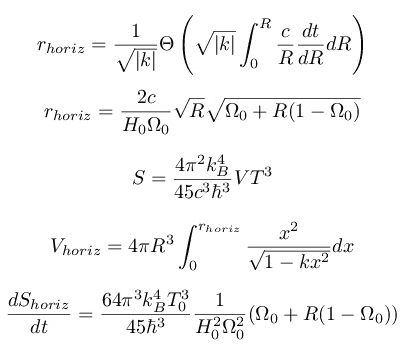
The problem is that the equations are resolved regardless of the spatial curvature of the universe. For the comoving distance I used :
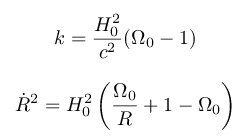
But I cannot find the same result. I have
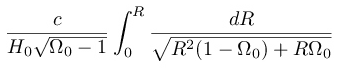
If I use a calculator I have an equation with logarithm and I do not find the previous result andI cannot find where is my mistake.
And I have a similar problem with the integral for the volume. With a calculator I have a monster with Arcsin and I cannot find the final expression for the entropy.
If someone could help me with the different steps for the two integrals so that I can find the expression for the derivative of the entropy.
Thank you !
I try to find the expression of the time derivative of the entropy for the CMB (photon gas) but I am stuck with the calculations.
We are in the matter-domination area and at the present time (Ro=1). No radiation and no vacuum, only the curvature. The different equations are:
The problem is that the equations are resolved regardless of the spatial curvature of the universe. For the comoving distance I used :
But I cannot find the same result. I have
If I use a calculator I have an equation with logarithm and I do not find the previous result andI cannot find where is my mistake.
And I have a similar problem with the integral for the volume. With a calculator I have a monster with Arcsin and I cannot find the final expression for the entropy.
If someone could help me with the different steps for the two integrals so that I can find the expression for the derivative of the entropy.
Thank you !


