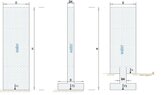
Comparing hydrostatic forces at the bottom of these 3 containers

  • Thread starter Thread starter ucody0911
  • Start date Start date
  • Tags Tags
    Forces Hydrostatic
Click For Summary

Homework Help Overview

The discussion revolves around comparing hydrostatic forces at the bottom of three different water containers, where the first two containers rest on the ground and the third is supported along the X-axis with its bottom suspended in air. Participants are exploring the implications of hydrostatic pressure and the forces acting on the containers based on their configurations.

Discussion Character

  • Exploratory, Assumption checking, Conceptual clarification

Approaches and Questions Raised

  • Participants are questioning the differences in hydrostatic forces (F1, F2, F3) and whether F3 can be equal to F1 and F2. They are discussing the implications of the T piece's position and whether it is fixed or falling. Some participants are also considering the effects of additional forces acting on the containers.

Discussion Status

The discussion is ongoing, with various interpretations being explored. Some participants have provided calculations for F1 and F2, while others are seeking clarification on F3. There is a mix of agreement and differing opinions on the assumptions being made about the forces acting on the containers.

Contextual Notes

Participants have noted potential missing information regarding the dimensions of the containers and the setup of the T piece. There is also an acknowledgment of the complexity introduced by the additional support in the third container, which may affect the hydrostatic forces.

ucody0911
Messages
21
Reaction score
2
Homework Statement
q
Relevant Equations
q
hello all ,
1st and 2 nd water containers sit on ground and 3rd type of water container sit on fixed support along X axis and bottom parts are suspended in air , pls see picture , the drawing is half cross sections of cylinders
All water level heights H and tubes D diameter are same ,
Hydrostatic forces on bottom face of containers , F1 ,F2 ,and F3
by the formula F=pgh x A , F1 and F2 are same , but , i think that F3 is not same , it is much less than F1 and F2 . am i right ? so , how i calculate F3 force ?
 

Attachments
  • hydforce.jpg
    hydforce.jpg
    46.8 KB · Views: 131
Last edited:
Physics news on Phys.org
What is holding the T piece at the bottom of #3 in place? Or is it in the process of falling?
 
haruspex said:
What is holding the T piece at the bottom of #3 in place? Or is it in the process of falling?
lets consider 2 cases ,
1. T piece is stationary fixed , welded along x axis
2 . T piece is falling down
 
ucody0911 said:
lets consider 2 cases ,
1. T piece is stationary fixed , welded along x axis
2 . T piece is falling down
Then what are your answers for the two cases (and why)?
 
haruspex said:
Then what are your answers for the two cases (and why)?
canceling case of falling ,
just consider , T piece is fixed and stationary
 
I'm not very sure, but I think the platform of the second container is a cube and we should be given the length of its one more dimension (the one going into the page).
 
Hall said:
I'm not very sure, but I think the platform of the second container is a cube and we should be given the length of its one more dimension (the one going into the page).

drawing is half cross sections of cylinders ,
 
ucody0911 said:
drawing is half cross sections of cylinders ,
Can you please show me your calculations for ##F_2##?
 
ucody0911 said:
by the formula F=pgh x A , F1 and F2 are same , but , i think that F3 is not same
Oh, and why is that ?

##\ ##
 
  • #10
ucody0911 said:
canceling case of falling ,
just consider , T piece is fixed and stationary
Ok, so what is your answer for that case, and why?
 
  • #11
haruspex said:
Ok, so what is your answer for that case, and why?

Hall said:
Can you please show me your calculations for ##F_2##?
F1=F2 = pgH x A = 1000 x 9.8 x H x 3.14 x D x D / 4
 
  • #12
haruspex said:
Ok, so what is your answer for that case, and why?
question is : is F3 not equal to F1 and F2 ? is less than F1 and F2 ?
"why ? " - just very needs to clarify for this . :)
 
Last edited:
  • #13
Haven't seen your calculation for F3 yet !

##\ ##
 
  • #14
BvU said:
Haven't seen your calculation for F3 yet !

##\ ##
so and my question is also for F3 :)
 
  • #15
ucody0911 said:
am i right ?
No.

##\ ##
 
  • #16
Here's the three central columns:
1642502400926.png
does this picture ring a bell ?

##\ ##
 
Last edited:
  • #17
Did I miss a post that was quickly removed ?
(I do admit to being male ... :smile: )

And I didn't intend to insult @ucody0911 , but apparently caused an explosion nevertheless ...

##\ ##
 
  • #18
BvU said:
Did I miss a post that was quickly removed ?
(I do admit to being male ... :smile: )

And I didn't intend to insult @ucody0911 , but apparently caused an explosion nevertheless ...
had feeling like that, angry teacher is RINGING BELL in school boy's ear and screaming as "NO " and "WHY " and reminding Newton's or pascal's law , i thought that this forum is not for school boys to help to make their homework , but may be my question is kind of level of school knowledge

Anyway, I'm taking back my words and saying sorry
i just wanted to discuss here :

in my opinion, F3 is not possible to be same equal force to F1,F2 , because there is also hydrostatic fx force on level of X line ,
and i think that if F3 is same with F1 , our energy conservation law saying that it is not possible to be almost doubled hydrostatic force if we consider fx as hydrostatic force
 
  • Like
Likes   Reactions: BvU and berkeman
  • #19
ucody0911 said:
had feeling like that, angry teacher is RINGING BELL in school boy's ear and screaming as "NO " and "WHY " and reminding Newton's or pascal's law
Yeah, the phrase "ring a bell" didn't translate very well into your native language and sayings. In English it just refers to an "Aha" moment, when you finally understand something. Similar to the cartoons you see with a light bulb lighting above a person't head when they finally understand something.

Thanks for deleting your post. :smile:
 
  • #20
ucody0911 said:
had feeling like that, angry teacher is RINGING BELL in school boy's ear and screaming as "NO " and "WHY " and reminding Newton's or pascal's law , i thought that this forum is not for school boys to help to make their homework , but may be my question is kind of level of school knowledge

Anyway, I'm taking back my words and saying sorry
i just wanted to discuss here :

in my opinion, F3 is not possible to be same equal force to F1,F2 , because there is also hydrostatic fx force on level of X line ,
and i think that if F3 is same with F1 , our energy conservation law saying that it is not possible to be almost doubled hydrostatic force if we consider fx as hydrostatic force
Most unfortunate. In dutch the expression 'lichtje doen branden' has no traumatic connotations. And it translated into 'ring a bell'.

The idea of the picture in #16 was: these columns are exactly identical. Any forces on the sides can only work in a horizontal direction and therefore not exert any contribution in the vertical direction. And for all three we have $$\Delta p = \rho \,g\,\Delta h$$
The composer of the exercise was (is) just trying to confuse you by adding extra stuff on the sides.

All in good spirit !

##\ ##
 
  • #21
I need to think about it some more, but it seems like:

(a) the weights of the 3 containers of water are different, since they have different amounts of water in them

(b) the water pressures at the bottom of the 3 water columns need to be the same for the 3 containers, since the water columns are the same heights

(c) the extra support near the bottom of the 3rd container should support most of the weight of that container.

I'm having trouble reconciling these 3 things, but will keep thinking about it...
 
  • #22
BvU said:
The composer of the exercise was (is) just trying to confuse you
And this composer apparently is doing a good job !

:biggrin:
 
  • Like
Likes   Reactions: Tom.G and berkeman
  • #23
ucody0911 said:
F3 is not possible to be same equal force to F1,F2 , because there is also hydrostatic fx force on level of X line ,
Is your thought that the reaction force to fx (i.e., fx upwards on the water) is helping to support the water, so it needs less support at the bottom? If so, you need to consider all the vertical forces on the water. Those include a downward force from the upper face of the horizontal part of the T.

If you were to add variables for all the different heights and cross sections in the diagrams, you would find that for these forces to add up to balance the weights of water then F1=F2=F3. But of course it is much simpler just to apply the pressure law: at depth H the pressure is ##\rho gH#, so if the bases are all the same area then the forces there are all the same.
 
  • Like
Likes   Reactions: Hall

Similar threads

  • · Replies 11 ·
Replies
11
Views
2K
  • · Replies 4 ·
Replies
4
Views
1K
  • · Replies 2 ·
Replies
2
Views
2K
  • · Replies 1 ·
Replies
1
Views
4K
  • · Replies 24 ·
Replies
24
Views
3K
  • · Replies 17 ·
Replies
17
Views
6K
  • · Replies 7 ·
Replies
7
Views
2K
  • · Replies 16 ·
Replies
16
Views
5K
  • · Replies 31 ·
2
Replies
31
Views
5K
  • · Replies 27 ·
Replies
27
Views
5K