Saracen Rue
- 150
- 10
- TL;DR
- Evaluate the following integral ##\int_0^1 ((−ln(x↑↑(2k)))↑↑(2k+1))dx## as ##k \to \infty##
I've been playing around with Up-Arrow notation quite a lot lately and have come up with the following "thought experiment" so to speak. Consider the following function: $$f(x)=(−ln(x↑↑(2k)))↑↑(2k+1)$$ $$\text{Where }k∈\mathbb{Z} ^+$$
In the image below we can see some examples of what this function looks like for the first ##5## values of ##k##:
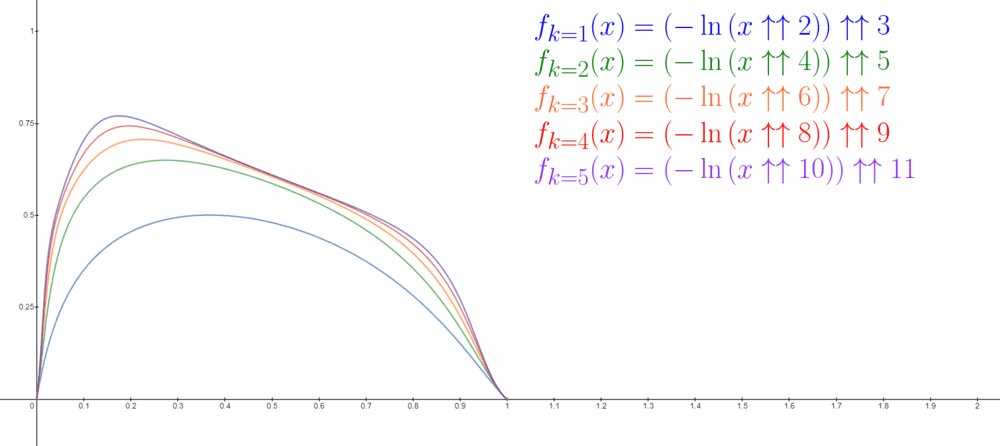
It can be visually seen from the graphs that while the area under each graph does become larger for increasing values of ##k##, the rate at which the area is increases decrease. However, I went ahead and took the liberty of doing the calculations anyway. I found the difference in area between ## f_{k=2}(x)## and ## f_{k=1}(x)##, and then between ## f_{k=3}(x)## and ## f_{k=2}(x)##, and so on. I then took these values and plotted them as such:
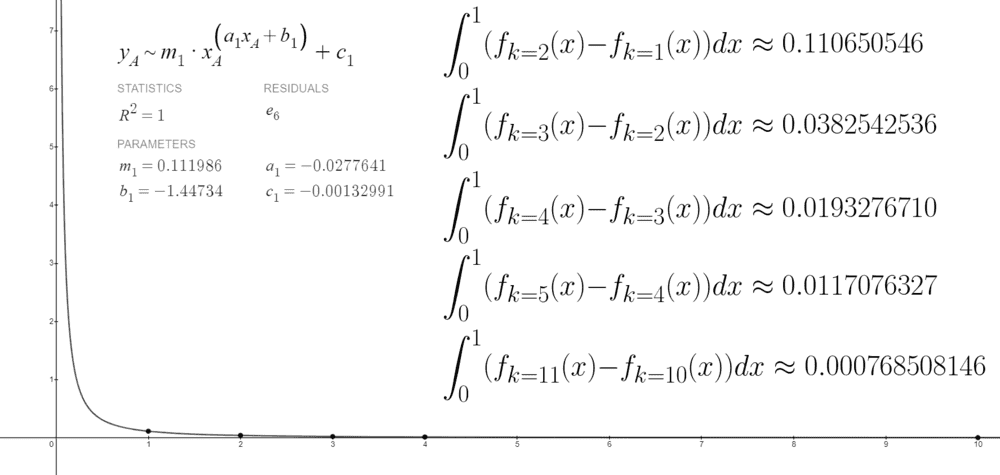
(Note: The graphs of ##f_{k=10}(x)##and ##f_{k=11}(x)## weren't included previously, they are only being used here now to help with the accuracy of the curve fitting)
Each point was plotted in the following manor: ##(1, \int_0^1(f_{k=2}(x)-f_{k=1}(x))dx), (2, \int_0^1(f_{k=3}(x)-f_{k=2}(x))dx), \text{etc}.##
The points were found to fit the general relationship of ##y_A \approx m_1 x_A^{a_1x_A+b_1}+c_1## extremely well, have an ##R^2## value very close to ##1##. This leads me to believe that this relationship appropriately represents the difference in area between different values of ##k## in ##f(x)##. Therefore, because this regression curve approaches ##0## as ##x## approaches ##\infty##, the area enclosed by the graph of ##f(x)=(−ln(x↑↑(2k)))↑↑(2k+1)## must approach a constant value as ##k \to \infty##.
So, we know it does approach a constant value, we just need to find out what said value is. In other words, we need to evaluate $$\int_0^1 ((−ln(x↑↑(2k)))↑↑(2k+1))dx \text{ as } k \to \infty$$
In the image below we can see some examples of what this function looks like for the first ##5## values of ##k##:
It can be visually seen from the graphs that while the area under each graph does become larger for increasing values of ##k##, the rate at which the area is increases decrease. However, I went ahead and took the liberty of doing the calculations anyway. I found the difference in area between ## f_{k=2}(x)## and ## f_{k=1}(x)##, and then between ## f_{k=3}(x)## and ## f_{k=2}(x)##, and so on. I then took these values and plotted them as such:
(Note: The graphs of ##f_{k=10}(x)##and ##f_{k=11}(x)## weren't included previously, they are only being used here now to help with the accuracy of the curve fitting)
Each point was plotted in the following manor: ##(1, \int_0^1(f_{k=2}(x)-f_{k=1}(x))dx), (2, \int_0^1(f_{k=3}(x)-f_{k=2}(x))dx), \text{etc}.##
The points were found to fit the general relationship of ##y_A \approx m_1 x_A^{a_1x_A+b_1}+c_1## extremely well, have an ##R^2## value very close to ##1##. This leads me to believe that this relationship appropriately represents the difference in area between different values of ##k## in ##f(x)##. Therefore, because this regression curve approaches ##0## as ##x## approaches ##\infty##, the area enclosed by the graph of ##f(x)=(−ln(x↑↑(2k)))↑↑(2k+1)## must approach a constant value as ##k \to \infty##.
So, we know it does approach a constant value, we just need to find out what said value is. In other words, we need to evaluate $$\int_0^1 ((−ln(x↑↑(2k)))↑↑(2k+1))dx \text{ as } k \to \infty$$