Need an Equation for converting Vertical to horizontal FOV

  • Context: High School 
  • Thread starter Thread starter Justice Hunter
  • Start date Start date
  • Tags Tags
    Horizontal Vertical
Click For Summary

Discussion Overview

The discussion revolves around the mathematical relationship between vertical and horizontal fields of view (FOV), particularly in the context of a rectangular aspect ratio, such as 16:9. Participants explore the calculations involved in converting vertical FOV to horizontal FOV and the implications of using trigonometric functions in this context.

Discussion Character

  • Technical explanation
  • Mathematical reasoning
  • Debate/contested

Main Points Raised

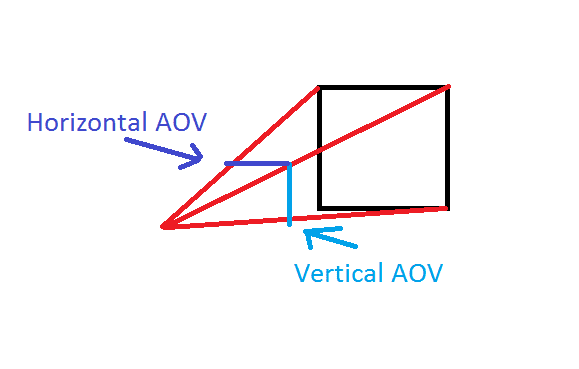
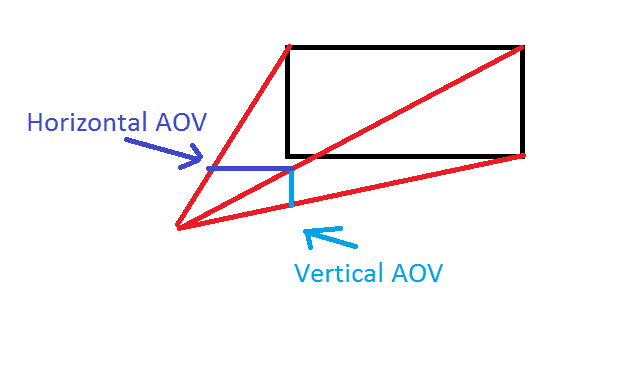
  • One participant describes a scenario involving a square and a rectangle, noting that the relationship between horizontal and vertical components changes with aspect ratio, specifically 16:9.
  • The same participant questions why a calculator yields a horizontal FOV of 121 degrees for a 90-degree vertical FOV instead of the expected 160 degrees.
  • Another participant suggests that the tangent function is essential for understanding the relationship between the angles.
  • A subsequent reply indicates that without distance measurements, only a ratio of the tangent function can be obtained, not a ratio of angles.
  • Another participant challenges this by referencing a functioning FOV calculator, implying that there is a relationship based solely on angles given a specific aspect ratio.
  • A later response clarifies that the relationship is indeed based on the tangent function values, providing a mathematical expression involving the angles.
  • The original poster acknowledges this clarification, suggesting that the relationship can be viewed as a proportion within a proportion.

Areas of Agreement / Disagreement

Participants express differing views on the necessity of distance measurements and the role of trigonometric functions in determining the relationship between vertical and horizontal FOV. The discussion does not reach a consensus on these points.

Contextual Notes

Participants note that the calculations are strictly mathematical and do not relate to physical measurements, which may limit the applicability of certain assumptions.

Justice Hunter
Messages
98
Reaction score
7
This is a representation of a square, and a triangle that creates an angle between that square. In this case, the horizontal and vertical components to the Angle of View are the same.
anamorphic (aovfov calc question1).png


Now, change this square into a rectangle, and the relationship to the horizontal and vertical components are changed by a proportion. Let's assume it's a 16:9 proportion.
anamorphic (aovfov calc question2).png


So this should have technically been correct...16/9 (1920/1080) should equal 160/90...but this turned out to give me a not so right answer.

I went and used this calculator, the results of a 90 Degree Vertical FOV yields "121" degree Horizontal FoV. for 1920/1080 pixels.

This calculator is nice and all, but
a) it's not exact enough for the calculation for what I'm doing, and...
b) What am i missing that it yields 90x121 rather than 90x160? I understand that as the AOV's approach 180 degrees, the FOV approaches infinity, so i know the two arn't the same, but it also means that the equation isn't just defined by a proportion.

Before anyone jumps to the comments, i want to point out that no, this situation is strictly mathematical in nature and has no analog to the physical world, or measuring distances in terms of feet or inches.

Thanks in advance.
 
Physics news on Phys.org
Justice Hunter said:
What am i missing that it yields 90x121 rather than 90x160?

You are missing the tangent function.
 
hutchphd said:
You are missing the tangent function.

hmm okay. But what if the distances are not available to me? The only distance i have available would be the size in pixels, of the box (in our example, 1920/1080).
 
Then all you can get is a ratio of the tangent function of the angle, but not a ratio of angles.
 
  • Like
Likes   Reactions: hutchphd
mfb said:
Then all you can get is a ratio of the tangent function of the angle, but not a ratio of angles.

But how can that be true? How is it then, that this website has a functioning FOV calculator? There must be some relationship that is based solely on the angles, given a certain aspect ratio. Not saying that a trig function has nothing to do with that, but there must be more to this problem then what your saying.
 
The "relationship based on the angles" is the fixed ratio of their tangent function values.

##\tan(\beta) = \frac{16}{9}\tan(\alpha)## for suitable ##\alpha##, ##\beta##. Or, solved for one angle, ##\beta = \arctan(\frac{16}{9}\tan(\alpha))##
 
mfb said:
The "relationship based on the angles" is the fixed ratio of their tangent function values.

##\tan(\beta) = \frac{16}{9}\tan(\alpha)## for suitable ##\alpha##, ##\beta##. Or, solved for one angle, ##\beta = \arctan(\frac{16}{9}\tan(\alpha))##

Okay I see. This helped me out a a lot, it’s essentially a proportion, just a proportion within a proportion (since the Opposite and adjacent lengths can be arbitrary so long as you have a single angle)

Thanks
 

Similar threads

  • · Replies 2 ·
Replies
2
Views
2K
  • · Replies 4 ·
Replies
4
Views
7K
  • · Replies 6 ·
Replies
6
Views
1K
Replies
2
Views
1K
  • · Replies 152 ·
6
Replies
152
Views
11K
  • · Replies 2 ·
Replies
2
Views
13K
  • · Replies 23 ·
Replies
23
Views
9K
  • · Replies 6 ·
Replies
6
Views
7K
Replies
1
Views
7K