Complex frames - analytical calculations

Click For Summary

Discussion Overview

The discussion revolves around the analytical solutions for complex frames, specifically planar and spatial frames with various loading conditions. Participants explore the challenges of solving these frames analytically, considering their structural characteristics and the implications of rigid connections versus hinged joints.

Discussion Character

  • Exploratory
  • Technical explanation
  • Debate/contested
  • Mathematical reasoning

Main Points Raised

  • One participant questions whether all the frames can be solved analytically and suggests breaking them into individual beams for separate analysis.
  • Another participant seeks clarification on the nature of the joints in the frames, specifically whether they are pin joints or rigid connections.
  • A participant notes that the rigidity of the connections introduces complexities, as the members will experience bending, affecting the results.
  • Participants identify the frames' real-world applications, including a workshop crane, a curtain rod, a bus seat support, and a different type of crane.
  • One participant mentions having solved similar systems analytically but acknowledges the extensive effort required, suggesting that finite element analysis (FEA) might be a simpler alternative.
  • Another participant agrees on the ease of using FEA for these models but expresses a desire to learn the analytical methods, indicating that flexibility or stiffness methods may be necessary due to the statically indeterminate nature of the systems.

Areas of Agreement / Disagreement

Participants express differing views on the feasibility and complexity of solving the frames analytically versus using FEA. There is no consensus on the best approach, and the discussion remains unresolved regarding the analytical methods applicable to these frames.

Contextual Notes

Participants highlight the dependence on the nature of the joints and the rigidity of the connections, which may affect the analytical solutions. The discussion also reflects uncertainty about the specific methods to be employed for statically indeterminate systems.

FEAnalyst
Messages
348
Reaction score
149
TL;DR
How can one solve complex frames, like those shown in the post?
Hi,

I came across some interesting frames recently. Here they are:
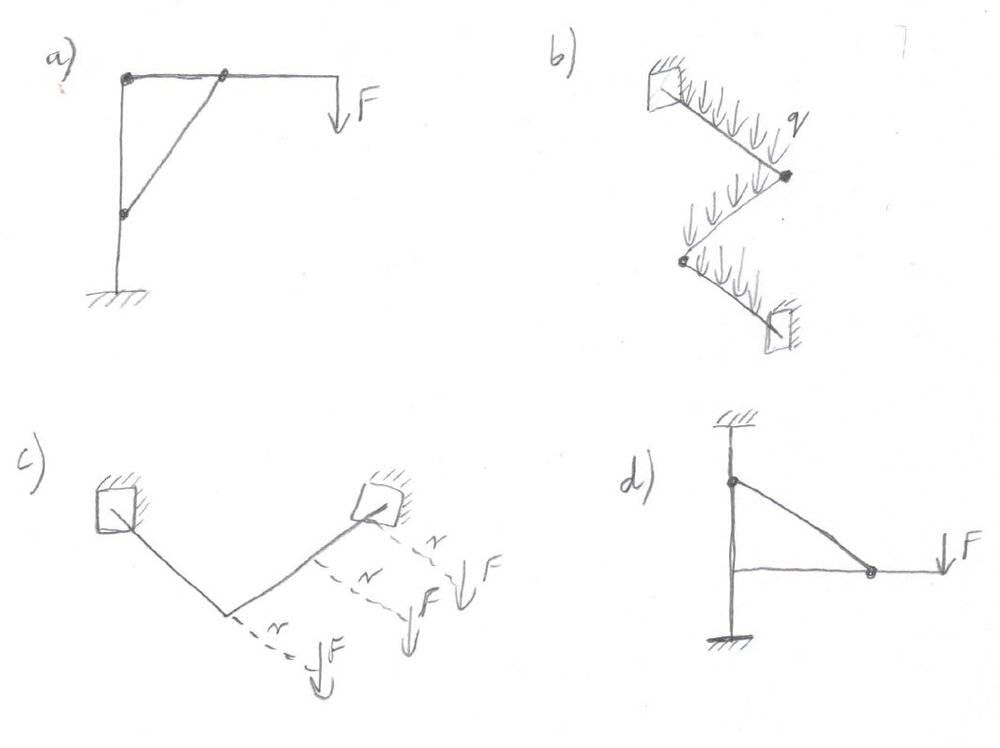
ramy.JPG

I wonder if all these frames can be solved analytically. If yes then how to do it ? Examples a) and d) are planar frames with diagonal members while b) and c) are spatial frames: b is subjected to uniformly distributed load while c) is subjected to remote loads (forces acting at a distance ##r## and transmitted to the frame via rigid links). How can I solve these examples ? I guess that at least some of them are statically indeterminate. Should I break them into individual beams and solve their members separately ? Is there a book or online source where I could find similar cases ?

Thanks in advance for your help
 
Engineering news on Phys.org
Where you show dots, are those pin (revolute) joints, welds, or what?
 
I should have drawn them better. All of these are not hinges but rigid connections of the beams.
 
I think there is a difficulty here because the joints are not hinged, so the members are subject to bending. As a result, the elasticity of the members will affect the result. For instance, in (d), the lateral load on the top support will depend on the rigidity of the bottom support and vertical member in bending.
 
I should have mentioned what these frames actually represent:
a - workshop crane
b - curtain rod
c - support of a seat in a bus
d - different type of crane
 
I have solved similar systems analytically,, but it is a whole lot of work. I would think and FEAnalyst would simple to a finite element model.
 
Sure, it’s very easy to solve these models with FEA (even using some free online apps) and I already did that. But I would also like to learn how to do it analytically. Since these are statically indeterminate systems, it seems that, apart from FEM, only flexibility or stiffness method can be used to solve them.
 
  • Like
Likes   Reactions: Mech_LS24

Similar threads

  • · Replies 8 ·
Replies
8
Views
2K
Replies
6
Views
2K
Replies
33
Views
6K
  • · Replies 2 ·
Replies
2
Views
2K
  • · Replies 6 ·
Replies
6
Views
4K
Replies
6
Views
3K
  • · Replies 4 ·
Replies
4
Views
3K
  • · Replies 3 ·
Replies
3
Views
2K
  • · Replies 5 ·
Replies
5
Views
2K
Replies
6
Views
5K