Complex Number Problems in Applied Maths

Join the discussion
Ask a follow-up here, or get your own question answered by working scientists, mathematicians and engineers — people, not an autocomplete.
Real named experts · corrections over time · the nuance an AI answer skips
4 replies · 3K views
anil86
Messages
10
Reaction score
0
This is a thread for complex number problems in applied mathematics.

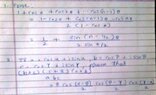
1. Prove that: 1 + cos x + cos 2x + ...cos (n - 1)x
= {1 - cos x + cos (n - 1)x - cos nx} / 2 (1 - cos x)

= 1/2 + [{sin (n - 1/2)x}/2sin (x/2)]2. If a = cos x + i sin x, b = cos y + i sin y, c = cos z + i sin z, prove that

{(b + c) (c + a) (a + b)}/abc = 8 cos (x - y)/2 cos (y - z)/2 cos (z - x)/2
View attachment 1621View attachment 1621
 

Attachments
  • Image0319.jpg
    Image0319.jpg
    80.3 KB · Views: 171
Physics news on Phys.org
I have moved this topic here to our Pre-Calculus sub-forum as it is a better fit than Number Theory.

Can you show what you have tried so our helpers know where you are stuck and what mistake(s) you may be making?
 
Solve equations using De Moivre's theorem:

1. x^7 + x^4 + x^3 + 1 = 0

2. x^7 - x^4 + x^3 - 1 = 0I tried multiplying with (x - 1). Also tried putting x^3 = y; didn't work.
 
anil86 said:
Solve equations using De Moivre's theorem:

1. x^7 + x^4 + x^3 + 1 = 0

2. x^7 - x^4 + x^3 - 1 = 0I tried multiplying with (x - 1). Also tried putting x^3 = y; didn't work.
Those polynomials factorise, e.g. $x^7 + x^4 + x^3 + 1 = x^4(x^3 +1) + x^3+1 = \ldots$.
 
Opalg said:
Those polynomials factorise, e.g. $x^7 + x^4 + x^3 + 1 = x^4(x^3 +1) + x^3+1 = \ldots$.

Hi Opalg,

I solved it by first factorizing & then using De-Moivre theorem as suggested by you. Thank you.

Anil