Complex numbers: if (u+v)/(u-v) is purely imaginary, show that mod(u)=mod(v)

Click For Summary
SUMMARY

The discussion centers on proving that if the expression (u+v)/(u-v) is purely imaginary, then the magnitudes of u and v are equal, specifically |u| = |v|. Participants utilized complex number representations, such as u = p + iq and v = r + is, and derived the condition ac + bd = 0 to establish the relationship between the magnitudes. The conversation highlighted various methods to manipulate the expression, including multiplying by the conjugate and rearranging terms to isolate u and v.

PREREQUISITES
  • Understanding of complex numbers and their representation (e.g., u = p + iq)
  • Familiarity with the concept of modulus in complex analysis (e.g., |u|, |v|)
  • Knowledge of algebraic manipulation involving fractions and conjugates
  • Ability to work with imaginary numbers and their properties
NEXT STEPS
  • Study the properties of complex numbers and their geometric interpretations
  • Learn about the modulus of complex numbers and its applications
  • Explore the concept of complex conjugates and their role in simplifying expressions
  • Investigate alternative proofs for relationships involving complex numbers
USEFUL FOR

Mathematicians, students studying complex analysis, and anyone interested in the properties of complex numbers and their applications in proofs and problem-solving.

jisbon
Messages
475
Reaction score
30
Homework Statement
If u and v are complex numbers such that u+v/u-v is purely imaginary, show that mod(u)=mod(v)
Relevant Equations
NIL
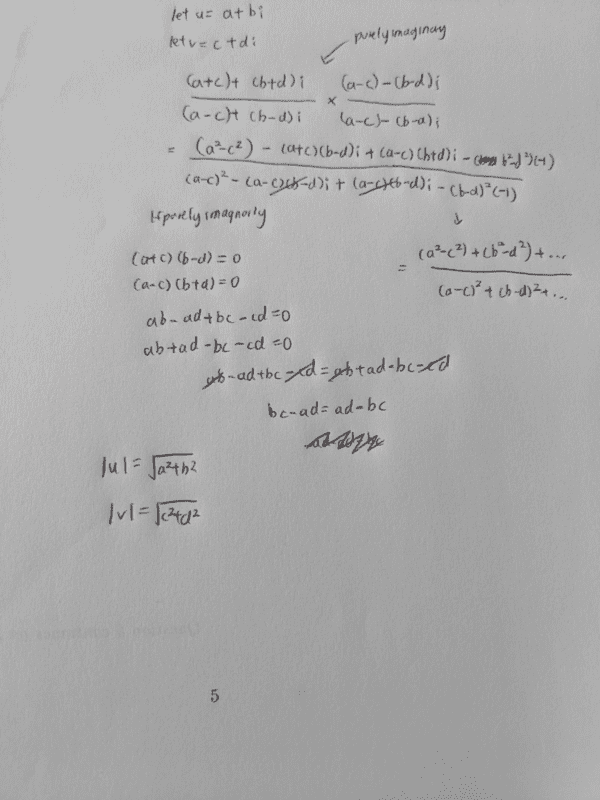
I'm kind of stuck over here at one part, but something is telling me that it might be wrong too :( Do assist, thanks.
1564799648981.png
 
Last edited by a moderator:
Physics news on Phys.org
I don't know what mod(u) is but my calculation got ##|u|=|v|##. I started with ##u+v=a+ib## and ##u-v=c+id## and only wrote ##u,v## as single numbers as I had the condition of pure imaginary derived.
 
fresh_42 said:
I don't know what mod(u) is but my calculation got ##|u|=|v|##. I started with ##u+v=a+ib## and ##u-v=c+id## and only wrote ##u,v## as single numbers as I had the condition of pure imaginary derived.
oh my bad mod(u) is |u|,
and what do you mean by writing u and v as single numbers?

EDIT: I got this after following your advice:

1564802998804.png

what should I do next ? hm
 
There is a sign error. You have to expand the quotient by ##1=\dfrac{c-id}{c-id}##. Next you separate the real part (with corrected sign), since this is all we are interested in. We only know that this part is zero. Now a quotient is zero if ... Now you can replace ##u=p+iq## and ##v=r+is##. The advantage is, that we got rid of all unnecessary parts: the imaginary part and the denominator.

You set the imaginary part zero, but the real part is!
 
fresh_42 said:
There is a sign error. You have to expand the quotient by ##1=\dfrac{c-id}{c-id}##. Next you separate the real part (with corrected sign), since this is all we are interested in. We only know that this part is zero. Now a quotient is zero if ... Now you can replace ##u=p+iq## and ##v=r+is##. The advantage is, that we got rid of all unnecessary parts: the imaginary part and the denominator.

You set the imaginary part zero, but the real part is!
Oh sh**. Yep I made a careless mistake right here. Not sure what you meant by replacing ##u=p+iq## and ##v=r+is## tho :( I'm still stuck at:

##\dfrac {a+ib}{c+id}## x ##\dfrac {c-id}{c-id}## = ##\dfrac {ac+bd}{c^2+d^2}## + ##\dfrac {i(bc-ad)}{c^2+d^2}##

Since imaginary, no real numbers.

So ##\dfrac {ac+bd}{c^2+d^2} = 0##

ac+bd=0

What should I do next?
 
An alternative is to start with:

##\frac{u+v}{u-v} = ai##

For some real number ##a##. That seems a much simpler approach.
 
Last edited:
PeroK said:
An alternative is to start with:

##\frac{u+v}{u-v} = ai##

For some real number ##a##. That seems a much simpler approach.
So something like: ##\frac{u+v}{u-v} *\frac{u+v}{u+v}## ? What difference will it be though compared to the one I did above a.k.a
##\dfrac {a+ib}{c+id}## x ##\dfrac {c-id}{c-id}## = ##\dfrac {ac+bd}{c^2+d^2}## + ##\dfrac {i(bc-ad)}{c^2+d^2}##

Since imaginary, no real numbers.

So ##\dfrac {ac+bd}{c^2+d^2} = 0##

ac+bd=0
 
jisbon said:
So something like: ##\frac{u+v}{u-v} *\frac{u+v}{u+v}## ? What difference will it be though compared to the one I did above a.k.a
##\dfrac {a+ib}{c+id}## x ##\dfrac {c-id}{c-id}## = ##\dfrac {ac+bd}{c^2+d^2}## + ##\dfrac {i(bc-ad)}{c^2+d^2}##

Since imaginary, no real numbers.

So ##\dfrac {ac+bd}{c^2+d^2} = 0##

ac+bd=0

Why not simply multiply by ##u - v## as a first step?

There's no need to expand ##u, v## into Cartesian form.
 
PeroK said:
Why not simply multiply by ##u - v## as a first step?

There's no need to expand ##u, v## into Cartesian form.

If I do multiply by ##u - v## as a first step, I will get ##\frac {u^2+2uv+v^2}{u^2-v^2} = ai##
Do I now expand ##u+v=a+ib## and ##u-v=c+id## in the above equation now?
 
  • #10
jisbon said:
If I do multiply by ##u - v## as a first step, I will get ##\frac {u^2+2uv+v^2}{u^2-v^2} = ai##
Do I now expand ##u+v=a+ib## and ##u-v=c+id## in the above equation now?
That's not what I get. I get

## u + v = (u-v)ai##

Sorry, I'm not getting alerts on my phone. So I'm missing replies.
 
  • #11
jisbon said:
Oh sh**. Yep I made a careless mistake right here. Not sure what you meant by replacing ##u=p+iq## and ##v=r+is## tho :( I'm still stuck at:

##\dfrac {a+ib}{c+id}## x ##\dfrac {c-id}{c-id}## = ##\dfrac {ac+bd}{c^2+d^2}## + ##\dfrac {i(bc-ad)}{c^2+d^2}##

Since imaginary, no real numbers.

So ##\dfrac {ac+bd}{c^2+d^2} = 0##

ac+bd=0

What should I do next?
Yes. And here I substituted ##u=p+iq## and ##v=r+is##, which means ##a= p+r## and ##c=p-q## etc. since we had ##u+v=a+ib\, , \,u-v=c+id##. Now replace ##a,b,c,d## by ##p,q,r,s## accordingly and calculate ##ac+bd=0## with the new variables, sort the positive summands on different sides of the equation and done.

I would not change the strategy in the middle of the race. With ##ac+bd=0## your are almost done. The rest is easy and fast.
 
  • #12
fresh_42 said:
Yes. And here I substituted ##u=p+iq## and ##v=r+is##, which means ##a= p+r## and ##c=p-q## etc. since we had ##u+v=a+ib\, , \,u-v=c+id##. Now replace ##a,b,c,d## by ##p,q,r,s## accordingly and calculate ##ac+bd=0## with the new variables, sort the positive summands on different sides of the equation and done.

I would not change the strategy in the middle of the race. With ##ac+bd=0## your are almost done. The rest is easy and fast.
But, so many unnecessary variables!
 
  • #13
PeroK said:
That's not what I get. I get

## u + v = (u-v)ai##

Sorry, I'm not getting alerts on my phone. So I'm missing replies.
It's okay. Thanks for your help.
As to the question could you check this:
##\frac{u+v}{u-v} *\frac{u+v}{u+v}## = ##\frac{u^2+2uv+v^2}{u^2-v^2} =ai##
How did you get:
##u+v=(u−v)ai##

EDIT: Nevermind my bad, I'm seeing this now. So if ##u+v=(u−v)ai## , what should I do next?
 
  • #14
fresh_42 said:
Yes. And here I substituted ##u=p+iq## and ##v=r+is##, which means ##a= p+r## and ##c=p-q## etc. since we had ##u+v=a+ib\, , \,u-v=c+id##. Now replace ##a,b,c,d## by ##p,q,r,s## accordingly and calculate ##ac+bd=0## with the new variables, sort the positive summands on different sides of the equation and done.

I would not change the strategy in the middle of the race. With ##ac+bd=0## your are almost done. The rest is easy and fast.
With ##ac+bd=0##, what should I do next?
 
  • #15
jisbon said:
With ##ac+bd=0##, what should I do next?
##u+v=a+ib = (p+iq)+(r+is) \text{ and } u-v=c+id = (p+iq)-(r+is)## means ##a=p+r\, , \,b=q+s\, , \,c=p-r\, , \,d=q-s## and now simply calculate ##ac+bd=0=(p+r)(p-r)+(q+s)(q-s)## and rearrange the terms.
 
  • #16
jisbon said:
It's okay. Thanks for your help.
As to the question could you check this:
##\frac{u+v}{u-v} *\frac{u+v}{u+v}## = ##\frac{u^2+2uv+v^2}{u^2-v^2} =ai##
How did you get:
##u+v=(u−v)ai##

EDIT: Nevermind my bad, I'm seeing this now. So if ##u+v=(u−v)ai## , what should I do next?
I would rearrange that to get an equation relating ##u## and ##v##.
 
  • #17
fresh_42 said:
##u+v=a+ib = (p+iq)+(r+is) \text{ and } u-v=c+id = (p+iq)-(r+is)## means ##a=p+r\, , \,b=q+s\, , \,c=p-r\, , \,d=q-s## and now simply calculate ##ac+bd=0=(p+r)(p-r)+(q+s)(q-s)## and rearrange the terms.
Oh my, finally gotten this actually. Is there actually a simpler way or is the clearest way to do it?
 
  • #18
jisbon said:
Oh my, finally gotten this actually. Is there actually a simpler way or is the clearest way to do it?
Yes, @PeroK's. Rearrange ##u+v=(u-v)ai## with ##u's## on one side, ##v's## on the other and take the norm aka modulus aka length aka absolute value, whatever you call it. You need that it is multiplicative.
 
  • #19
fresh_42 said:
Yes, @PeroK's. Rearrange ##u+v=(u-v)ai## with ##u's## on one side, ##v's## on the other and take the norm aka modulus aka length aka absolute value, whatever you call it. You need that it is multiplicative.
Ah alright :) Thanks so much for the help everybody :)
 
  • #20
jisbon said:
Ah alright :) Thanks so much for the help everybody :)

Just to say that I think all the steps I took were the most obvious.

1) Write down what you have been given.

##\frac{u+v}{u-v} = ai##

2) Get rid of the fraction:

##u + v = (u-v) ai##

3) Rearrange, as you are looking for the equation ##|u|= |v|##:

##u(1-ai) = -v(1 + ai)##

4) Take the absolute value:

##|u||1-ai| = |v||1+ai|##

5) Note that ##|1-ai| = |1+ai|##

In each case, the next step looked the most obvious - the one to try first.
 
  • Like
Likes Delta2 and ehild
  • #21
PeroK said:
Just to say that I think all the steps I took were the most obvious.

1) Write down what you have been given.

##\frac{u+v}{u-v} = ai##

2) Get rid of the fraction:

##u + v = (u-v) ai##

3) Rearrange, as you are looking for the equation ##|u|= |v|##:

##u(1-ai) = -v(1 + ai)##

4) Take the absolute value:

##|u||1-ai| = |v||1+ai|##

5) Note that ##|1-ai| = |1+ai|##

In each case, the next step looked the most obvious - the one to try first.
Wow this is a fast method haha. Thanks for your guidance!
 

Similar threads

  • · Replies 9 ·
Replies
9
Views
5K
  • · Replies 11 ·
Replies
11
Views
2K
  • · Replies 6 ·
Replies
6
Views
2K
  • · Replies 20 ·
Replies
20
Views
2K
Replies
4
Views
4K
Replies
12
Views
2K
  • · Replies 4 ·
Replies
4
Views
3K
  • · Replies 16 ·
Replies
16
Views
3K
  • · Replies 12 ·
Replies
12
Views
2K
  • · Replies 16 ·
Replies
16
Views
4K