Complex Numbers (Laurent Series)

  • Thread starter Thread starter jojosg
  • Start date Start date
Click For Summary

Homework Help Overview

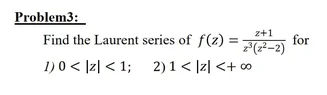
The discussion revolves around finding the Laurent series for the function \( f(z) = \frac{z+1}{z^3(z^2-2)} \) in specified domains. Participants are examining the validity of the problem as presented, particularly focusing on the convergence regions of the series expansions.

Discussion Character

  • Mixed

Approaches and Questions Raised

  • Some participants question the validity of the problem statement, suggesting alternative functions and domains that would make more sense. Others discuss the implications of poles in relation to the convergence of the Laurent series.

Discussion Status

The discussion is ongoing, with participants exploring different interpretations of the problem. Some have provided guidance on using partial fraction decomposition and series expansions, while others emphasize the need for clarification regarding the function and its intended domain.

Contextual Notes

There are concerns about the convergence of the series at specific points, particularly at \( z = \sqrt{2} \), which is identified as a pole of the function. Participants are also discussing the implications of the teacher's instructions and the need for accurate domain specifications.
jojosg
Messages
27
Reaction score
3
Homework Statement
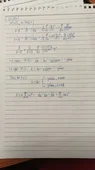
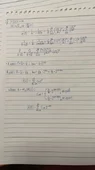
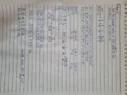
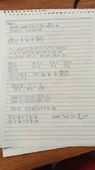
Am attempting a Laurent Series question but I'm not confident in my answers. would appreciate any corrections.
Relevant Equations
f(z) = sigma (cnz^n)
see attached.
 

Attachments

  • question.webp
    question.webp
    11.3 KB · Views: 11
  • 1.webp
    1.webp
    24.8 KB · Views: 24
  • 2.webp
    2.webp
    17.4 KB · Views: 31
  • 3.webp
    3.webp
    17.4 KB · Views: 19
Physics news on Phys.org
Are you sure this problem is valid? The domains of the two expansions would make more sense to me if the function was
##\frac {z+1}{z^3(z^2-1)}##
or if the domains were ##0\lt z \lt \sqrt 2## and ##\sqrt 2 \lt z \lt \infty##

PS. I can not read your work.
 
FactChecker said:
Are you sure this problem is valid? The domains of the two expansions would make more sense to me if the function was
##\frac {z+1}{z^3(z^2-1)}##
or if the domains were ##0\lt z \lt \sqrt 2## and ##\sqrt 2 \lt z \lt \infty##

PS. I can not read your work.
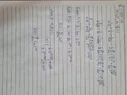
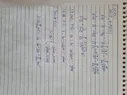
It was given by my teacher so I assume the problem is valid. Hope these are clearer.
 

Attachments

  • 20251021_081602.webp
    20251021_081602.webp
    40 KB · Views: 32
  • 20251021_081553.webp
    20251021_081553.webp
    38.4 KB · Views: 31
  • 20251021_081529.webp
    20251021_081529.webp
    34.8 KB · Views: 21
jojosg said:
It was given by my teacher so I assume the problem is valid. Hope these are clearer.
I don't believe there is a Laurent series for that function that converges for ##1 \lt |z| \lt \infty##
 
##\boxed{
\textbf{Problem 3: Find the Laurent series of } f(z) = \frac{z+1}{z^3(z^2-2)} \text{ for:}
\quad \text{(1) } 0 < |z| < 1 \quad \text{(2) } 1 < |z| < +\infty
}##

**Partial Fraction Decomposition**

We begin with the partial fraction decomposition:

$$f(z) = \frac{z+1}{z^3(z^2-2)} = \frac{A}{z} + \frac{B}{z^2} + \frac{C}{z^3} + \frac{Dz+E}{z^2-2}$$

Multiply both sides by ##z^3(z^2-2)##:

$$z+1 = Az^2(z^2-2) + Bz(z^2-2) + C(z^2-2) + (Dz+E)z^3$$

$$z+1 = A(z^4-2z^2) + B(z^3-2z) + C(z^2-2) + Dz^4 + Ez^3$$

$$z+1 = (A+D)z^4 + (B+E)z^3 + (-2A+C)z^2 - 2Bz - 2C$$

Comparing coefficients:

$$\begin{cases}
z^4: & A + D = 0 \\
z^3: & B + E = 0 \\
z^2: & -2A + C = 0 \\
z^1: & -2B = 1 \\
\text{Constant}: & -2C = 1
\end{cases}$$

Solving:

$$B = -\frac{1}{2}, \quad C = -\frac{1}{2}, \quad -2A - \frac{1}{2} = 0 \Rightarrow A = -\frac{1}{4}$$
$$D = -A = \frac{1}{4}, \quad E = -B = \frac{1}{2}$$

Thus:

$$f(z) = -\frac{1}{4z} - \frac{1}{2z^2} - \frac{1}{2z^3} + \frac{\frac{1}{4}z + \frac{1}{2}}{z^2-2}$$

**1. Laurent Series for ##0 < |z| < 1##**

For ##|z| < 1##, we expand ##\frac{1}{z^2-2}##:

$$\frac{1}{z^2-2} = -\frac{1}{2} \cdot \frac{1}{1 - \frac{z^2}{2}} = -\frac{1}{2} \sum_{n=0}^{\infty} \left(\frac{z^2}{2}\right)^n = -\sum_{n=0}^{\infty} \frac{z^{2n}}{2^{n+1}}$$

Then:

$$\frac{\frac{1}{4}z + \frac{1}{2}}{z^2-2} = \left(\frac{1}{4}z + \frac{1}{2}\right) \left(-\sum_{n=0}^{\infty} \frac{z^{2n}}{2^{n+1}}\right) = -\frac{1}{4} \sum_{n=0}^{\infty} \frac{z^{2n+1}}{2^{n+1}} - \frac{1}{2} \sum_{n=0}^{\infty} \frac{z^{2n}}{2^{n+1}}$$

So the Laurent series for ##0 < |z| < 1## is:

$$f(z) = -\frac{1}{4z} - \frac{1}{2z^2} - \frac{1}{2z^3} - \frac{1}{4} \sum_{n=0}^{\infty} \frac{z^{2n+1}}{2^{n+1}} - \frac{1}{2} \sum_{n=0}^{\infty} \frac{z^{2n}}{2^{n+1}}$$

**2. Laurent Series for ##1 < |z| < +\infty##**

For ##|z| > 1##, we expand ##\frac{1}{z^2-2}## differently:

$$\frac{1}{z^2-2} = \frac{1}{z^2} \cdot \frac{1}{1 - \frac{2}{z^2}} = \frac{1}{z^2} \sum_{n=0}^{\infty} \left(\frac{2}{z^2}\right)^n = \sum_{n=0}^{\infty} \frac{2^n}{z^{2n+2}}$$

Then:

$$\frac{\frac{1}{4}z + \frac{1}{2}}{z^2-2} = \left(\frac{1}{4}z + \frac{1}{2}\right) \sum_{n=0}^{\infty} \frac{2^n}{z^{2n+2}} = \frac{1}{4} \sum_{n=0}^{\infty} \frac{2^n}{z^{2n+1}} + \frac{1}{2} \sum_{n=0}^{\infty} \frac{2^n}{z^{2n+2}}$$

So the Laurent series for ##1 < |z| < +\infty## is:

$$f(z) = -\frac{1}{4z} - \frac{1}{2z^2} - \frac{1}{2z^3} + \frac{1}{4} \sum_{n=0}^{\infty} \frac{2^n}{z^{2n+1}} + \frac{1}{2} \sum_{n=0}^{\infty} \frac{2^n}{z^{2n+2}}$$

**Final Answer:**

**(1) For ##0 < |z| < 1##:**
$$f(z) = -\frac{1}{4z} - \frac{1}{2z^2} - \frac{1}{2z^3} - \frac{1}{4} \sum_{n=0}^{\infty} \frac{z^{2n+1}}{2^{n+1}} - \frac{1}{2} \sum_{n=0}^{\infty} \frac{z^{2n}}{2^{n+1}}$$

**(2) For ##1 < |z| < +\infty##:**
$$f(z) = -\frac{1}{4z} - \frac{1}{2z^2} - \frac{1}{2z^3} + \frac{1}{4} \sum_{n=0}^{\infty} \frac{2^n}{z^{2n+1}} + \frac{1}{2} \sum_{n=0}^{\infty} \frac{2^n}{z^{2n+2}}$$
 
Last edited:
  • Like
Likes   Reactions: fresh_42
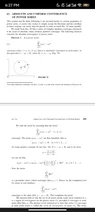
Series (2) can not converge at ##z=\sqrt 2## because the function is not defined there. The region of convergence (##1 \lt |z| \lt +\infty##) of a Laurent series can not include a pole (## z=\sqrt 2##) of the original function, .
I repeat that the problem statement is wrong.
 
Last edited:
  • Like
Likes   Reactions: wrobel
Yes. Expanding ##(z - a)^{-k}## in binomial series can be done in two ways; one converges for ##|z| < |a|## and the other for ##|z| > |a|##.
 
  • Like
Likes   Reactions: FactChecker and fresh_42
FactChecker said:
I repeat that the problem statement is wrong.
I agree
 
  • #10
jojosg said:
It was given by my teacher so I assume the problem is valid. Hope these are clearer.
Your teacher is not infallible, so I'd reach out for clarification about the intended function and intended domain.

Note that your first series converges when ##\left\lvert \frac{z^2}2 \right\rvert < 1## or, equivalently, ##\lvert z \rvert < \sqrt 2##.
 
  • #11
I haven't looked at your work, but if it is correct, then it will be valid for the modified problem with domains specified as ##|z|\lt \sqrt 2## and ##\sqrt 2 \lt |z| \lt +\infty##.
 
  • #12
FactChecker said:
I haven't looked at your work, but if it is correct, then it will be valid for the modified problem with domains specified as ##|z|\lt \sqrt 2## and ##\sqrt 2 \lt |z| \lt +\infty##.
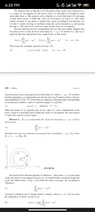
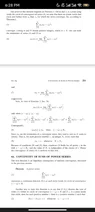
can I use this theorem to prove that its not analytic in that range for part 2?
 

Attachments

  • Screenshot_2025-10-22-18-27-55-103_com.microsoft.skydrive.webp
    Screenshot_2025-10-22-18-27-55-103_com.microsoft.skydrive.webp
    18.2 KB · Views: 20
  • Screenshot_2025-10-22-18-28-12-374_com.microsoft.skydrive.webp
    Screenshot_2025-10-22-18-28-12-374_com.microsoft.skydrive.webp
    21.5 KB · Views: 10
  • Screenshot_2025-10-22-18-28-31-656_com.microsoft.skydrive.webp
    Screenshot_2025-10-22-18-28-31-656_com.microsoft.skydrive.webp
    17.3 KB · Views: 32
  • #13
WA delivers a series for all values, just not the same. However, it does not provide the convergence radii.
 
  • #14
jojosg said:
##\boxed{
\textbf{Problem 3: Find the Laurent series of } f(z) = \frac{z+1}{z^3(z^2-2)} \text{ for:}
\quad \text{(1) } 0 < |z| < 1 \quad \text{(2) } 1 < |z| < +\infty
}##

**Partial Fraction Decomposition**

We begin with the partial fraction decomposition:

$$f(z) = \frac{z+1}{z^3(z^2-2)} = \frac{A}{z} + \frac{B}{z^2} + \frac{C}{z^3} + \frac{Dz+E}{z^2-2}$$

Multiply both sides by ##z^3(z^2-2)##:

$$z+1 = Az^2(z^2-2) + Bz(z^2-2) + C(z^2-2) + (Dz+E)z^3$$

$$z+1 = A(z^4-2z^2) + B(z^3-2z) + C(z^2-2) + Dz^4 + Ez^3$$

$$z+1 = (A+D)z^4 + (B+E)z^3 + (-2A+C)z^2 - 2Bz - 2C$$

Comparing coefficients:

$$\begin{cases}
z^4: & A + D = 0 \\
z^3: & B + E = 0 \\
z^2: & -2A + C = 0 \\
z^1: & -2B = 1 \\
\text{Constant}: & -2C = 1
\end{cases}$$

Solving:

$$B = -\frac{1}{2}, \quad C = -\frac{1}{2}, \quad -2A - \frac{1}{2} = 0 \Rightarrow A = -\frac{1}{4}$$
$$D = -A = \frac{1}{4}, \quad E = -B = \frac{1}{2}$$

Thus:

$$f(z) = -\frac{1}{4z} - \frac{1}{2z^2} - \frac{1}{2z^3} + \frac{\frac{1}{4}z + \frac{1}{2}}{z^2-2}$$
It is simpler to add the series expansions of ##\frac{z}{z^3(z^2-2)}## and ##\frac{1}{z^3(z^2-2)}##. Both series are simple to derive and valid for ##|z^2/2| \lt 1##. Your restriction of ##|z| \lt 1## is wrong.
 
  • #15
I don't think we should use the words wrong or false. The answer is simply not as simple as expected, since the crucial point is different from the one given by the problem statement.
 
  • Like
Likes   Reactions: FactChecker
  • #16
fresh_42 said:
I don't think we should use the words wrong or false. The answer is simply not as simple as expected, since the crucial point is different from the one given by the problem statement.
Maybe I should have said, unnecessary or misleading or arbitrary.
In any case, IMO, it is important to know and use the radius of convergence of the geometric series.
 
  • Like
Likes   Reactions: fresh_42

Similar threads

  • · Replies 7 ·
Replies
7
Views
2K
  • · Replies 3 ·
Replies
3
Views
1K
  • · Replies 12 ·
Replies
12
Views
5K
  • · Replies 2 ·
Replies
2
Views
3K
  • · Replies 1 ·
Replies
1
Views
1K
  • · Replies 30 ·
2
Replies
30
Views
4K
  • · Replies 1 ·
Replies
1
Views
5K
  • · Replies 2 ·
Replies
2
Views
2K
  • · Replies 3 ·
Replies
3
Views
1K
  • · Replies 1 ·
Replies
1
Views
2K