Complex Numbers (Laurent Series)

  • Thread starter jojosg
  • Start date
15 replies · 3K views · last reply
jojosg
Messages
37
Reaction score
5
Homework Statement
Am attempting a Laurent Series question but I'm not confident in my answers. would appreciate any corrections.
Relevant Equations
f(z) = sigma (cnz^n)
see attached.
 
Attachments
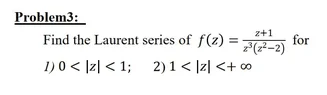
  • Typeset problem statement: Problem3. Find the Laurent series of f(z) = (z+1)/(z^3(z^2-2)) for 1) 0 < |z| < 1; 2) 1 < |z| < +infinity.
    question.webp
    11.3 KB · Views: 45
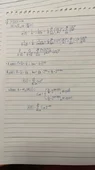
  • Handwritten solution to a Laurent series problem: partial fraction decomposition of (z+1)/(z^2(z^2-2)) with coefficients solved in a column, followed by the resulting series expansion.
    1.webp
    24.8 KB · Views: 58
  • Handwritten notes deriving a Laurent series expansion of a rational function in z, with partial fractions and geometric series for regions 0 < |z| < √2 and |z| > √2, and a final piecewise formula for the coefficients a_n.
    2.webp
    17.4 KB · Views: 78
  • Handwritten derivation of a Laurent series expansion for f(z) on the annulus |z| < √2 with a geometric series, splitting into even and odd cases with a coefficient formula c_m and a final sum over n.
    3.webp
    17.4 KB · Views: 48
Are you sure this problem is valid? The domains of the two expansions would make more sense to me if the function was
##\frac {z+1}{z^3(z^2-1)}##
or if the domains were ##0\lt z \lt \sqrt 2## and ##\sqrt 2 \lt z \lt \infty##

PS. I can not read your work.
 
FactChecker said:
Are you sure this problem is valid? The domains of the two expansions would make more sense to me if the function was
##\frac {z+1}{z^3(z^2-1)}##
or if the domains were ##0\lt z \lt \sqrt 2## and ##\sqrt 2 \lt z \lt \infty##

PS. I can not read your work.
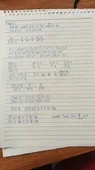
It was given by my teacher so I assume the problem is valid. Hope these are clearer.
 
Attachments
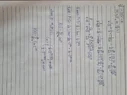
  • Handwritten derivation on lined paper of Laurent series expansions for 1/(z-√2) and 1/(z+√2) in powers of z, with separate sums for even and odd k and the resulting coefficients c_m.
    20251021_081602.webp
    40 KB · Views: 81
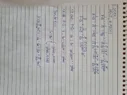
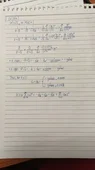
  • Handwritten notes on lined paper deriving a Laurent series expansion of a rational function for |z| < √2 and |z| > √2, with partial fractions, geometric series sums, and the resulting coefficients c_n for even and odd n.
    20251021_081553.webp
    38.4 KB · Views: 73
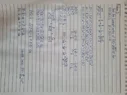
  • Handwritten notebook page solving Problem 3: finding the Laurent series of (z+1)/(z^2(z^2-2)) for 1 < |z| < ∞ and 0 < |z| < √2, with partial fraction decomposition and coefficient equations, ending with the Laurent series sum of c_n z^n.
    20251021_081529.webp
    34.8 KB · Views: 51
jojosg said:
It was given by my teacher so I assume the problem is valid. Hope these are clearer.
I don't believe there is a Laurent series for that function that converges for ##1 \lt |z| \lt \infty##
 
##\boxed{
\textbf{Problem 3: Find the Laurent series of } f(z) = \frac{z+1}{z^3(z^2-2)} \text{ for:}
\quad \text{(1) } 0 < |z| < 1 \quad \text{(2) } 1 < |z| < +\infty
}##

**Partial Fraction Decomposition**

We begin with the partial fraction decomposition:

$$f(z) = \frac{z+1}{z^3(z^2-2)} = \frac{A}{z} + \frac{B}{z^2} + \frac{C}{z^3} + \frac{Dz+E}{z^2-2}$$

Multiply both sides by ##z^3(z^2-2)##:

$$z+1 = Az^2(z^2-2) + Bz(z^2-2) + C(z^2-2) + (Dz+E)z^3$$

$$z+1 = A(z^4-2z^2) + B(z^3-2z) + C(z^2-2) + Dz^4 + Ez^3$$

$$z+1 = (A+D)z^4 + (B+E)z^3 + (-2A+C)z^2 - 2Bz - 2C$$

Comparing coefficients:

$$\begin{cases}
z^4: & A + D = 0 \\
z^3: & B + E = 0 \\
z^2: & -2A + C = 0 \\
z^1: & -2B = 1 \\
\text{Constant}: & -2C = 1
\end{cases}$$

Solving:

$$B = -\frac{1}{2}, \quad C = -\frac{1}{2}, \quad -2A - \frac{1}{2} = 0 \Rightarrow A = -\frac{1}{4}$$
$$D = -A = \frac{1}{4}, \quad E = -B = \frac{1}{2}$$

Thus:

$$f(z) = -\frac{1}{4z} - \frac{1}{2z^2} - \frac{1}{2z^3} + \frac{\frac{1}{4}z + \frac{1}{2}}{z^2-2}$$
**1. Laurent Series for ##0 < |z| < 1##**

For ##|z| < 1##, we expand ##\frac{1}{z^2-2}##:

$$\frac{1}{z^2-2} = -\frac{1}{2} \cdot \frac{1}{1 - \frac{z^2}{2}} = -\frac{1}{2} \sum_{n=0}^{\infty} \left(\frac{z^2}{2}\right)^n = -\sum_{n=0}^{\infty} \frac{z^{2n}}{2^{n+1}}$$

Then:

$$\frac{\frac{1}{4}z + \frac{1}{2}}{z^2-2} = \left(\frac{1}{4}z + \frac{1}{2}\right) \left(-\sum_{n=0}^{\infty} \frac{z^{2n}}{2^{n+1}}\right) = -\frac{1}{4} \sum_{n=0}^{\infty} \frac{z^{2n+1}}{2^{n+1}} - \frac{1}{2} \sum_{n=0}^{\infty} \frac{z^{2n}}{2^{n+1}}$$

So the Laurent series for ##0 < |z| < 1## is:

$$f(z) = -\frac{1}{4z} - \frac{1}{2z^2} - \frac{1}{2z^3} - \frac{1}{4} \sum_{n=0}^{\infty} \frac{z^{2n+1}}{2^{n+1}} - \frac{1}{2} \sum_{n=0}^{\infty} \frac{z^{2n}}{2^{n+1}}$$

**2. Laurent Series for ##1 < |z| < +\infty##**

For ##|z| > 1##, we expand ##\frac{1}{z^2-2}## differently:

$$\frac{1}{z^2-2} = \frac{1}{z^2} \cdot \frac{1}{1 - \frac{2}{z^2}} = \frac{1}{z^2} \sum_{n=0}^{\infty} \left(\frac{2}{z^2}\right)^n = \sum_{n=0}^{\infty} \frac{2^n}{z^{2n+2}}$$

Then:

$$\frac{\frac{1}{4}z + \frac{1}{2}}{z^2-2} = \left(\frac{1}{4}z + \frac{1}{2}\right) \sum_{n=0}^{\infty} \frac{2^n}{z^{2n+2}} = \frac{1}{4} \sum_{n=0}^{\infty} \frac{2^n}{z^{2n+1}} + \frac{1}{2} \sum_{n=0}^{\infty} \frac{2^n}{z^{2n+2}}$$

So the Laurent series for ##1 < |z| < +\infty## is:

$$f(z) = -\frac{1}{4z} - \frac{1}{2z^2} - \frac{1}{2z^3} + \frac{1}{4} \sum_{n=0}^{\infty} \frac{2^n}{z^{2n+1}} + \frac{1}{2} \sum_{n=0}^{\infty} \frac{2^n}{z^{2n+2}}$$

**Final Answer:**

**(1) For ##0 < |z| < 1##:**
$$f(z) = -\frac{1}{4z} - \frac{1}{2z^2} - \frac{1}{2z^3} - \frac{1}{4} \sum_{n=0}^{\infty} \frac{z^{2n+1}}{2^{n+1}} - \frac{1}{2} \sum_{n=0}^{\infty} \frac{z^{2n}}{2^{n+1}}$$

**(2) For ##1 < |z| < +\infty##:**
$$f(z) = -\frac{1}{4z} - \frac{1}{2z^2} - \frac{1}{2z^3} + \frac{1}{4} \sum_{n=0}^{\infty} \frac{2^n}{z^{2n+1}} + \frac{1}{2} \sum_{n=0}^{\infty} \frac{2^n}{z^{2n+2}}$$
 
Last edited:
Series (2) can not converge at ##z=\sqrt 2## because the function is not defined there. The region of convergence (##1 \lt |z| \lt +\infty##) of a Laurent series can not include a pole (## z=\sqrt 2##) of the original function, .
I repeat that the problem statement is wrong.
 
Last edited:
Yes. Expanding ##(z - a)^{-k}## in binomial series can be done in two ways; one converges for ##|z| < |a|## and the other for ##|z| > |a|##.
 
  • Like
Likes   Reactions: FactChecker and fresh_42
jojosg said:
It was given by my teacher so I assume the problem is valid. Hope these are clearer.
Your teacher is not infallible, so I'd reach out for clarification about the intended function and intended domain.

Note that your first series converges when ##\left\lvert \frac{z^2}2 \right\rvert < 1## or, equivalently, ##\lvert z \rvert < \sqrt 2##.
 
I haven't looked at your work, but if it is correct, then it will be valid for the modified problem with domains specified as ##|z|\lt \sqrt 2## and ##\sqrt 2 \lt |z| \lt +\infty##.
 
FactChecker said:
I haven't looked at your work, but if it is correct, then it will be valid for the modified problem with domains specified as ##|z|\lt \sqrt 2## and ##\sqrt 2 \lt |z| \lt +\infty##.
can I use this theorem to prove that its not analytic in that range for part 2?
 
Attachments
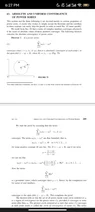
  • Page from a textbook titled Absolute and Uniform Convergence of Power Series, showing Theorem 1 and a circular convergence diagram labelled Figure 79 with a disk of radius R1 around z0.
    Screenshot_2025-10-22-18-27-55-103_com.microsoft.skydrive.webp
    18.2 KB · Views: 54
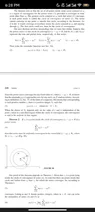
  • Textbook page on power series showing Theorem 2 with a diagram of a circle of convergence centred at z0 with radius R1 inside radius R, and figure 80 labelled below.
    Screenshot_2025-10-22-18-28-12-374_com.microsoft.skydrive.webp
    21.5 KB · Views: 39
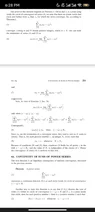
  • Printed textbook page, numbered 211, covering the continuity of sums of power series. It states a theorem that a power series represents a continuous function inside its circle of convergence, with numbered equations (1) to (9) and the proof text above them.
    Screenshot_2025-10-22-18-28-31-656_com.microsoft.skydrive.webp
    17.3 KB · Views: 72
jojosg said:
##\boxed{
\textbf{Problem 3: Find the Laurent series of } f(z) = \frac{z+1}{z^3(z^2-2)} \text{ for:}
\quad \text{(1) } 0 < |z| < 1 \quad \text{(2) } 1 < |z| < +\infty
}##

**Partial Fraction Decomposition**

We begin with the partial fraction decomposition:

$$f(z) = \frac{z+1}{z^3(z^2-2)} = \frac{A}{z} + \frac{B}{z^2} + \frac{C}{z^3} + \frac{Dz+E}{z^2-2}$$

Multiply both sides by ##z^3(z^2-2)##:

$$z+1 = Az^2(z^2-2) + Bz(z^2-2) + C(z^2-2) + (Dz+E)z^3$$

$$z+1 = A(z^4-2z^2) + B(z^3-2z) + C(z^2-2) + Dz^4 + Ez^3$$

$$z+1 = (A+D)z^4 + (B+E)z^3 + (-2A+C)z^2 - 2Bz - 2C$$

Comparing coefficients:

$$\begin{cases}
z^4: & A + D = 0 \\
z^3: & B + E = 0 \\
z^2: & -2A + C = 0 \\
z^1: & -2B = 1 \\
\text{Constant}: & -2C = 1
\end{cases}$$

Solving:

$$B = -\frac{1}{2}, \quad C = -\frac{1}{2}, \quad -2A - \frac{1}{2} = 0 \Rightarrow A = -\frac{1}{4}$$
$$D = -A = \frac{1}{4}, \quad E = -B = \frac{1}{2}$$

Thus:

$$f(z) = -\frac{1}{4z} - \frac{1}{2z^2} - \frac{1}{2z^3} + \frac{\frac{1}{4}z + \frac{1}{2}}{z^2-2}$$
It is simpler to add the series expansions of ##\frac{z}{z^3(z^2-2)}## and ##\frac{1}{z^3(z^2-2)}##. Both series are simple to derive and valid for ##|z^2/2| \lt 1##. Your restriction of ##|z| \lt 1## is wrong.
 
I don't think we should use the words wrong or false. The answer is simply not as simple as expected, since the crucial point is different from the one given by the problem statement.
 
fresh_42 said:
I don't think we should use the words wrong or false. The answer is simply not as simple as expected, since the crucial point is different from the one given by the problem statement.
Maybe I should have said, unnecessary or misleading or arbitrary.
In any case, IMO, it is important to know and use the radius of convergence of the geometric series.