Component of Force downward on Loppers (the kind for trimming bushes)

  • Context: Undergrad 
  • Thread starter Thread starter noblerare
  • Start date Start date
  • Tags Tags
    Component Force
Click For Summary
SUMMARY

The discussion focuses on the analysis of force components in a lopper used for trimming bushes. The user applies a downward force using a load cell, which alters the angle of the upper arm (theta). The correct method to componentize the force F into orthogonal and parallel components relative to the diagonal bar is established as follows: the parallel component is F sin(theta) and the orthogonal component is F cos(theta). This clarification resolves the user's confusion regarding the application of trigonometric functions in force analysis.

PREREQUISITES
  • Understanding of basic physics concepts, specifically force components
  • Familiarity with trigonometric functions, particularly sine and cosine
  • Knowledge of load cells and their application in measuring force
  • Basic mechanics of levers and angles in physical systems
NEXT STEPS
  • Study the principles of static equilibrium in mechanical systems
  • Learn about the application of trigonometric functions in physics problems
  • Explore the use of load cells in various engineering applications
  • Investigate the mechanics of levers and their force distribution
USEFUL FOR

This discussion is beneficial for mechanical engineers, physics students, and anyone involved in the design or analysis of tools that utilize lever mechanics and force measurement systems.

noblerare
Messages
49
Reaction score
0
Hi people,

I have a lopper (the kind for trimming bushes or tree branches). I have it rigged up like the diagram below. The blades are on the bottom left. The bottom arm is straight while the top arm is at an angle theta. I have a load cell which is applying a constant force downward and compressing the arm, thus changing the theta.

I noticed that as I apply the load cell force downward, it starts slipping down the upper handle as it compresses. In any case, if F is the force that I apply downward, does it make sense to componentize it into F_x and F_y components? If so, what would that be? I figured it may be some sort of arctan equation but haven't quite wrapped my head around how to go about doing it.
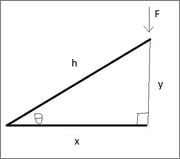
diagram.jpg


Thanks for your help.
 

Attachments

  • diagram.png
    diagram.png
    1.5 KB · Views: 448
Physics news on Phys.org
F, as you draw it, does not have a (non-zero) x component. You can split the force in a component orthogonal and a component parallel to the diagonal bar, however. Sine and cosine give the corresponding force components.
 
Okay, so if I were the break up F into the orthogonal and parallel components to the diagonal bar (upper handle) would it be:

Parallel: F*csc(theta)
Orthogonal:F*csc(theta+90)
?

Not sure if that is right...

Edit: No, it seems the orthogonal is Fcos(theta)..
 
Last edited:
noblerare said:
Edit: No, it seems the orthogonal is Fcos(theta)..
And the other one is F sin(theta).
 
Perfect. Thank you!
 

Similar threads

  • · Replies 8 ·
Replies
8
Views
4K
  • · Replies 6 ·
Replies
6
Views
2K
  • · Replies 1 ·
Replies
1
Views
1K
  • · Replies 19 ·
Replies
19
Views
15K
  • · Replies 1 ·
Replies
1
Views
3K
  • · Replies 7 ·
Replies
7
Views
2K
  • · Replies 1 ·
Replies
1
Views
3K
  • · Replies 7 ·
Replies
7
Views
5K
  • · Replies 1 ·
Replies
1
Views
3K
  • · Replies 2 ·
Replies
2
Views
3K