Component of Force downward on Loppers (the kind for trimming bushes)

  • Context: Undergrad 
  • Thread starter Thread starter noblerare
  • Start date Start date
  • Tags Tags
    Component Force
Click For Summary

Discussion Overview

The discussion revolves around the analysis of forces acting on a lopper used for trimming bushes, specifically focusing on the componentization of a downward force applied via a load cell. Participants explore the relationship between the applied force and its components in relation to the angles involved in the setup.

Discussion Character

  • Technical explanation
  • Mathematical reasoning

Main Points Raised

  • One participant inquires about the feasibility of breaking down the downward force (F) into its x and y components, considering the angle (theta) of the upper arm.
  • Another participant asserts that the force does not have a non-zero x component but can be split into components that are orthogonal and parallel to the diagonal bar.
  • A subsequent reply proposes expressions for the parallel and orthogonal components of the force relative to the diagonal bar, initially suggesting csc(theta) and later correcting to sine and cosine functions.

Areas of Agreement / Disagreement

Participants demonstrate some agreement on the need to componentize the force but exhibit uncertainty regarding the correct expressions for the components, leading to corrections and refinements in the proposed equations.

Contextual Notes

There are unresolved aspects regarding the definitions of the angles and the specific geometry of the lopper setup, which may affect the accuracy of the component expressions.

noblerare
Messages
49
Reaction score
0
Hi people,

I have a lopper (the kind for trimming bushes or tree branches). I have it rigged up like the diagram below. The blades are on the bottom left. The bottom arm is straight while the top arm is at an angle theta. I have a load cell which is applying a constant force downward and compressing the arm, thus changing the theta.

I noticed that as I apply the load cell force downward, it starts slipping down the upper handle as it compresses. In any case, if F is the force that I apply downward, does it make sense to componentize it into F_x and F_y components? If so, what would that be? I figured it may be some sort of arctan equation but haven't quite wrapped my head around how to go about doing it.
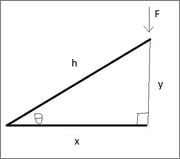
diagram.jpg


Thanks for your help.
 

Attachments

  • diagram.png
    diagram.png
    1.5 KB · Views: 457
Physics news on Phys.org
F, as you draw it, does not have a (non-zero) x component. You can split the force in a component orthogonal and a component parallel to the diagonal bar, however. Sine and cosine give the corresponding force components.
 
Okay, so if I were the break up F into the orthogonal and parallel components to the diagonal bar (upper handle) would it be:

Parallel: F*csc(theta)
Orthogonal:F*csc(theta+90)
?

Not sure if that is right...

Edit: No, it seems the orthogonal is Fcos(theta)..
 
Last edited:
noblerare said:
Edit: No, it seems the orthogonal is Fcos(theta)..
And the other one is F sin(theta).
 
Perfect. Thank you!
 

Similar threads

  • · Replies 8 ·
Replies
8
Views
5K
  • · Replies 6 ·
Replies
6
Views
2K
  • · Replies 1 ·
Replies
1
Views
2K
  • · Replies 19 ·
Replies
19
Views
15K
  • · Replies 1 ·
Replies
1
Views
3K
  • · Replies 7 ·
Replies
7
Views
2K
  • · Replies 1 ·
Replies
1
Views
3K
  • · Replies 7 ·
Replies
7
Views
5K
  • · Replies 1 ·
Replies
1
Views
3K
  • · Replies 2 ·
Replies
2
Views
3K