Compression Nozzles on Model Rockets

Click For Summary

Discussion Overview

The discussion centers around the potential effects of adding compression nozzles to model rocket engines, specifically examining whether such modifications can enhance engine performance. Participants explore various aspects of nozzle design, including the implications for thrust, specific impulse, and overall flight dynamics. The conversation encompasses theoretical considerations, experimental observations, and practical challenges associated with nozzle modifications in model rocketry.

Discussion Character

  • Exploratory
  • Technical explanation
  • Debate/contested
  • Experimental/applied

Main Points Raised

  • One participant proposes testing an additional exterior compression nozzle to improve performance, seeking opinions on its potential effectiveness.
  • Another participant shares experiences indicating that replacing nozzles can enhance total impulse and specific impulse, but notes challenges related to weight and flight dynamics.
  • Concerns are raised about the effectiveness of convergent-divergent nozzles for supersonic exhaust velocities, suggesting that existing divergent nozzles may already perform adequately.
  • Some participants argue that improved nozzle designs can reduce turbulence and enhance rearward flow, rather than focusing solely on supersonic flow characteristics.
  • Questions are posed regarding the design of solid propellant slugs and the potential benefits of alternative geometries for burn patterns and thrust profiles.
  • Discussion includes the potential for augmenter tubes to increase thrust, particularly at lower speeds, while noting that static thrust measurements may be misleading.
  • One participant mentions a student project measuring thrust differences at various altitudes, suggesting that nozzle design could yield measurable improvements in thrust.
  • Another participant suggests simplifying the design by attaching a diverging section directly to the existing nozzle, potentially achieving higher exit velocities without the complexity of a full converging-diverging nozzle.
  • Concerns are raised about the efficiency of sharp edge entry nozzles, with suggestions for radiused entries to improve performance.
  • Some participants express surprise at the lack of attention given to supersonic nozzle designs, citing energy losses observed in standard convergent nozzles.

Areas of Agreement / Disagreement

Participants express a range of views on the effectiveness of nozzle modifications, with some advocating for specific designs while others question their utility. There is no clear consensus on the best approach or the extent of potential performance improvements.

Contextual Notes

Participants note various limitations in their discussions, including the challenges of accurately measuring thrust differences, the dependence on specific motor designs, and the unresolved nature of certain technical claims regarding nozzle efficiency and performance.

Gbl911
Messages
18
Reaction score
0
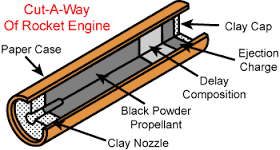
I am doing a experiment with model rockets to see if a added compression nozzle on a model rocket would make the engine perform better.
images?q=tbn:ANd9GcRzsg4nDXtdUoTzNCr3N9sIPGkemhXfP5IXfolSevDMunKVDEWF.png
As you can see in this picture there is a small clay nozzle immediate to the propellant. This is the same place that you put the igniter.
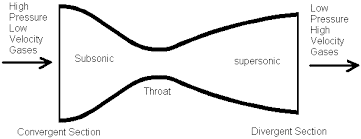
My experiment is going to test to see if adding a additional exterior compression nozzle will more improve the performance.
images?q=tbn:ANd9GcQ772NNbVuIPveo67XwRGKdeXrhEOLVpv4qoBBaXYxlHEj2g8PX8g.png
This is along the lines of what I am planning to make. I would like to get an opinion if this would actually make a difference.

Thanks
 

Attachments

  • images?q=tbn:ANd9GcRzsg4nDXtdUoTzNCr3N9sIPGkemhXfP5IXfolSevDMunKVDEWF.png
    images?q=tbn:ANd9GcRzsg4nDXtdUoTzNCr3N9sIPGkemhXfP5IXfolSevDMunKVDEWF.png
    8.3 KB · Views: 3,162
Physics news on Phys.org
We've played around a bit with nozzles on model rocket motors. With enough care, a replacement of the nozzle can improve the total impulse and the specific impulse over the clay nozzles on the black powder based motors. It is a bigger challenge for the improvement to offset the extra weight of the improved nozzle on the flight dynamics. You'll need a decent thrust measurement curve to see the difference.

Getting a reasonable approximation to a de Laval nozzle can be a tricky maching problem at the smaller diameters. Mounting the nozzle on the back end of the cheap BP motors with clay nozzles already in place can also be tricky. Using the ammonium perchlorate based reloadable motors from Aerotech make the effects of improved nozzles larger and also make it easier to test customized nozzle designs.
 
An Estes B6 Motor with specific impulse of 101s has an exhaust velocity of 101s x 9.81 m/s/s = 990.81 m/s which is supersonic, therefore a convergent-divergent nozzle would hinder rather than help. The divergent nozzle already fitted to the motor will work very well.
 
Blibbler said:
An Estes B6 Motor with specific impulse of 101s has an exhaust velocity of 101s x 9.81 m/s/s = 990.81 m/s which is supersonic, therefore a convergent-divergent nozzle would hinder rather than help. The divergent nozzle already fitted to the motor will work very well.

In our experience the advantages of improved nozzle design is not the difference between supersonic and subsonic flow, but rather decreased turbulence, constant throat diameter, and a more predictably rearward flow. Certainly not all nozzles that achieve supersonic flow have equal performance.

Most of the BP based Estes motors we've tested fail to meet their specifications for thrust, impulse, and specific impulse due to various manufacturing imperfections including amount of propellant, quality of propellant, and quality of the nozzle.
 
I have no background with simple black power model rockets, my exposure is more to my university aerospace propulsion course. I am curious as to the burn pattern and thrust profile of what appears to be a solid propellant slug. Why is this design used as opposed to a formed cone bore in the propellant that provides a more predictable burn pattern and increases burn rate and thrust pressure at launch. It would also allow for a more efficient tapered nozzle inlet as well.

With regard to a convergent/divergent supersonic nozzle, have the designs tried on this type of rocket been critically designed for a nozzle discharge static pressure of 1 Bar; or, simply a cone shaped discharge. I ask because eliminating a shock front in the nozzle throat should improve the engine thrust performance; or, is the burn time so short that the improvement is negligible.
 
JBA said:
I have no background with simple black power model rockets, my exposure is more to my university aerospace propulsion course. I am curious as to the burn pattern and thrust profile of what appears to be a solid propellant slug. Why is this design used as opposed to a formed cone bore in the propellant that provides a more predictable burn pattern and increases burn rate and thrust pressure at launch. It would also allow for a more efficient tapered nozzle inlet as well.

With regard to a convergent/divergent supersonic nozzle, have the designs tried on this type of rocket been critically designed for a nozzle discharge static pressure of 1 Bar; or, simply a cone shaped discharge. I ask because eliminating a shock front in the nozzle throat should improve the engine thrust performance; or, is the burn time so short that the improvement is negligible.

Most black powder motors do have a conical or cylindrical bore into the propellant at the base, giving a thrust increase at liftoff to ensure adequate speed off the launchpad for aerodynamic stability. A purely endburning propellant slug is quite rare. This is clear if you look at the given thrust curves for the motors, since they have a large spike in thrust at the beginning of the burn, followed by a longer duration "sustain" period to keep the rocket moving after the initial hard acceleration.
 
Thanks for the response, my comments were based upon my observation of the cutaway figure in the above earlier post.
 
The attachment shows a student project results measuring Estes rocket motor thrusts at different altitudes. A relatively simple force plate was sensitive enough to quantify the small thrust differences between sea level and 7000 ft, so I am fairly certain a similar arrangement would be effective quantifying any significant thrust differences related to nozzle design.

Another student repeated the experiment a year or two later with composite rocket motors with nozzles that would be easier to customize because the motors use a reloadable design (Aerotech). If one has the capability to machine de Laval nozzles, they would be relatively easy to test in the Aerotech reloadable motors. Figuring out how to attach a de Laval nozzle to the clay back end of those Estes motors is a harder problem.

I think most people who have looked at them think some degree of thrust improvement is possible by improving the nozzles of cheap hobbyist rocket motors. It might be 5% or it might br 25%. You won't know until you try.
 

Attachments

  • Estes Rocket Motor Thrust Curves.PNG
    Estes Rocket Motor Thrust Curves.PNG
    22.2 KB · Views: 1,471
  • #10
In reality there is likely no reason to include the converging portion of the nozzle. Just stick the diverging section to the existing clay nozzle and that ought to give the same mass flow rate but much higher exit velocity. I would imagine doing that is easier than attaching a full C-D nozzle to the end, as well.
 
Last edited:
  • Like
Likes   Reactions: Dr. Courtney
  • #11
A sharp edge entry nozzle is not he best solution since it will have a low efficiency although I will agree that a radiused entry would generally suffice.

Considering the large velocity increase achievable with a supersonic nozzle I am surprised that more attention apparently has not been devoted to adding that feature. There is extensive energy wasted in a standard convergent nozzle design as observed by the train the shock diamonds that form shortly after the nozzle discharge point.

For reference: As a prior 20 yr high pressure relief valve developer/designer/tester I am well versed on the issues of nozzle designs and their efficiency factors.
 
  • #12
JBA said:
A sharp edge entry nozzle is not he best solution since it will have a low efficiency although I will agree that a radiused entry would generally suffice.

Considering the large velocity increase achievable with a supersonic nozzle I am surprised that more attention apparently has not been devoted to adding that feature. There is extensive energy wasted in a standard convergent nozzle design as observed by the train the shock diamonds that form shortly after the nozzle discharge point.

For reference: As a prior 20 yr high pressure relief valve developer/designer/tester I am well versed on the issues of nozzle designs and their efficiency factors.

Model rockets already have supersonic nozzles. The shock diamonds just show you that they do not have ideally expanded supersonic nozzles.
 
  • #13
I am aware that well designed model rockets do in fact have that type of nozzle but this thread has been discussing the specific black powder rockets of the type displayed in an above post, where, apparently this type of nozzle is not generally used.

I am aware of the source of the shock diamonds on supersonic nozzles when not at the design altitude; as per my above note, I was speaking of the difference between a straight bore sonic nozzle vs a supersonic nozzle.
 
  • #14
It's likely even those Estes engines go slightly supersonic, as the "straight" nozzles generally have a fillet along that edge which would serve as a bit of an expansion. It's going to be extraordinarily inefficient, but it would not surprise me at all if it was something like ##M = 1.3## or something mildly supersonic.
 
  • #15
JBA said:
I am aware that well designed model rockets do in fact have that type of nozzle but this thread has been discussing the specific black powder rockets of the type displayed in an above post, where, apparently this type of nozzle is not generally used.

I am aware of the source of the shock diamonds on supersonic nozzles when not at the design altitude; as per my above note, I was speaking of the difference between a straight bore sonic nozzle vs a supersonic nozzle.

Black powder motors have supersonic nozzles too - they are what I was referring to. Look at what you're calling a "straight bore" nozzle and you'll see that they're actually shallow conical nozzles. I can't find any really good pictures of it (it's fairly easy to see in person), but you can kind of see it here: http://warwickaerospace.co.uk/wp-content/uploads/2014/11/17.jpg

Admittedly, the expansion ratio isn't terribly good, but the combustion temperature and pressure aren't fantastic either, and for the cost and size, they do alright.
 

Similar threads

Replies
2
Views
3K
  • · Replies 26 ·
Replies
26
Views
4K
Replies
7
Views
5K
  • · Replies 5 ·
Replies
5
Views
4K
  • · Replies 9 ·
Replies
9
Views
4K
  • · Replies 4 ·
Replies
4
Views
5K
Replies
7
Views
5K
Replies
39
Views
30K
  • · Replies 8 ·
Replies
8
Views
6K
Replies
5
Views
967