Compton scattering amplitude and propagator

1 reply · 2K views · last reply
Dhmht_Kr
Messages
4
Reaction score
0
Hi everyone
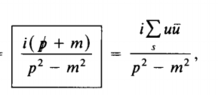
How can i prove that the propagator is
Two equal fractions. Left: i(p-slash + m) over p squared minus m squared, boxed. Right: i times the sum over s of u u-bar, over p squared minus m squared, followed by a comma.

And then
Feynman amplitude expression: -i M1 = u-bar(s')(p') [ epsilon'*_nu (ie gamma^nu) i((p-slash + k-slash + m)) / ((p+k)^2 - m^2) (ie gamma^mu) epsilon_mu ] u(s)(p)
 
Attachments
  • Two fractions joined by an equals sign: left, i(p-slash + m) over p^2 - m^2 inside a box; right, i times the sum over spins of u ubar over p^2 - m^2.
    1681501897142.png
    2.2 KB · Views: 190
I'm afraid answering your questions will depend on the background you'd like the explanation to be standing in. In other words, what level of QFT physics you are interested in? For instance, can I assume you're aware of how to quantize the Dirac field and then get its propagation amplitudes?

If you let me know your overall level in QFT, I might be able to answer the above questions.