Computing Ricci Tensor Coefficients w/ Tetrad Formalism

Click For Summary

Discussion Overview

The discussion centers around the computation of Ricci tensor coefficients using tetrad formalism, as illustrated in a specific textbook. Participants explore the derivation of these coefficients, the implications of the equations presented, and the conventions used in the calculations.

Discussion Character

  • Technical explanation
  • Mathematical reasoning
  • Debate/contested

Main Points Raised

  • One participant questions the factor of 2 in the coefficient for ##\Gamma_{2[12]}##, suggesting it should be ##\frac{\sqrt{1-kr^2}}{r}## instead of ##\frac{\sqrt{1-kr^2}}{2r}##.
  • Another participant notes that the summation in the formula for ##d\theta^2## includes terms that contribute to the coefficient, indicating that the factor of 2 arises from the antisymmetrization of indices.
  • There is a discussion about the meaning of the dots in the equations, with one participant clarifying that they represent other terms with indices not equal to 1 and 2.
  • One participant expresses confusion about why certain terms involving ##\theta^2 \wedge \theta^3## are not considered in the calculation of ##\Gamma^3_{[13]}##.
  • A participant elaborates on the reduction of terms in the equation for ##d\theta^3##, questioning which property of exterior derivatives was used for this reduction.
  • Another participant raises a question about the definition of ##\Gamma^i_{jk}## in a non-coordinate basis and discusses the relationship between different bases and their connection coefficients.
  • A participant mentions that in holonomic bases, the connection coefficients correspond to Christoffel symbols, which are symmetric in lower components, contrasting this with (pseudo)-orthonormal bases.

Areas of Agreement / Disagreement

Participants express differing views on the coefficients and their derivations, indicating that multiple competing interpretations and methods exist. The discussion remains unresolved regarding the specific calculations and conventions used.

Contextual Notes

Participants highlight potential limitations in understanding the conventions of antisymmetrization and the implications of using different bases for the connection coefficients. There is also uncertainty regarding the application of exterior derivative properties in the calculations.

snypehype46
Messages
10
Reaction score
1
TL;DR
Computing Ricci tensor coefficients using the tetrad formalism
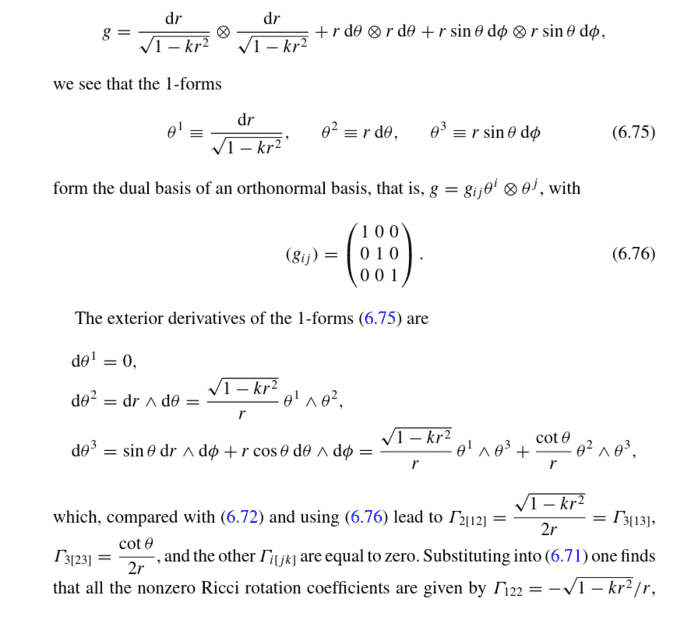
I'm reading "Differentiable manifolds: A Theoretical Physics Approach" by Castillo and on page 170 of the book a calculation of the Ricci tensor coefficients for a metric is illustrated. In the book the starting point for this method is the equation given by:

$$d\theta^i = \Gamma^i_{[jk]} \theta^j \wedge \theta^k$$

where ##\theta^i## are 1-forms.

Then the book proceeds to calculate the coefficients for the following metric:
1621383077968.png


What I don't quite understand is why is the coefficient for ##\Gamma_{2[12]}## is given by ##\frac{\sqrt{1-kr^2}}{2r}##. From the second equation I would have guessed the coefficient is actually ##\frac{\sqrt{1-kr^2}}{r}##, so why do we need to divide by 2? From the second equation I would read $$d\theta^2 = \Gamma_{[12]}^2 \theta^1 \wedge \theta^2$$.

Also I'm not sure how the book actually computed the term for ##\Gamma^3_{[13]}##.
 
  • Like
Likes   Reactions: vanhees71
Physics news on Phys.org
There is summation in the formula

##d\theta^2 = \Gamma^2_{[jk]} \theta^j \wedge \theta^k=\cdots+\Gamma^2_{[12]} \theta^1 \wedge \theta^2+\Gamma^2_{[21]} \theta^2 \wedge \theta^1+\cdots=\cdots+2\Gamma^2_{[12]} \theta^1 \wedge \theta^2+\cdots##
 
  • Like
Likes   Reactions: vanhees71
@martinbn what is the meaning of the dots?
 
snypehype46 said:
@martinbn what is the meaning of the dots?
Just the other terms with indeces not 1 and 2.
 
Ok I see, so for the term ##\Gamma^3_{[13]}##, we used the last equation. My point of confusion is why we don't care about the factor involving ##\theta^2 \wedge \theta^3##
 
I'm going to be explicit!

$$d\theta^i = \Gamma^i_{jk} \theta^j \wedge \theta^K$$
$$d\theta^3 = \Gamma^3_{11} \theta^1 \wedge \theta^1 + \Gamma^3_{12} \theta^1 \wedge \theta^2 + \Gamma^3_{13} \theta^1 \wedge \theta^3$$ $$+ \Gamma^3_{21} \theta^2 \wedge \theta^1 + \Gamma^3_{22} \theta^2 \wedge \theta^2 + \Gamma^3_{23} \theta^2 \wedge \theta^3$$ $$ + \Gamma^3_{31} \theta^3 \wedge \theta^1 + \Gamma^3_{32} \theta^3 \wedge \theta^2 + \Gamma^3_{33} \theta^3 \wedge \theta^3$$

Reducing this down (which property of exterior derivatives did i use to reduce to this point?), we get:
$$d\theta^3 =\Gamma^3_{12} \theta^1 \wedge \theta^2 + \Gamma^3_{13} \theta^1 \wedge \theta^3$$ $$+ \Gamma^3_{21} \theta^2 \wedge \theta^1+ \Gamma^3_{23} \theta^2 \wedge \theta^3$$ $$ + \Gamma^3_{31} \theta^3 \wedge \theta^1 + \Gamma^3_{32} \theta^3 \wedge \theta^2$$

Now, we know that ##d\theta^3 = \frac{\sqrt{1-kr^2}}{r} \theta^1 \wedge \theta^3 + \frac{\cot \theta}{r} \theta^2 \wedge \theta^3##

Match the same with the same. Which terms involve ##\theta^1 \wedge \theta^3##? You're not ignoring the ##\theta^2 \wedge \theta^3## terms, it's just that ##\Gamma^3_{13}## doesn't have any ##\theta^2 \wedge \theta^3## terms!

Also, some food for thought, what can you conclude about ##\Gamma^3_{12}, \Gamma^3_{21}## from this equation?
 
A quickie: factors of 2 and antisymmetrization [...] , what's the book's convention? Weight one (anti)symmetrization?
 
I have never worked in a non-coordinate basis before, so I'm having trouble with the basic equation:

##d \Theta^i = \Gamma^i_{|jk|} \Theta^j \wedge \Theta^k##

Is ##\Gamma^i_{jk}## defined for a non-coordinate basis via:

##\nabla_{e_i} e_j = \Gamma^k_{ij} e_k##

If so, then it seems to me that if ##e_\mu## is a coordinate basis, with corresponding connection ##\Gamma^\lambda_{\mu \nu}##, and ##e_i## is some other basis (coordinate or not), then the relationship between the ##\Gamma##s is given by:

##\Gamma^k_{ij} = \Lambda^\nu_i \Lambda^k_\mu \partial_\nu \Lambda^\mu_j + \Lambda^k_\mu \Lambda^\nu_i \Lambda^\lambda_j \Gamma^\mu_{\nu \lambda}##

where ##\Lambda^\mu_i## is the coordinate transformation matrix, and ##\Lambda^i_\mu## is its inverse.

On the other hand, in the covector basis,
##e^k = \Lambda^k_\mu e^\mu = \Lambda^k_\mu d x^\mu##

Taking exterior derivatives of both sides gives:

##d e^k = d(\Lambda^k_\mu d x^\mu) = (\partial_\nu \Lambda^k_\mu) d x^\nu \wedge dx^\mu## (because ##d d x^\mu = 0##)

Re-expressing in terms of the noncovariant basis ##e^i## gives:

##d e^k = \Lambda^\nu_i \Lambda^\mu_j (\partial_\nu \Lambda^k_\mu) e^i \wedge e^j##

So that's not the same thing as ##d e^k = \Gamma^k_{|ij|} e^i \wedge e^j##. Is it?
 
In holonomic bases ("coordinate bases") in a space without torsion (as in standard GR) the connection coefficients are the Christoffel symbols, which are symmetric in the lower components.

That's different for (pseudo)-orthonormal bases of course.
 

Similar threads

  • · Replies 1 ·
Replies
1
Views
1K
  • · Replies 6 ·
Replies
6
Views
1K
Replies
1
Views
2K
  • · Replies 4 ·
Replies
4
Views
1K
  • · Replies 8 ·
Replies
8
Views
3K
  • · Replies 1 ·
Replies
1
Views
2K
  • · Replies 7 ·
Replies
7
Views
2K
  • · Replies 10 ·
Replies
10
Views
3K
  • · Replies 11 ·
Replies
11
Views
2K
  • · Replies 5 ·
Replies
5
Views
1K