Coelum
- 97
- 32
- TL;DR
- While computing the transformation matrix associated to Thomas precession - as described by Goldstein (7.3) - I cannot reproduce a step in the derivation. This is a step later than the one described in my previous post "Computing the Thomas precession".
Dear PFer's,
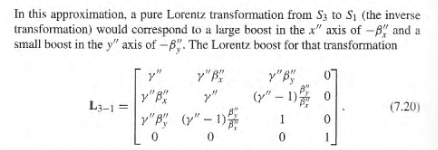
I am reproducing the steps to derive the expression for the Thomas precession, as described in Goldstein/Poole/Safko "Classical Mechanics". Hereafter an excerpt from the book describing the step I am currently working on.
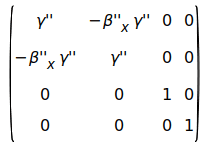
Based on the text, the transformation S_3 -> S_1 should be the composition of a boost on the x" axis
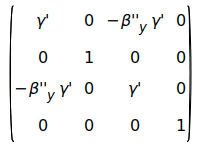
and a boost on the y" axis
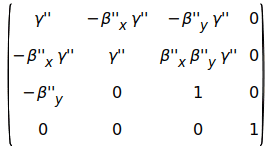
which, when composed assuming γ'=1, yield
 .
.
The differences with (7.20) are:
Thanks,
Francesco
I am reproducing the steps to derive the expression for the Thomas precession, as described in Goldstein/Poole/Safko "Classical Mechanics". Hereafter an excerpt from the book describing the step I am currently working on.
Based on the text, the transformation S_3 -> S_1 should be the composition of a boost on the x" axis
and a boost on the y" axis
which, when composed assuming γ'=1, yield
The differences with (7.20) are:
- the '-' sign in elements [1,2], [2,2], [2,1], [3,1]
- the '0' in position [3,2]
- the element in position [2,3], which can be approximated as (dropping the " for readability):
βxβyγ = γ(βy/βx)βx2 ≈ γ(βy/βx)β2 = γ(βy/βx)(1-1/γ2) = (γ-1/γ)βy/βx. Close, but not identical.
Thanks,
Francesco