Discussion Overview
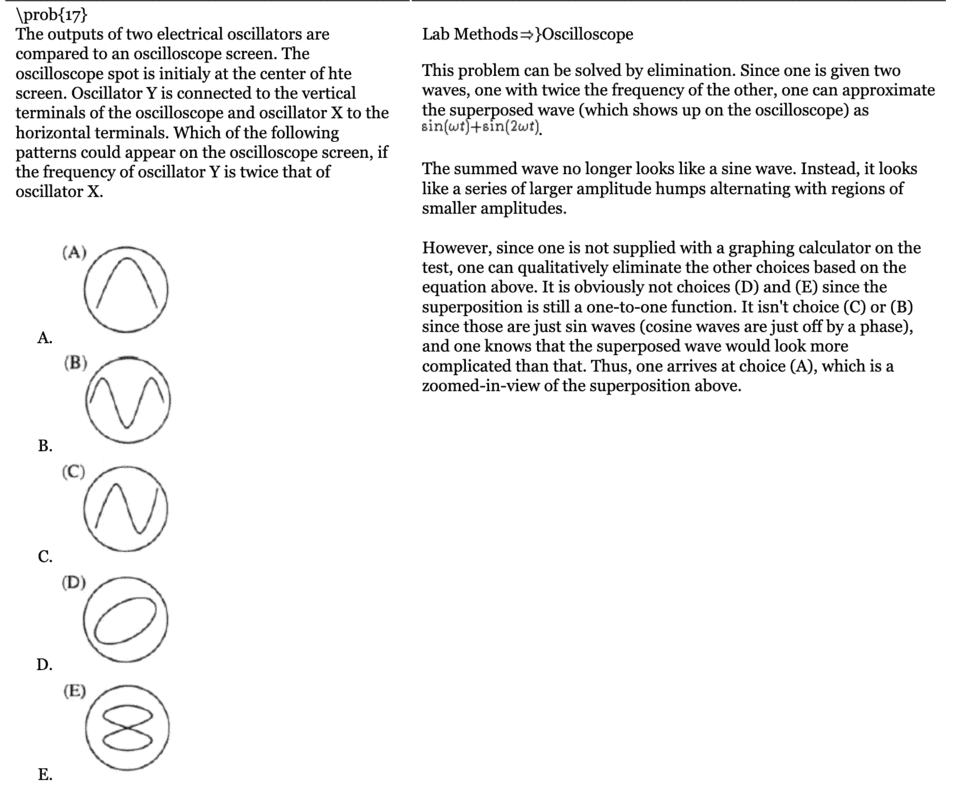
The discussion revolves around a conceptual problem related to oscilloscope output and the interpretation of superposition in the context of Lissajous figures. Participants explore the implications of different frequencies assigned to the X and Y axes and how this affects the resulting graphical representation.
Discussion Character
- Conceptual clarification
- Debate/contested
- Mathematical reasoning
Main Points Raised
- Some participants express doubt about the explanation of superposition, questioning whether it applies when frequencies are on orthogonal axes.
- One participant plotted the function sin(x) + sin(2x) in Mathematica to explore the problem further.
- Multiple participants assert that none of the provided answer choices are correct, suggesting that choice (E) would be valid if the X/Y axis assignments were reversed.
- There is a shared sentiment regarding the problem's origin from the 1992 GRE, with participants speculating about potential mistakes made by the problem creator.
- One participant proposes that zooming in on the graph might lead to choice (A) being correct, while another agrees that a 90-degree phase shift could make the 'rotated' (E) resemble (A).
- A participant shares a personal anecdote about experimenting with oscilloscopes and signal generators in high school, relating it to the current discussion.
- Another participant describes the parametric nature of the equations involved, noting the implications of differing frequencies on the slope of the resulting figure.
Areas of Agreement / Disagreement
Participants generally express disagreement regarding the correctness of the answer choices, with multiple competing views on the implications of frequency assignments and their effects on the graphical output. The discussion remains unresolved with no consensus on the correct interpretation.
Contextual Notes
Participants highlight the complexity of the problem due to the specific conditions set by the frequencies and their implications for the resulting Lissajous figures. There are unresolved assumptions regarding the interpretation of phase shifts and frequency relationships.