Concerning centripetal accelaeration & force

  • Context: Undergrad 
  • Thread starter Thread starter Neferkamichael
  • Start date Start date
  • Tags Tags
    Centripetal Force
Click For Summary
SUMMARY

The discussion centers on calculating the force required to spin a 12-inch diameter flywheel weighing 27.006 pounds at 3600 RPM. The calculations reveal that while the centripetal force is approximately 1,920,613.646 lbf, this value does not represent the force needed to maintain constant rotation, which is effectively zero in the absence of drag. Participants emphasize the importance of understanding the distinction between force, energy, and power, noting that any small force can initiate rotation, but overcoming resistance forces is essential for continuous operation.

PREREQUISITES
  • Understanding of centripetal acceleration and force calculations
  • Familiarity with rotational dynamics and angular momentum
  • Knowledge of frictional torque and its impact on rotating systems
  • Basic principles of energy and power in mechanical systems
NEXT STEPS
  • Research "frictional torque" specifications from bearing manufacturers
  • Study "moment of inertia" and its role in rotational motion
  • Explore the relationship between "power, energy, and force" in mechanical systems
  • Learn about "aerodynamic drag" and its effects on rotating objects
USEFUL FOR

Mechanical engineers, physics students, and anyone involved in the design or analysis of rotating machinery will benefit from this discussion.

Neferkamichael
Messages
9
Reaction score
0
I am working on a project and the image you see is a 12 inch diameter flywheel that weighs 27.006 pounds. The RPM's will be 3600. My questions will be about the very large values I get for the acceleration and force. Since I am most familiar with ft/sec and pounds, those are the units I will use.
Time period for 1 revolution = .01666
V=2∏r/T= 2x3.14159x.5(ft)/.01666(sec)= 188.570ft/sec
A=V2/r=188.572/.5= 71118.0347ft/sec2
centripetal force=mr(4∏2/t2)=27.006x.5x4x3.141592/.016662=1,920,613.646(lbf)
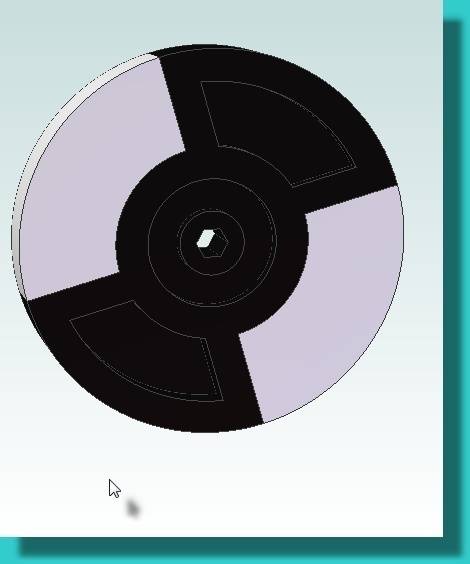
MagFly.jpg
I have checked the math and that force value seems to be very high.
What I would like to know is how much force it takes to spin the flywheel at 3600RPM's. Any help would be greatly appreciated.
Thanks

as I kept working on this I divided 1,920,613.646 by 3600=533.5037. Is that the amount of force per revolution?
 
Last edited:
Physics news on Phys.org
Neferkamichael said:
What I would like to know is how much force it takes to spin the flywheel at 3600RPM's.
0. Assuming no drag. If there is drag then the force is equal to the drag.

Are you looking to find the stress in the disk? Or are you perhaps looking to find the external force that must be supplied to accelerate it?
 
I'm looking for the external force necessary to spin the flywheel at 3600RPM's.
 
That is 0. Assuming no drag.
 
Neferkamichael said:
as I kept working on this I divided 1,920,613.646 by 3600=533.5037. Is that the amount of force per revolution?
What do you mean by force per revolution? If the wheel is rotating constantly at that rpm, then that is the centripetal force on the rim which acts all the time, not only per one revolution.
 
I don't know how else to state that I want to know how much force is required to spin this flywheel at 3600 rpm's. If anybody knows the answer and doesn't mind please write the equation. I don't need to worry about drag and stress at this point.
Thanks
 
Neferkamichael said:
I don't know how else to state that I want to know how much force is required to spin this flywheel at 3600 rpm's.

The answer has been given twice over. No force at all is required to maintain the rotation.

Any arbitrarily small force is adequate to create the rotation, provided it is applied for a long enouh time.
 
Neferkamichael said:
I don't know how else to state that I want to know how much force is required to spin this flywheel at 3600 rpm's. If anybody knows the answer and doesn't mind please write the equation. I don't need to worry about drag and stress at this point.
Here is the equation: f=0

It doesn't take any force to have something spin at a constant speed if there is no drag.
 
Neferkamichael said:
centripetal force=mr(4∏2/t2)=27.006x.5x4x3.141592/.016662=1,920,613.646(lbf)

You forgot to divide by g to convert that into pounds force, so the correct value is about 60,000 lbf or 26.7 tons force.

That is the total radial force acting on the flywheel shaft (and the big number is why you don't want to be standing near this machine if something breaks) but it has nothing to do with the force needed to spin the flywheel.
 
  • #10
Gentlemen I want to apopogize for not stating what I want to know, but thanks to you all I understand much more than before, and I hope that now I can. I've been an avide reader of physics most of my life and recently have wanted to understand more.

This statement. Any arbitrarily small force is adequate to create the rotation, provided it is applied for a long enouh time. You got to keep putting gas in the tank to keep all the moving parts moving. You have to apply a force to the piston and I believe all of you know the rest of that. That is the force I want to know. Yes there is drag and whatever else. You need a force to overcome those resistances. I have the moment of inertia and can figure the angular momentum, can I find the value I'm looking for with them. Also should I be thinking in terms of torgue instead of force. I hope that you all will help me understand more than I do now. Any help would be greatly appreciated.
Thanks.
 
  • #11
Perhaps you should be thinking in terms of energy rather than force. The wheel needs a certain amount of energy to spin. This energy is supplied by a force, but any small or large force will do. As was mentioned, the smaller the force the longer it will take to spin up to speed. But any arbitrarily small force will do. This is where the idea of power, energy per time, comes into play.

Make sure you are clear on the very important differences between the words: force, energy and power. Only when you can clearly distinguish between those words can you start to formulate your question and thoughts about the spinning disc.
 
  • #12
Neferkamichael said:
That is the force I want to know. Yes there is drag and whatever else. You need a force to overcome those resistances.
The force required is equal to the resistance force. Unfortunately, that is all about the bearings and the environment, and has very little to do with any of the characteristics of the flywheel (except maybe aerodynamics).

Neferkamichael said:
Also should I be thinking in terms of torgue instead of force. I hope that you all will help me understand more than I do now.
Yes, you want to look for the "frictional torque" of your bearing. That should be information that the manufacturer can tell you. Note that frictional torque is a function of speed and sometimes load, so you would need to tell the manufacturer the speed and maybe the load.
 

Similar threads

  • · Replies 4 ·
Replies
4
Views
5K
  • · Replies 17 ·
Replies
17
Views
2K
  • · Replies 2 ·
Replies
2
Views
6K
  • · Replies 14 ·
Replies
14
Views
3K
Replies
13
Views
4K
  • · Replies 9 ·
Replies
9
Views
4K
  • · Replies 14 ·
Replies
14
Views
2K
  • · Replies 2 ·
Replies
2
Views
2K
  • · Replies 3 ·
Replies
3
Views
2K
  • · Replies 1 ·
Replies
1
Views
1K