Conflicting definition of degree of freedom in Kinetic Theory of Gases

Click For Summary
SUMMARY

The discussion centers on the conflicting definitions of "degree of freedom" in the context of Kinetic Theory of Gases. One definition describes it as the number of independent variables needed to define a molecule's energy, while another suggests it refers to any single independent variable. The participants clarify that a monatomic gas has three degrees of freedom and a diatomic gas has five, emphasizing the importance of accurate definitions in understanding the equipartition of energy. The Berkeley physics course volume on Statistical Physics is recommended as a more reliable resource.

PREREQUISITES
  • Understanding of Kinetic Theory of Gases
  • Familiarity with the concept of degrees of freedom in physics
  • Knowledge of the equipartition theorem
  • Basic principles of Hamiltonian mechanics
NEXT STEPS
  • Study the equipartition theorem in detail
  • Learn about Hamiltonian mechanics and its applications
  • Explore the Berkeley physics course volume on Statistical Physics
  • Investigate the role of vibrational modes in molecular degrees of freedom
USEFUL FOR

Students of physics, educators in thermodynamics, and researchers focusing on molecular dynamics and statistical mechanics will benefit from this discussion.

vcsharp2003
Messages
913
Reaction score
179
TL;DR
Is degree of freedom just an independent term/variable/coordinate or the number of independent terms/variables/coordinates?
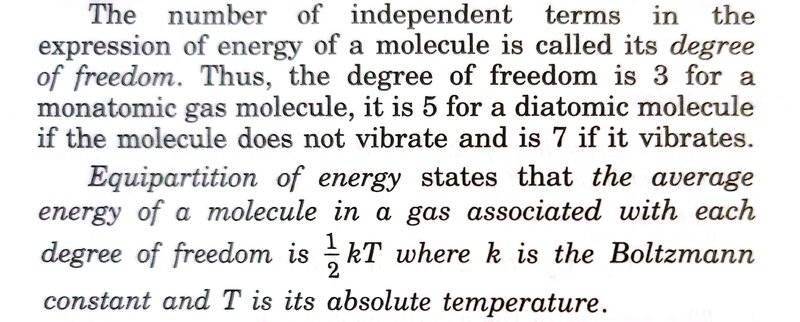
I am seeing conflicting definitions of degree of freedom in my textbook. If I look at the definition given as per screenshot below then it is the number of independent terms/variables/coordinates used to define the energy of a molecule. But, if I look at the statement of Equipartition of energy that is given below the definition, then it seems that degree of freedom is any one of independent terms/variables/coordinates used to get energy of a molecule.

I think degree of freedom should just be the independent term/variable/coordinate.

CamScanner 02-15-2023 19.48_3.jpg
 
Science news on Phys.org
Why do you think the two paragraphs conflict?
 
Doc Al said:
Why do you think the two paragraphs conflict?
The first paragraph says that degree of freedom is the number of independent variables.

The second paragraph is is meaning degree of freedom to be the independent variable.
 
Ah, I think I see what you're saying. I can appreciate the confusion.

I would have said something like: A monatomic gas molecule has three degrees of freedom, a diatomic molecule has five, etc. And the equipartition of energy gives the average energy associated with each degree of freedom.
 
  • Like
Likes   Reactions: vcsharp2003
For me the excerpt from the book is formulated so inaccurately that it's even errorneous and misleading. I trcommend to use another book. I'd rdcommend the Berkeley physics course volume on Statistical Physics (the "little Reif").
 
  • Like
Likes   Reactions: vcsharp2003
Doc Al said:
Ah, I think I see what you're saying. I can appreciate the confusion.

I would have said something like: A monatomic gas molecule has three degrees of freedom, a diatomic molecule has five, etc. And the equipartition of energy gives the average energy associated with each degree of freedom.
Yes, that makes perfect sense; I mean the last paragraph.

It appears that degree of freedom means the independent coordinate/variable/term.
 
vanhees71 said:
For me the excerpt from the book is formulated so inaccurately that it's even errorneous and misleading. I trcommend to use another book. I'd rdcommend the Berkeley physics course volume on Statistical Physics (the "little Reif").
I agree. Its clearly confusing since a student reading these paragraphs from that book would be left wondering "What exactly is a degree of freedom".
 
The correct statement for the equipartition theorem is that any phase-space-degree of freedom, which enters the Hamiltonian quadratically (!!!) contributes ##k_{\text{B}} T/2## per particle to the (mean) energy. E.g., for an ideal mon-atomic gas, the single-particle Hamiltonian is ##H=\vec{p}^2/(2m)##, and thus the mean energy per particle is ##3 k_{\text{B}} T/2##. For two-atomic (and more-atomic) molecules you have two (three) more rotational degrees of freedom. This is when the vibrational modes are still frozen, i.e., at not too high temperatures. At higher temperatures you get additional vibrational degrees of freedom and the corresponding contributions to the mean energy per particle (in the harmoni-oscillator approximation).
 
  • Like
Likes   Reactions: vcsharp2003

Similar threads

  • · Replies 6 ·
Replies
6
Views
2K
  • · Replies 17 ·
Replies
17
Views
3K
  • · Replies 1 ·
Replies
1
Views
2K
  • · Replies 6 ·
Replies
6
Views
2K
Replies
11
Views
2K
  • · Replies 4 ·
Replies
4
Views
3K
  • · Replies 7 ·
Replies
7
Views
2K
  • · Replies 2 ·
Replies
2
Views
1K
  • · Replies 19 ·
Replies
19
Views
10K
  • · Replies 15 ·
Replies
15
Views
2K