Confused by the behavior of sqrt(z^2+1)

Click For Summary
SUMMARY

The discussion focuses on understanding the behavior of the function sqrt(z^2 + 1) in the context of complex analysis, specifically regarding branch cuts and discontinuities. The vertical line in the complex plane from i to i∞ indicates the points where the function experiences jumps in value. The discontinuities occur when z crosses the negative real axis, leading to sqrt(z^2 + 1) transitioning between positive and negative imaginary values. The analysis emphasizes the significance of the argument of z and its effect on the square root function as z encircles points in the complex plane.

PREREQUISITES
  • Understanding of complex numbers and the complex plane
  • Familiarity with branch cuts in complex analysis
  • Knowledge of the principal value of square roots in complex functions
  • Basic concepts of continuity and discontinuity in mathematical functions
NEXT STEPS
  • Study the properties of branch cuts in complex functions
  • Learn about the principal value of complex square roots
  • Explore the concept of discontinuities in complex analysis
  • Investigate the implications of winding numbers in complex functions
USEFUL FOR

Students of complex analysis, mathematicians exploring branch cuts, and anyone seeking to understand the behavior of complex functions like sqrt(z^2 + 1).

Measle
Messages
4
Reaction score
0
(mentor note: this is a homework problem with a solution that the OP would like to understand better)

In Taylor's Complex Variables,

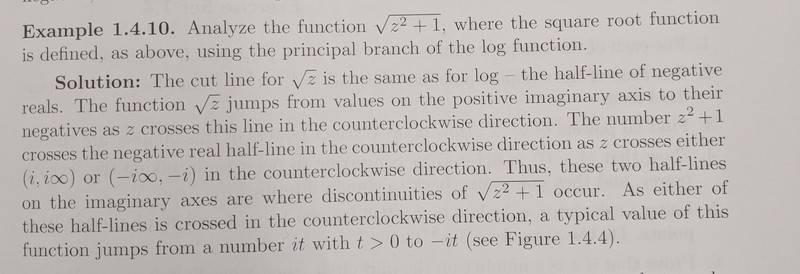
Example 1.4.10
WSK46H9.jpg


Can someone help me understand this? I don't know what they mean by (i, i inf), or how they got it and -it
 

Attachments

  • WSK46H9.jpg
    WSK46H9.jpg
    35.7 KB · Views: 949
Last edited by a moderator:
Physics news on Phys.org
##(i, i\infty)## is the vertical line in the complex plane along the imaginary axis from ##i## upward to ##i\infty##.
 
FactChecker said:
##(i, i\infty)## is the vertical line in the complex plane along the imaginary axis from ##i## upward to ##i\infty##.
I see - how does that lead to -it and it? or rather how do you find the discontinuities of sqrt(1 + z^2)?
 
Last edited:
OK, I'm a little rusty on branch cuts and complex analysis but let me try to reconstruct what that answer is saying. Unfortunately I don't have whatever definition they refer to in terms of the log function.

First, what are they saying about ##\sqrt{z}## as z goes counterclockwise? ##\sqrt{z}## is a solution w to ##w^2 = z = re^{i\theta}## so ##\sqrt z = \sqrt r e^{i(\theta/2)}##. If ##\theta## is just under ##\pi##, ##\theta = \pi - \epsilon##, then we choose as the principal value for ##\sqrt z## the solution with argument, i.e. phase, ##(\pi/2) - (\epsilon/2)##. That makes it a value just to the right of the positive imaginary axis.

But as we increase the angle to something above ##\pi## to ##\theta = \pi + \epsilon##, dividing that by two would give an argument for ##\sqrt z## of just over ##\pi/2##. We choose instead to use the equivalent angle ##\theta = \pi + \epsilon - 2\pi = -\pi + \epsilon##. As a result, the argument of ##\sqrt z## is ##-(\pi/2) + (\epsilon/2)## and the square root is just to the right of the negative imaginary axis.

This accounts for the sentence in the solution "The function ##\sqrt z## jumps from values on the positive imaginary axis to their negatives as z crosses this line [the negative real axis] in the counterclockwise direction".

##\sqrt z## has a discontinuity when z crosses that line, when z goes from a negative real number with a small positive imaginary part to one with a small negative imaginary part. The cut line is where z is a negative real number. So ##\sqrt {z^2 + 1}## is going to have a jump where ##(z^2 + 1)## does that, where ##z^2 + 1## is a negative real number.

##z^2 + 1## has real values ##< 0## when ##z^2 < -1## which means z is an imaginary number ##i \alpha## with either ##\alpha > 1## or ##\alpha < -1##. So the cut lines for ##\sqrt{z^2 + 1}## are those locations on the imaginary axis, the part going from i up and from -i down. As before, when you cross those lines, the square root jumps from values with positive imaginary parts and values with negative imaginary parts.
 
  • Like
Likes   Reactions: Delta2 and FactChecker
One thing that may help is considering this other way of seeing what happens when you wind once, twice around ( Sorry if this is what you did)

## \sqrt {e^{i\theta}}=e^{i(\theta/2)} \sqrt{e^(i(\theta +2\pi)}= e^ (i(\theta/2+ \pi)}= e^{(\theta/2)} e^{i\pi} = -e^{i\theta/2}##

So that the square root changes sine when you wind around a second time. The branch cut is intended to prevent that from happening, i.e., to prevent a curve having that property. If you remove the x-axis in above case, no curve will wind twice around.
Notice that if you go around a third time you return to the original value of the square root. In some cases , like that of Logz , you will never return to your initial value. For n-th root, you go around n times.
 
Last edited:
WWGD said:
One thing that may help is considering this other way of seeing what happens when you wind once, twice around ( Sorry if this is what you did)

$$ \sqrt{e^{(i\theta)}}=e^{i(\theta/2)} \sqrt{e^{(i(\theta +2\pi)}}= e^{(i(\theta/2+ \pi)}= e^{i\theta/2} e^{i\pi} = e^{-i\theta/2} $$

So that the square root changes sine when you wind around a second time. The branch cut is intended to prevent that from happening, i.e., to prevent a curve having that property. If you remove the x-axis in above case, no curve will wind twice around.
Notice that if you go around a third time you return to the original value of the square root. In some cases , like that of Logz , you will never return to your initial value. For n-th root, you go around n times.
I just corrected the LaTeX mistakes.
 
  • Like
Likes   Reactions: WWGD
RPinPA said:
OK, I'm a little rusty on branch cuts and complex analysis but let me try to reconstruct what that answer is saying. Unfortunately I don't have whatever definition they refer to in terms of the log function.

First, what are they saying about ##\sqrt{z}## as z goes counterclockwise? ##\sqrt{z}## is a solution w to ##w^2 = z = re^{i\theta}## so ##\sqrt z = \sqrt r e^{i(\theta/2)}##. If ##\theta## is just under ##\pi##, ##\theta = \pi - \epsilon##, then we choose as the principal value for ##\sqrt z## the solution with argument, i.e. phase, ##(\pi/2) - (\epsilon/2)##. That makes it a value just to the right of the positive imaginary axis.

But as we increase the angle to something above ##\pi## to ##\theta = \pi + \epsilon##, dividing that by two would give an argument for ##\sqrt z## of just over ##\pi/2##. We choose instead to use the equivalent angle ##\theta = \pi + \epsilon - 2\pi = -\pi + \epsilon##. As a result, the argument of ##\sqrt z## is ##-(\pi/2) + (\epsilon/2)## and the square root is just to the right of the negative imaginary axis.

This accounts for the sentence in the solution "The function ##\sqrt z## jumps from values on the positive imaginary axis to their negatives as z crosses this line [the negative real axis] in the counterclockwise direction".

##\sqrt z## has a discontinuity when z crosses that line, when z goes from a negative real number with a small positive imaginary part to one with a small negative imaginary part. The cut line is where z is a negative real number. So ##\sqrt {z^2 + 1}## is going to have a jump where ##(z^2 + 1)## does that, where ##z^2 + 1## is a negative real number.

##z^2 + 1## has real values ##< 0## when ##z^2 < -1## which means z is an imaginary number ##i \alpha## with either ##\alpha > 1## or ##\alpha < -1##. So the cut lines for ##\sqrt{z^2 + 1}## are those locations on the imaginary axis, the part going from i up and from -i down. As before, when you cross those lines, the square root jumps from values with positive imaginary parts and values with negative imaginary parts.
nrqed said:
I just corrected the LaTeX mistakes.
Thanks and sorry, I was just leaving the coffee shop and did not have internet access till just now.
 

Similar threads

  • · Replies 7 ·
Replies
7
Views
2K
  • · Replies 1 ·
Replies
1
Views
2K
  • · Replies 7 ·
Replies
7
Views
4K
  • · Replies 4 ·
Replies
4
Views
3K
  • · Replies 5 ·
Replies
5
Views
2K
  • · Replies 4 ·
Replies
4
Views
2K
  • · Replies 1 ·
Replies
1
Views
2K
  • · Replies 4 ·
Replies
4
Views
3K
Replies
1
Views
1K
Replies
3
Views
2K