Confusion about squeeze theorem example; plugging 0 into x when x ≠ 0.

Click For Summary
The discussion centers on confusion regarding the application of the Squeeze Theorem in a textbook example where it states "for all x ≠ 0" but appears to evaluate limits at x = 0. Participants clarify that limits can be evaluated at points where the function is continuous, even if the function is not defined at that point. They emphasize that the limit of a function as x approaches a value can be determined without needing the function's value at that point, as long as the function behaves consistently around it. The key takeaway is that the Squeeze Theorem allows for determining limits without directly substituting the excluded value, provided the function is continuous near that point. Understanding this concept is crucial for grasping limits in calculus.
Mholnic-
Messages
43
Reaction score
0
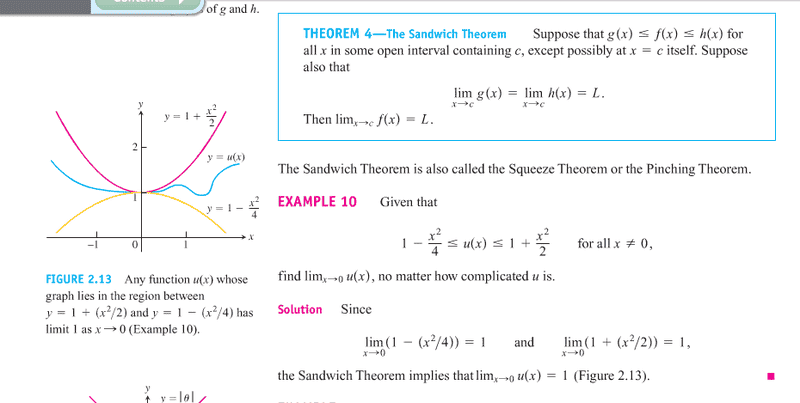
This is from a textbook but it is not a homework problem, it's an example following the introduction of the "Sandwich Theorem".

It says "for all x ≠ 0", but then it appears to assume that x = 0 when it finds the limits of g(x) and h(x). Clearly 1 ≤ u(x) ≤ 1 means u(x) = 1, I don't dispute that. I'm just confused as to why they plugged 0 into x after saying that x was not zero. It's more than likely that I'm just reading it incorrectly.. so.. what am I missing?
pWhmz.png
 
Physics news on Phys.org
Mholnic- said:
This is from a textbook but it is not a homework problem, it's an example following the introduction of the "Sandwich Theorem".

It says "for all x ≠ 0", but then it appears to assume that x = 0 when it finds the limits of g(x) and h(x). Clearly 1 ≤ u(x) ≤ 1 means u(x) = 1, I don't dispute that. I'm just confused as to why they plugged 0 into x after saying that x was not zero. It's more than likely that I'm just reading it incorrectly.. so.. what am I missing?

pWhmz.png


Where exactly in that page do you see x=0 being plugged somewhere??

DonAntonio
 
You know that if a function f is continuous, then you can find limits with plugging in values in the function.

So, we have that if f is continuous at 0, then

\lim_{x\rightarrow 0}{f(x)}=f(0)

This explains the two limits in the end.

However, when writing the expression

\lim_{x\rightarrow 0}{u(x)}

and if u is not continuous in 0 then the values of u(x) (with x nonzero) have nothing to do with u(0). In fact, u(0) could be 2 or 4 or 1234, the limit would stay the same after all.

Actually, the limit signifies what the function value of u(0) would be if the function were continuous.

So, if we demand that

f(x)\leq u(x)\leq g(x)

for all nonzero x, then we do that because the value in 0 doesn't matter anyway for the limit. It is only if the function is continuous that it matters.
 
@Don:

I'm assuming that the only way 1-(x^2/4) can be equal to 1 is if you assume x=0. I'm also assuming that you have to make x=0 for 1+(x^2/2) equal to 1. Like I said I'm probably grossly misunderstanding some part of this, which is why I'm asking the question. xD From my novice point of view it looks as if they're saying that x can't equal 0 and then plugging 0 into x to make g(x) and h(x) both equal to 1. Then using the theorem to make u(x) equal to 1.

So it looks like they're putting 0 into X when they calculate the two limits under the red "Solution".
 
Mholnic- said:
Like I said I'm probably grossly misunderstanding some part of this, which is why I'm asking the question.
You are misunderstanding the concept of limits.

Suppose this function u(x) is defined by
<br /> u(x) = \begin{cases} 1 &amp; x\ne 0 \\ 42 &amp; x = 0\end{cases}<br />Note that for all x≠0 we have 1-\frac{x^2} 4 \le u(x) \le 1+\frac{x^2} 2, just as the discussion in the text states. The squeeze theorem says that \lim_{x\to 0} u(x)=1 -- does this mean u(0)=1? No. u(0) obviously is not 1, by definition. Note that the result from the squeeze theorem is exactly what results from applying the definition of the limit to the definition of u(x) itself.
 
here is my attempt:
 

Attachments

I more than readily admit that some aspects of limits escape me -- I can solve them but my intuitive grasp of them is rusty at best. Where I initially became confused was from seeing "Since limx →0 (1 - (x2/4) = 1". I look at that and think "Hey! They put in 0!"

I'll take a look at that, Mathwonk, thanks.

I'm 4 days into my summer calc I course.. 2 more class periods left before the first test, so we're getting the material at a firehose pace. Trying to keep from developing bad habits, or it'll kill me in the fall.
 
Mholnic- said:
I more than readily admit that some aspects of limits escape me -- I can solve them but my intuitive grasp of them is rusty at best. Where I initially became confused was from seeing "Since limx →0 (1 - (x2/4) = 1". I look at that and think "Hey! They put in 0!"

And you are right, they did put in 0! The reason that you can do this is that

f(x)=1-\frac{x^2}{4}

is continuous.
 
A very basic and very important theorem about limits that beginning students often overlook is:
If f(x)= g(x) for all x except x= a, then lim_{x\to a}f(x)= \lim_{x\to a}g(x).

(The definition of \lim_{x\to a} f(x)= L is, remember, "Given any \epsilon&gt; 0, there exist \delta&gt; 0 such that if 0&lt; |x- a|&lt; \delta then |f(x)- L|&lt; \epsilon."

Notice the "0< " in 0&lt; |x- a|&lt; \delta. That, unfortunately is often neglected. I know I often forget to write it!)

That is why, to find
\lim_{x\to 2}\frac{x^2- 4}{x- 2}
we can note that for x any number except 2,
\frac{x^2- 4}{x- 2}= x+ 2.

They have the same value every where except at x= 2 so they have the same limit there. It is easy to see that \lim_{x\to 2} x+ 2= 4 so that is the other limit also.
 

Similar threads

  • · Replies 9 ·
Replies
9
Views
3K
  • · Replies 6 ·
Replies
6
Views
3K
  • · Replies 10 ·
Replies
10
Views
3K
  • · Replies 3 ·
Replies
3
Views
2K
  • · Replies 6 ·
Replies
6
Views
3K
  • · Replies 3 ·
Replies
3
Views
3K
  • · Replies 19 ·
Replies
19
Views
4K
  • · Replies 25 ·
Replies
25
Views
4K
  • · Replies 7 ·
Replies
7
Views
2K
  • · Replies 5 ·
Replies
5
Views
3K