Conservation of angular momentum

Click For Summary
SUMMARY

The discussion centers on calculating the angular velocity of a system consisting of a homogeneous disc and a particle after a collision. The disc has a mass of 1.78 kg and a radius of 0.547 m, while the particle has a mass of 0.311 kg and an initial velocity of 103 m/s. The correct approach involves using the conservation of angular momentum, where the initial angular momentum of the particle is given by L = mvR, and the final angular momentum of the system is (I_d + I_p)ω. The calculations reveal that the final angular velocity (ω) is 17.8 rad/s, confirming the importance of using the correct moment of inertia for the particle.

PREREQUISITES
  • Understanding of angular momentum and its conservation principles
  • Familiarity with moment of inertia calculations for rigid bodies
  • Knowledge of basic collision mechanics in physics
  • Ability to perform vector cross product calculations
NEXT STEPS
  • Study the conservation of angular momentum in more complex systems
  • Learn about moment of inertia for various shapes and configurations
  • Explore the effects of different types of collisions on angular momentum
  • Investigate the role of torque in rotational dynamics
USEFUL FOR

This discussion is beneficial for physics students, educators, and anyone interested in understanding rotational dynamics and angular momentum conservation in mechanical systems.

WonderKitten
Messages
4
Reaction score
1
Hi, I have the following problem:
A homogeneous disc with M = 1.78 kg and R = 0.547 m is lying down at rest on a perfectly polished surface. The disc is kept in place by an axis O although it can turn freely around it.
A particle with m = 0.311 kg and v = 103 m/s, normal to the disc's surface at the point of contact.
After the collision, the particle stays stuck to the impact point O'.
What's the angular velocity of the system after the collision?
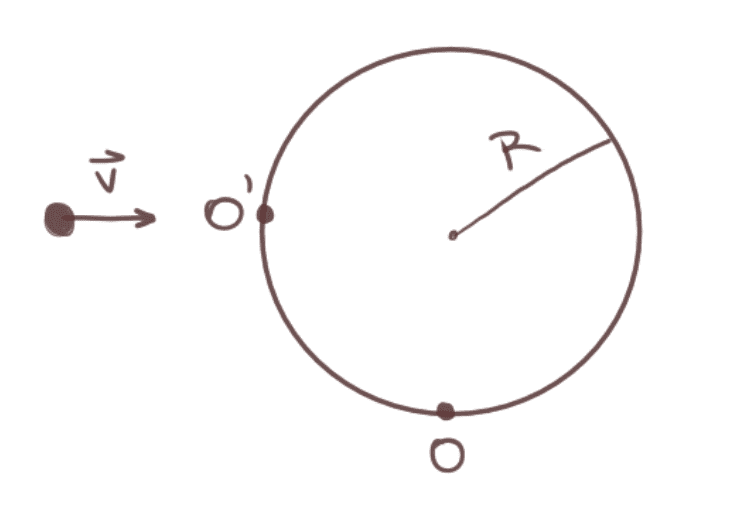
1.problemafisica.png

It might be a bit confusing as I had to translate the problem, sorry about that. I'm not entirely sure if the disc is rotating on it's x-axis or z-axis (y-axis?), and by the particle being 'normal to the disc's surface' I think it means it's perpendicular to the disc? Not sure what I should do with this information.

So, since the axis of rotation isn't on the center of mass:
I (disc) = MR²/2 + MR² = 3MR²/2
The distance from O' to O: (using pythagoras)
r = 0.774
I (particle) = mr²

Ip * vR = - (Id + Ip) * wf
solving for wf and substituting the values I get wf = -10.6.

This is wrong, apparently. Not sure why, I'm out of ideas. Could someone help me out? Thanks!

[Moderator's note: Moved from a technical forum and thus no template.]
 
Last edited by a moderator:
Physics news on Phys.org
Your method is correct, recheck your calculations. I got a different answer. Also, why the negative sign? If your repeated calculation returns the same answer, please post it in more detail.

The disk is rotating about point O in the plane of the screen. The particle collides with the disk in a direction perpendicular to the rim, i.e. the velocity is directed towards the center of the disk. This allows you to write the angular momentum of the particle relative to point O as ##L=mvR## which I think is what you have done, but I am not sure.
 
Last edited:
  • Like
Likes   Reactions: WonderKitten
When the particle hits the disc it will begin rotating in the clockwise direction, that's why it's negative.
As for the calculations:
Ip = mr² = 0.186
Id = 3MR²/2 = 0.799
Ip + Id = 0.985
Ip * vR / Ip + Id = 10.6

If I use mVR = (Ip+Id)wf (as suggested by someone)
I get 17.8... but shouldn't I use 'mr²' instead of 'm'?
Thanks

Just saw your edit and I think that's it then? Thanks for the explanation on why it's mvR, got it.
 
Last edited:
WonderKitten said:
get 17.8... but shouldn't I use 'mr²' instead of 'm'?
That's the number I got. Use mr2 instead of m in what expression? Angular momentum conservation says $$L_{\mathrm{before}}=L_{\mathrm{after}}$$ where$$L_{\mathrm{before}}=mvR; ~~L_{\mathrm{after}}=(I_d+I_p)\omega~~ \text{with} ~~I_d=\frac{3}{2}MR^2~~\text{and } I_p=m(2R^2).$$Perhaps you missed the point that the angular momentum of a particle is, by definition, the cross product ##\vec L =\vec r \times \vec p##, See here for example. In the present case, ##r ~\sin\theta =\text{constant}=R.##
 
Last edited:
kuruman said:
Perhaps you missed the point that the angular momentum of a particle is, by definition, the cross product ##\vec L =\vec r \times \vec p##, See here for example. In the present case, ##r ~\sin\theta =\text{constant}=R.##
Yep, that was it. Thank you!
 

Similar threads

  • · Replies 17 ·
Replies
17
Views
925
  • · Replies 3 ·
Replies
3
Views
2K
Replies
335
Views
16K
  • · Replies 20 ·
Replies
20
Views
2K
  • · Replies 7 ·
Replies
7
Views
2K
Replies
17
Views
2K
Replies
26
Views
1K
  • · Replies 5 ·
Replies
5
Views
2K
Replies
5
Views
1K
  • · Replies 6 ·
Replies
6
Views
3K