Conservation of energy of two blocks

Click For Summary

Homework Help Overview

The problem involves two blocks connected to a spring, focusing on the conservation of energy principles. Participants are tasked with determining the kinetic energy of the blocks at a specific distance fallen and the maximum distance the hanging block falls before stopping.

Discussion Character

  • Exploratory, Conceptual clarification, Assumption checking

Approaches and Questions Raised

  • Participants discuss the application of gravitational potential energy and spring potential energy in solving for kinetic energy. There are inquiries about how to calculate velocity and the relationship between energy types.

Discussion Status

Some participants have provided attempts at solutions for parts A and B, while others express confusion regarding the calculations and the interpretation of energy conservation in part C. There is a recognition of differing understandings regarding the maximum distance the block falls, with some participants questioning the validity of the stated answer.

Contextual Notes

Participants are navigating through the constraints of the problem, including the assumptions of frictionless surfaces and the nature of energy transformations. There is also a note about the age of the thread, which may affect the relevance of responses.

iamkristing
Messages
33
Reaction score
0
[SOLVED] conservation of energy

Homework Statement


Two blocks, of masses M = 1.9 kg and 2M are connected to a spring of spring constant k = 220 N/m that has one end fixed, as shown in the figure below. The horizontal surface and the pulley are frictionless, and the pulley has negligible mass. The blocks are released from rest with the spring relaxed.

(a) What is the combined kinetic energy of the two blocks when the hanging block has fallen a distance of 0.090 m?
J

(b) What is the kinetic energy of the hanging block when it has fallen that 0.090 m?
J

(c) What maximum distance does the hanging block fall before momentarily stopping?
m
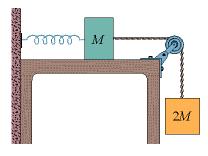
W0155-N.jpg


Homework Equations


k=(1/2)mv^2
u=mgh

ki + ui = kf + uf

The Attempt at a Solution


I solved A using u(grav) =kf +us and got 2.7 J
For B i got 1.8 J

C is where I have a problem. I know the kinetic energy must equal zero and somehow you find the height from u=mgh. I just can't seem to connect the two...
 
Last edited by a moderator:
Physics news on Phys.org
iamkristing said:
C is where I have a problem. I know the kinetic energy must equal zero and somehow you find the height from u=mgh. I just can't seem to connect the two...
The change in energy must be zero. You start with gravitational PE, which gets converted to spring PE.


iamkristing said:


Homework Equations


k=(1/2)mv^2
u=mgh

ki + ui = kf + uf

The Attempt at a Solution


I solved A using u(grav) =kf +us and got 2.7 J
For B i got 1.8 J

C is where I have a problem. I know the kinetic energy must equal zero and somehow you find the height from u=mgh. I just can't seem to connect the two...


For part A, when you say you used Ugrav = final kinetic energy + Spring potential energy, could you please elaborate as to how that was accomplished? If final kinetic energy is 0.5*mass*velocity, how did you calculate velocity?

For part B, I run into the same roadblock, the veocity.

For C, I don't understand how the distance is 0. The answer is supposed to be 0.39m (I'm referring to the answsers in the back.

I apologise for asking so much, but I would really like to understand how this problem is solved. Thank you in advance.

EDIT: Just realized that the thread is about a year old! I apologise for that...
 
Last edited:


iceman2048 said:
For part A, when you say you used Ugrav = final kinetic energy + Spring potential energy, could you please elaborate as to how that was accomplished? If final kinetic energy is 0.5*mass*velocity, how did you calculate velocity?

For part B, I run into the same roadblock, the veocity.
For both A and B you are solving for the final kinetic energy.

For C, I don't understand how the distance is 0. The answer is supposed to be 0.39m (I'm referring to the answsers in the back.
The distance is not zero. (That earlier post of mine states that the change in energy is zero, not the distance. That's just a statement of energy conservation.)
EDIT: Just realized that the thread is about a year old! I apologise for that...
Yeah, it generally doesn't make sense to respond to an old post... but here we are!
 

Similar threads

Replies
24
Views
4K
  • · Replies 12 ·
Replies
12
Views
3K
  • · Replies 1 ·
Replies
1
Views
2K
Replies
1
Views
1K
Replies
17
Views
2K
Replies
30
Views
2K
  • · Replies 1 ·
Replies
1
Views
6K
Replies
8
Views
6K
  • · Replies 12 ·
Replies
12
Views
2K
  • · Replies 33 ·
2
Replies
33
Views
4K