Conservation of Momentum in a Moving System

  • Thread starter Thread starter kbyws37
  • Start date Start date
  • Tags Tags
    Car
Click For Summary
SUMMARY

The discussion centers on the conservation of momentum in a moving system, specifically involving a marksman on a railroad car who fires a bullet at a 30.0° angle. The bullet's speed is 175 m/s and its mass is 0.0110 kg. After firing, the marksman and the car move to the left at a speed of 1.20 x 10⁻³ m/s. The conservation of momentum equation is applied, leading to the conclusion that the horizontal component of the bullet's momentum must be calculated using trigonometric functions to find the mass of the man and the car.

PREREQUISITES
  • Understanding of conservation of momentum principles
  • Basic knowledge of trigonometric functions (sine, cosine)
  • Familiarity with vector components in physics
  • Ability to solve equations involving multiple variables
NEXT STEPS
  • Study the application of conservation of momentum in two-dimensional systems
  • Learn how to resolve vectors into components using trigonometric functions
  • Explore examples of momentum conservation in projectile motion
  • Investigate the effects of external forces on momentum conservation
USEFUL FOR

Physics students, educators, and anyone interested in understanding the principles of momentum conservation in dynamic systems.

kbyws37
Messages
67
Reaction score
0
A marksman standing on a motionless railroad car fires a gun into the air at an angle of 30.0° from the horizontal (the figure below). The bullet has a speed of 175 m/s (relative to the ground) and a mass of 0.0110 kg. The man and car move to the left at a speed of 1.20 10−3 m/s after he shoots. What is the mass of the man and car?
[Hint: A component of a system's momentum along an axis is conserved if the net external force acting on the system has no component along that axis.]
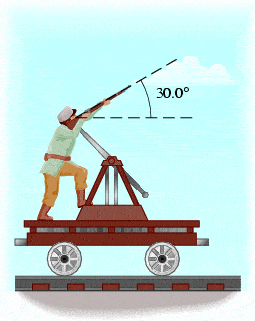
fig026.gif


I know that Pi = Pf where there is conservation of momentum.

so M1V1i + M2V2i = M1V1f + M2V2f
0 = M1V1f + M2V2f

but I'm not sure what numbers to plug in because there is also an angle involved.
 
Physics news on Phys.org
kbyws37 said:
A marksman standing on a motionless railroad car fires a gun into the air at an angle of 30.0° from the horizontal (the figure below). The bullet has a speed of 175 m/s (relative to the ground) and a mass of 0.0110 kg. The man and car move to the left at a speed of 1.20 10−3 m/s after he shoots. What is the mass of the man and car?
[Hint: A component of a system's momentum along an axis is conserved if the net external force acting on the system has no component along that axis.]

fig026.gif


I know that Pi = Pf where there is conservation of momentum.

so M1V1i + M2V2i = M1V1f + M2V2f
0 = M1V1f + M2V2f

but I'm not sure what numbers to plug in because there is also an angle involved.

Use the horizontal component of the bullet (it will involve a trig function [sin, cos, or tan] of the angle).
 
thanks! i got the correct answer. :)
 

Similar threads

Replies
10
Views
3K
  • · Replies 4 ·
Replies
4
Views
2K
Replies
8
Views
2K
  • · Replies 3 ·
Replies
3
Views
2K
  • · Replies 3 ·
Replies
3
Views
4K
  • · Replies 6 ·
Replies
6
Views
2K
  • · Replies 1 ·
Replies
1
Views
3K
  • · Replies 2 ·
Replies
2
Views
1K
  • · Replies 1 ·
Replies
1
Views
1K
  • · Replies 13 ·
Replies
13
Views
4K