Conservative force pairs

Click For Summary
SUMMARY

The discussion centers on the nature of conservative force pairs in a system of N point particles, specifically addressing why the partial derivative of the potential V with respect to the position x_k of the particle receiving the force is utilized. The participants clarify that in two-body forces, x_k represents the field coordinate while x_i denotes the source coordinate. The potential V is defined to reflect the work done on a particle, which is directly related to the force acting on it and its displacement. The conclusion emphasizes that the definition of V necessitates differentiation with respect to the position of the particle experiencing the force.

PREREQUISITES
  • Understanding of conservative forces in physics
  • Familiarity with Newtonian mechanics and point particle systems
  • Knowledge of vector calculus, specifically gradients
  • Basic concepts of potential energy and work done on particles
NEXT STEPS
  • Study the mathematical formulation of conservative forces in classical mechanics
  • Explore the implications of Galilean invariance in Newtonian physics
  • Learn about the derivation and applications of potential energy functions in multi-particle systems
  • Investigate the relationship between force, potential energy, and work in various physical contexts
USEFUL FOR

Physics students, researchers in classical mechanics, and anyone interested in the mathematical foundations of force interactions in multi-body systems.

Hajarmq
Messages
8
Reaction score
1
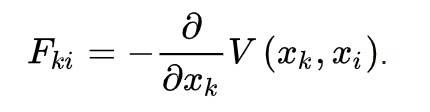
Let F_ki be the force applied by a point mass i on a point mass k. This force depends on the variables x_k and x_i which are the position vectors of respectively k and i (to simplify let´'s consider this in 1 dimension). Suppose this force is conservative. Then, according to my course and wikipedia, it can be written as:
Unbenannt.jpg
My question is: why is the partial derivative with respect to x_k, the coordinate of the point mass the force is applied on? Why not x_i, or both x_i and x_k, since the potential depends on both of them?
 
Last edited by a moderator:
Physics news on Phys.org
By definition the force on a particle is, for a conservative force, given as the gradient of a potential wrt. the position of that particle.

If you have a socalled two-body force, the potential for a system of ##N## point particles is given by
$$V(\vec{x}_1,\ldots,\vec{x}_2)=\sum_{j<k} V_{jk}(\vec{x}_j,\vec{x}_k).$$
The force on the ##i##-th particle then is
$$\vec{F}_i=-\vec{\nabla} V(\vec{x}_1,\ldots,\vec{x}_N)=-\sum_{k \neq i} \vec{\nabla}_i V_{ik}(\vec{x}_i,\vec{x}_k).$$
 
vanhees71 said:
By definition the force on a particle is, for a conservative force, given as the gradient of a potential wrt. the position of that particle.

If you have a socalled two-body force, the potential for a system of ##N## point particles is given by
$$V(\vec{x}_1,\ldots,\vec{x}_2)=\sum_{j<k} V_{jk}(\vec{x}_j,\vec{x}_k).$$
The force on the ##i##-th particle then is
$$\vec{F}_i=-\vec{\nabla} V(\vec{x}_1,\ldots,\vec{x}_N)=-\sum_{k \neq i} \vec{\nabla}_i V_{ik}(\vec{x}_i,\vec{x}_k).$$
I think the answer is a bit more subtle. In two-body forces one body is at the "source" (primed) coordinates and the other is at the "field" (unprimed) coordinates. Then one writes,$$V[(\vec{x}_1-\vec{x}'_1),\ldots,(\vec{x}_N-\vec{x}'_N)]=\sum_{j<k} V_{jk}[(\vec{x}_j-\vec x'_j),(\vec{x}_k-\vec x'_k)].$$In order to find the force on the ##i##th particle, derivatives need to be taken with respect to the unprimed field coordinates where the particle is.

In OP's equation ##x_k## is the field coordinate and ##x_i## the source coordinate. If this equation is in OP's course notes and Wikipedia (reference?), the meaning of the coordinates must have been given.
 
Hajarmq said:
why is the partial derivative with respect to x_k, the coordinate of the point mass the force is applied on? Why not x_i, or both x_i and x_k, since the potential depends on both of them?
As mentioned above this is basically how ##V## is defined. To motivate that definition, let’s think about what we want ##V## to do.

We want the potential to tell us the work done on a particle. The work done on a given particle is given by ##\vec F \cdot \Delta\vec x## where ##\vec F## is a force acting on the given particle and ##\Delta\vec x## is the displacement of that particle.

So the work done on a particle is given by the force on that particle and the displacement of that particle. Therefore, the partial derivative in the definition of ##V## should be with respect to the position of the particle that the force is acting on, which is ##x_k##
 
  • Like
Likes   Reactions: Hajarmq
kuruman said:
I think the answer is a bit more subtle. In two-body forces one body is at the "source" (primed) coordinates and the other is at the "field" (unprimed) coordinates. Then one writes,$$V[(\vec{x}_1-\vec{x}'_1),\ldots,(\vec{x}_N-\vec{x}'_N)]=\sum_{j<k} V_{jk}[(\vec{x}_j-\vec x'_j),(\vec{x}_k-\vec x'_k)].$$In order to find the force on the ##i##th particle, derivatives need to be taken with respect to the unprimed field coordinates where the particle is.

In OP's equation ##x_k## is the field coordinate and ##x_i## the source coordinate. If this equation is in OP's course notes and Wikipedia (reference?), the meaning of the coordinates must have been given.
There are ##N## point particles, and the forces in Newtonian mechanics only depend on the positions of these ##N## point particles. What should thus the primed position vectors mean?

Of course you are right. Taking Galilei invariance of Newtonian spacetime into account the two-body forces must be central forces, i.e.,
$$V_{jk}(\vec{x}_j,\vec{x}_k)=V_{jk}(|\vec{x}_j-\vec{x}_k|)$$
due to homogeneity and isotropu of space. That the ##V_{jk}## also don't depend on ##t## is due to time-translation invariance.
 
  • Like
Likes   Reactions: Hajarmq

Similar threads

  • · Replies 9 ·
Replies
9
Views
3K
  • · Replies 52 ·
2
Replies
52
Views
4K
  • · Replies 77 ·
3
Replies
77
Views
6K
  • · Replies 14 ·
Replies
14
Views
1K
  • · Replies 24 ·
Replies
24
Views
2K
  • · Replies 14 ·
Replies
14
Views
2K
  • · Replies 9 ·
Replies
9
Views
2K
  • · Replies 12 ·
Replies
12
Views
1K
  • · Replies 53 ·
2
Replies
53
Views
5K
  • · Replies 3 ·
Replies
3
Views
3K