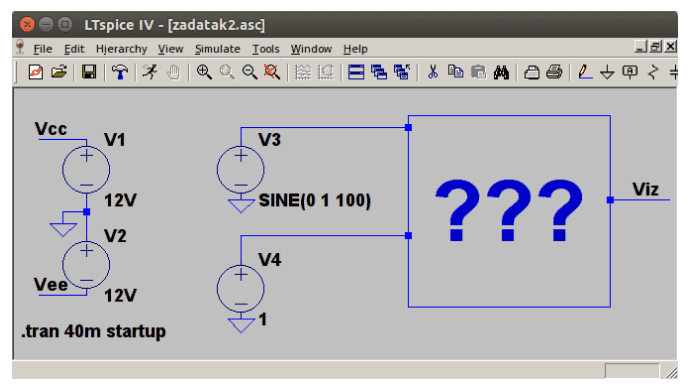
Construct Opamp circuit for given inputs and output

Click For Summary

Discussion Overview

The discussion revolves around constructing an operational amplifier (opamp) circuit that utilizes +12V and -12V power supplies to achieve a specified output voltage. Participants explore various configurations, including the use of multiple opamps versus a single opamp, and delve into the mathematical relationships and units involved in the circuit design.

Discussion Character

  • Technical explanation
  • Mathematical reasoning
  • Debate/contested
  • Experimental/applied

Main Points Raised

  • One participant describes a solution using four opamps, detailing their functions in scaling, integrating, summing, and inverting voltages.
  • Another participant questions the interpretation of the factor “–1/100ms” in the equation for Viz, suggesting it may represent a rate of change.
  • Concerns are raised about the units involved in the integration process and how they relate to the circuit's functionality.
  • A participant proposes a single opamp solution and provides a schematic, while expressing confusion about the units of the second term in the equation.
  • Discussion includes the calculation of resistor values based on capacitance and time constants, with varying interpretations of the necessary conditions for the circuit.
  • Participants discuss the implications of using low-value resistors and high capacitance in terms of current flow and stability.
  • There is a mention of the need for initial conditions in the circuit and considerations regarding real-world applications, such as stray capacitance and the behavior of potential dividers.
  • Several participants correct each other regarding the interpretation of the time constant and its implications for circuit design.
  • LTspice simulations are shared, with participants noting discrepancies in output voltages and discussing the implications of these results.

Areas of Agreement / Disagreement

Participants express differing views on the best approach to solve the circuit problem, with some advocating for a single opamp solution while others support the multi-opamp configuration. There is no consensus on the interpretation of certain terms and units, and the discussion remains unresolved regarding the optimal design and calculations.

Contextual Notes

Participants highlight limitations in understanding the units and assumptions underlying the mathematical relationships in the circuit design. The discussion also reflects dependencies on specific component values and configurations that may affect the overall performance of the circuit.

Who May Find This Useful

Readers interested in operational amplifier circuit design, mathematical modeling of electronic components, and practical applications of circuit theory may find this discussion valuable.

etf
Messages
179
Reaction score
2
Here is my task:

Construct circuit ? which uses power supplies +12V and -12V and gives output voltage:

51trpt.jpg


where

2s6oxgk.png


Here is circuit:

12153dj.png


I solved it using 4 opamps:

First opamp scales V3, second integrates V4, third sums the results of the prior two circuits and fourth inverts signs in sum (output of third opamp). Can this problem be solved using single opamp?
 
Last edited:
Engineering news on Phys.org
How do you interpret the factor “ –1/100ms ” in the equation for Viz ? “ –(1/100) ms ” ?

The LTspice schematic "filename.asc" is a text file.
You can append a .txt extension to make "filename.asc.txt" and attach it to your post.
 
  • Like
Likes   Reactions: etf
To be honest, I don't know exactly what they mean with ms.
 
Because dt is time, the integral of a constant voltage is a ramp with units of volts * time.
Before summing as a voltage it must be converted to the same dimensions, by multiplication by 1 / time.

Maybe the constant of integration is –1k / (100* sec) = – 10 / sec = – 10 * sec-1 ?

The op-amp sums a ramp with a sinewave, then inverts the result. Can V4= +1V be a floating voltage source ?
 
  • Like
Likes   Reactions: etf
I don't think they made mistake in original formulation...
I solved it using single opamp. Here is schematic:

singl.png


Here is relation for V1 (Viz in original formulation):

resenje.png

We can choose now C1 and C2 so C1 / C2 = 2 (for example C1= 2*470uF, C2=470uF), but I'm confused about second term, more precisely, about units.
 
If we solve equation R1[Ohm]*C2[Farad]=10*10^{}(-3)[seconds] for R1, we get:
R1 = \frac{10*10^{}(-3)[seconds]}{470*10^{}(-6)[F]} = 21.2766 [\frac{seconds}{Farads}] ?
 
Last edited:
Well done. Seems like a sensible solution.
There needs to be initial conditions of V3 = Vc1 = Vc2 = zero.

The mention of +/– 12V supplies suggests the real world. That may require a low value resistor be switched across C2 to bring the output back up to zero following an integration.

Most people do not consider potential dividers made out of capacitors, probably because stray capacitance becomes a problem when the signal currents are minimised. Oscilloscopes often use a resistance of 1M with about 12pF of parallel capacitance. For a broad band flat response, all R||C elements of the divider need to have the same time constant.
 
  • Like
Likes   Reactions: etf
etf said:
We can choose now C1 and C2 so C1 / C2 = 2 (for example C1= 2*470uF, C2=470uF), but I'm confused about second term, more precisely, about units.
-1/100ms. The units are reciprocal seconds which will cancel with the ( integrated V .dt ) = volts * seconds

The coefficient wanted is -1 / (R1 * C1)
Therefore R1*C1 = 100 m = 0.1
If C2 = 470 uF, and C1 = (470 + 470) uF
Since R1 * C1 = 0.1
R1 = 0.1 / C1 = 106.38 ohms

But that low resistance and huge capacitance will require very high currents.

Use 3 identical capacitors from the same batch to make the two capacitors needed.
Make the 2*C by paralleling two, as series connection reduces capacitance and so wastes space and dollars.

Use the smallest cap that will work with R1 = 100k. Above 100k, surface leakage starts to become important.
So now scale the capacitance by a factor of 1000 to get smaller stable capacitors of say; 940 nF and 470 nF.
R1 is now 0.1 / 0.940u
R1 = (0.1/0.940) Meg ohm
R1 = 106.38 k ohm.
The integration current has fallen from 10 mA to 10 uA. That's better.

But what is the order of magnitude of the current through the capacitive potential divider ?
C = Q / V; Q = I * t; C = I * t / V; therefore C = I * t / V; I = C * V / t
For C = 1uF, t = 1/100 sec and V = 2 we get I = 200uA which is now OK.
Add half more again for the output side; 300 uA. That is certainly better than 300mA.
 
  • Like
Likes   Reactions: etf
Attached is the LTspice simulation. Not sure why the output starts at -3V.
 

Attachments

  • #10
Baluncore said:
-1/100ms
You mean -1/10ms ?
 
  • #11
etf said:
You mean -1/10ms ?
You are correct. I should have checked the OP.
Everything I did needs to be recalculated, but I know you know what you are doing, because you picked up my error.
 
  • Like
Likes   Reactions: etf
  • #12
Attached is the LTspice simulation. Output now starts at 0V.
 

Attachments

  • #13
Thanks a lot!
 

Similar threads

Replies
3
Views
2K
  • · Replies 47 ·
2
Replies
47
Views
5K
  • · Replies 7 ·
Replies
7
Views
2K
  • · Replies 15 ·
Replies
15
Views
5K
  • · Replies 2 ·
Replies
2
Views
1K
  • · Replies 12 ·
Replies
12
Views
3K
Replies
2
Views
2K
  • · Replies 1 ·
Replies
1
Views
3K
  • · Replies 1 ·
Replies
1
Views
3K
  • · Replies 38 ·
2
Replies
38
Views
5K