Contact and electromagnetic force

Click For Summary
SUMMARY

The discussion centers on the concept of contact forces, specifically friction and normal forces, and their relationship to Newton's second law, expressed as ∑F = ma. Contact forces arise from direct physical interactions between surfaces, while gravity and electromagnetic forces are classified as non-contact forces. The participants clarify that the resultant contact force is the vector sum of all contact forces acting on an object, including friction and normal forces. Misunderstandings regarding the definitions and relationships of these forces are addressed, emphasizing that friction can exist without an applied force.

PREREQUISITES
  • Understanding of Newton's laws of motion, particularly Newton's second law (∑F = ma).
  • Familiarity with the concepts of friction and normal forces in physics.
  • Knowledge of vector addition and resultant forces.
  • Basic understanding of contact versus non-contact forces.
NEXT STEPS
  • Study the mathematical derivation of contact forces, including friction and normal components.
  • Explore the implications of static and kinetic friction coefficients in real-world applications.
  • Learn about the role of electromagnetic forces in contact interactions at the atomic level.
  • Investigate examples of contact forces in various physical scenarios, such as inclined planes and frictionless surfaces.
USEFUL FOR

Students of physics, educators teaching mechanics, and anyone interested in understanding the principles of forces and motion in physical systems.

  • #31
rudransh verma said:
Well It should be 700N since friction is zero(Standing), not ##mumg##
Yes, 700N. But putting the values into your formula gives ##F_c = 700\sqrt{1+0.5^2} = 783N## approx, which is clearly wrong.

Call the normal reaction ##F_n## (you are using ##F_n=mg##).

It is important to realize that ##\mu_sF_n## does not give the frictional force except in special circumstances.

Do you know under what special circumstances the frictional force is ##\mu_sF_n##?

(By the way, I think @kuruman is raising a different, but important, issue in Post #30.)

And note that to get the Greek letter ##\mu## in LaTeX, use \mu.
 
  • Like
Likes   Reactions: rudransh verma and jbriggs444
Physics news on Phys.org
  • #32
kuruman said:
OK, that is correct. Now suppose you weigh 700 N and you stand at rest on a rough plane inclined at 12° relative to the horizontal. What is the contact force on you in this case? Give magnitude and direction.
3796.15 N
90.5 degrees
 
  • #33
rudransh verma said:
3796.15 N
90.5 degrees
Simpler than that. Way simpler.

You have a 700 N man exerting a 3796.15 N force. Nice trick if you can pull it off.
 
  • Wow
  • Like
Likes   Reactions: Steve4Physics and kuruman
  • #34
rudransh verma said:
3796.15 N
90.5 degrees
Huh? Think again. This is a teaching moment. There are two forces acting on you, your weight exerted by the Earth and the contact force exerted by the incline. They add up to zero because you are rest and remain at rest. So ##\dots##
 
  • Like
Likes   Reactions: Steve4Physics and jbriggs444
  • #35
kuruman said:
Huh? Think again. This is a teaching moment. There are two forces acting on you, your weight exerted by the Earth and the contact force exerted by the incline. They add up to zero because you are rest and remain at rest. So ##\dots##
The contact force namely the resultant of friction and normal should be same and opposite to our weight. So 700N opposite of gravity.
We can also say the vector sum of gravity, normal and friction should be zero for the body to remain at rest.
 
  • Like
Likes   Reactions: Steve4Physics
  • #36
rudransh verma said:
The contact force namely the resultant of friction and normal should be same and opposite to our weight. So 700N opposite of gravity.
We can also say the vector sum of gravity, normal and friction should be zero for the body to remain at rest.
Very good. You got it. There is only one contact force exerted by the incline and it has components like any other force. Its component perpendicular to the incline is also called the normal force and its component parallel to the incline is also called friction.
 
  • Like
  • Love
Likes   Reactions: rudransh verma and jbriggs444
  • #37
kuruman said:
Very good. You got it. There is only one contact force exerted by the incline and it has components like any other force. Its component perpendicular to the incline is also called the normal force and its component parallel to the incline is also called friction.
But why I got the wrong result. I broke the three forces in components and added the all vertical components. Similarly added all the horizontal ones. Got two eqns. Solved. But got Fn and f such that the resultant is some way more than 700N.
 
  • #38
rudransh verma said:
But why I got the wrong result. I broke the three forces in components and added the all vertical components. Similarly added all the horizontal ones. Got two eqns. Solved. But got Fn and f such that the resultant is some way more than 700N.
You have posted here enough times to know that asking why you got the wrong result is insufficient. You have to show us what you did. Even though we often do a decent job as homework helpers, we suck consistently as mind readers.
 
Last edited:
  • Haha
Likes   Reactions: Steve4Physics, Doc Al and jbriggs444
  • #39
kuruman said:
You have posted here enough times to know that asking why you got the wrong result is insufficient. You have to show us what you did. Even though we often do a decent job as homework helpers, we suck consistently as mind readers.
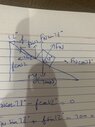
##F_N\cos78-f\cos12=0##
##F_N\sin78+f\sin12-700=0##
After solving,
##f=744 N##
##F_N=3638.5 N##
 

Attachments

  • image.jpg
    image.jpg
    34.2 KB · Views: 129
  • #40
rudransh verma said:
##F_N\cos78-f\cos12=0##
##F_N\sin78+f\sin12-700=0##
After solving,
##f=744 N##
##F_N=3638.5 N##
Let's check if that satisfies your equations:
##3638.5\sin(78°)+744\sin(12°)=3556+155=3711##.
Not 700.
You could, and should, have done that check for yourself.
Please post your working if you cannot find your mistake.
 
  • #41
haruspex said:
Let's check if that satisfies your equations:
##3638.5\sin(78°)+744\sin(12°)=3556+155=3711##.
Not 700.
You could, and should, have done that check for yourself.
Please post your working if you cannot find your mistake.
I got it! I was not multiplying by ##\cos78## to right hand side of second eqn.
I got ##F_N=762.5N##
##f=155.5N##
##F_C=778.19N## (maybe some small differences in decimal)
 
  • #42
rudransh verma said:
I got it! I was not multiplying by ##\cos78## to right hand side of second eqn.
I got ##F_N=762.5N##
##f=155.5N##
Does that satisfy your equations?
 
  • #43
haruspex said:
Does that satisfy your equations?
No! But I know it’s because I have rounded in the middle of solution. Small difference of 6 N in first eqn.
 
  • #44
rudransh verma said:
No! But I know it’s because I have rounded in the middle of solution. Small difference of 6 N in first eqn.
Your error is rather large, more than 10%. Please post your working.
 
  • #45
rudransh verma said:
I got it! I was not multiplying by ##\cos78## to right hand side of second eqn.
I got ##F_N=762.5N##
##f=155.5N##
##F_C=778.19N## (maybe some small differences in decimal)
You are trying to come up with two components which combine (via the Pythagorean theorem) to produce a sum of 700 N.

It is immediately obvious that neither component can be greater than their vector sum.
 
  • #46
haruspex said:
Please post your working.
##F_N\cos78-f\cos12=0##
##F_N\sin78+f\sin12=700##
So multiplying by sin78 in first and by cos78 in second eqn
##F_N\cos78\sin78-f\cos12\sin78=0##
##F_N\sin78\cos78+f\sin12cos78=700cos78##
On putting values of all trigonometric functions
##F_N(0.2)(0.97)-f(0.97)(0.97)=0##
##F_N(0.97)(0.2)+f(0.2)(0.2)=700(0.2)##

##f=142.72N## and ##F_N=692.19N##
Now its less than the resultant force.
But still there is a difference in the values.
 
  • #47
rudransh verma said:
##F_N\cos 78-f\cos 12=0##
##F_N\sin 78+f\sin 12=700##
So multiplying by ##\sin 78## in first and by ##\cos 78## in second eqn
##F_N\cos 78 \sin 78-f \cos12 \sin 78=0##
##F_N\sin 78 \cos 78+f \sin 12 \cos 78=700 \cos 78##
On putting values of all trigonometric functions
##F_N(0.2)(0.97)-f(0.97)(0.97)=0##
##F_N(0.97)(0.2)+f(0.2)(0.2)=700(0.2)##
[after minor repairs on your ##\LaTeX##]

Were you actually going to try to solve those equations?

The obvious next step would be to subtract the last two equations, thus arriving at an equation for ##f## alone. But if you were going to do that, it would be premature to substitute in values for the trig functions.

Although there are easier ways to break a vector into components, one can indeed do the job with simultaneous equations. Crucially, one must solve the simultaneous equations.
 
  • #48
jbriggs444 said:
Crucially, one must solve the simultaneous equations.
Indeed.
To @rudransh verma :
It would be best to not substitute numbers before solving because they often hide what is actually going and ho to take the next algebraic step. We have,
##F_N\sin\!\theta-f\cos\!\theta = 0~~~~~~~~~~(1)##
##F_N\cos\!\theta+f\sin\!\theta = W~~~~~~~~(2)##

I will follow your method and multiply the first equation by ##\cos\!\theta## and the second by ##\sin\!\theta##
##F_N\sin\!\theta\cos\!\theta-f\cos^2\!\theta = 0~~~~~~~~~~~~~~~~~(3)##
##F_N\cos\!\theta\sin\!\theta+f\sin^2\!\theta = W\sin\!\theta~~~~~~~~(4)##

As @jbriggs444 suggested, subtract equation (3) from (4) to get
##f\sin^2\!\theta+f\cos^2\!\theta=W\sin\!\theta~\implies f=W\sin\!\theta##
Finally, put this value for ##f## in either (1) or (2) to get ##F_N=W\cos\!\theta##,

You have been unable to get a reasonable answer. Why? My answer to that is that you have not yet acquired the single good habit that would limit algebraic and arithmetic mistakes and round off errors while simultaneously making it easy to troubleshoot your workings in case there is an actual mistake. That good habit is not substituting numbers until the very end.

What happened here? Not only you substituted numbers, but also you made things worse by mixing values of angles, using both 12° and 78°. I am sure you know that cos12° = sin78° but I am not sure that you would recognize on sight that (cos12°/sin78°) and (cos212° + sin278°) are both equal to 1.

I hope I have convinced you that your insistence on substituting numbers early on is actually a barrier to your ability to work out physics problems and a waste of your time. Using symbols instead of numbers makes it easier to be correct the first time around. I know that you been told that before, but here you have proof, three unsuccessful attempts at a solution, that your insistence on doing it your way does not work as well as you would want.
 
Last edited:
  • Like
Likes   Reactions: jbriggs444 and rudransh verma

Similar threads

  • · Replies 16 ·
Replies
16
Views
1K
Replies
14
Views
1K
Replies
31
Views
1K
Replies
7
Views
3K
  • · Replies 14 ·
Replies
14
Views
1K
  • · Replies 5 ·
Replies
5
Views
3K
  • · Replies 17 ·
Replies
17
Views
2K
  • · Replies 15 ·
Replies
15
Views
1K
Replies
4
Views
868
Replies
16
Views
2K