Contact pressure - screw pretension

Click For Summary
SUMMARY

The discussion focuses on calculating the maximum contact pressure in an assembly where a beam is clamped to a wall using a pretensioned screw. The key factors include ensuring the screw's tensile failure stress is not exceeded and understanding the relationship between initial friction force and lateral beam load. The contact pressure profile shifts as the pretensioned screw stretches, impacting the contact area on the wall. Proper design of the bolt's engaged thread depth is critical to prevent failure.

PREREQUISITES
  • Understanding of pretensioned screw mechanics
  • Knowledge of tensile failure stress in fasteners
  • Familiarity with contact pressure calculations
  • Basic principles of friction and load distribution in mechanical assemblies
NEXT STEPS
  • Research methods for calculating contact pressure in mechanical assemblies
  • Learn about the design principles for bolt thread engagement and tensile strength
  • Explore the effects of pretension on friction forces in clamped joints
  • Study the elastic and plastic deformation behavior of screws under load
USEFUL FOR

Mechanical engineers, structural analysts, and anyone involved in the design and analysis of bolted connections and assemblies.

carb
Messages
9
Reaction score
0
Hello,
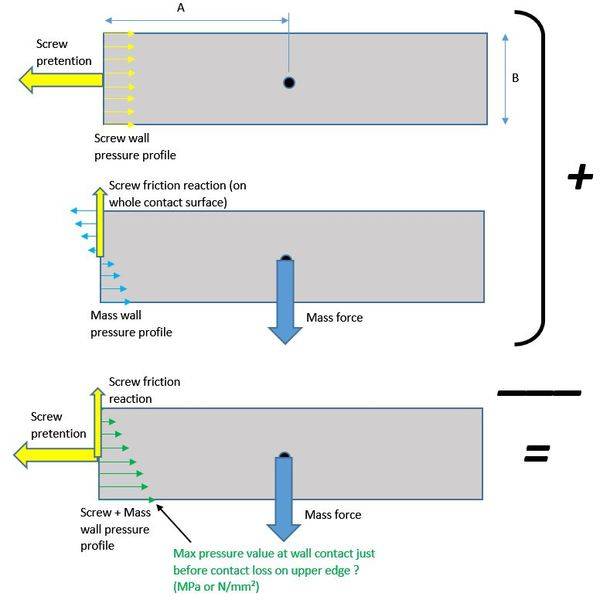
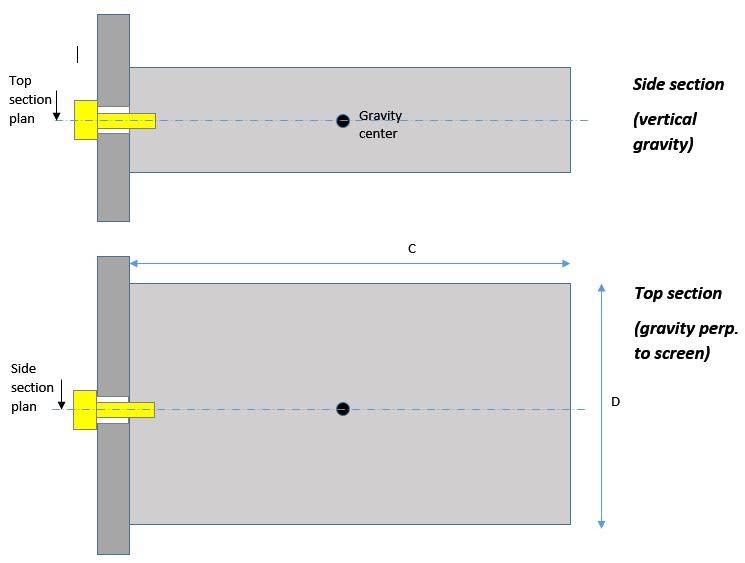
I'd like to calculate the max contact pressure in the below assembly, just before contact loss between the beam and the wall. The beam is clamped to the wall with a pretensioned screw, and sustaining a force at his gravity center.

I'm assuming all bodies dimensionnaly stable (no distorsion).

I wonder about few questions... how to calculate the maximum force at center of gravity before contact loss ? how to work out the composed pressure profile...

Here are some sketches that may help understanding the problem :
5K3J9.jpg


VZEoh.jpg


Thanks a lot for any kind of help (calculation steps...) !
 
Engineering news on Phys.org
The beam will not lose contact with the end plate until the screw exceeds its screw thread tensile failure stress (assuming the screw nut is properly sized so the thread shear failure load in the nut is greater than the tensile failure load of the screw).
As long as the initial friction force due to the pretension on the retaining screw is greater than the lateral beam load, the friction load on the end plate will remain constant but the contact pressure area on the wall will progressively move toward the bottom edge of the beam as the pretensioned screw is stretched.

Edit: In my above initial post I misspoke when I stated: (assuming the screw nut is properly sized so the thread shear failure load in the nut is greater than the tensile failure load of the screw).
That should have read: (assuming the bolt's engaged thread depth is correctly designed so the thread shear failure load of the engaged threads is greater than the tensile failure load of the screw).

An added note: The above statement about the initial preload vs friction force is correct, there are two stages of beam end to mounting plate contact loading as the bolt is stretched. Within the elastic range of the bolt stretch the beam end to mounting plate contact force; and, therefore the friction force will increase until the bolt's elastic limit is reached; which at that point, that level of increased amount of contact load will persist until the point of tensile failure of the bolt.
 
Last edited:
  • Like
Likes   Reactions: carb

Similar threads

Replies
3
Views
2K
  • · Replies 19 ·
Replies
19
Views
3K
Replies
3
Views
4K
Replies
1
Views
2K
  • · Replies 9 ·
Replies
9
Views
2K
Replies
5
Views
4K
  • · Replies 4 ·
Replies
4
Views
3K
Replies
12
Views
6K
  • · Replies 12 ·
Replies
12
Views
4K
  • · Replies 6 ·
Replies
6
Views
6K