Control Volume of single expansion ramp nozzle (SERN)

Click For Summary

Discussion Overview

The discussion revolves around the performance analysis of a single expansion ramp nozzle (SERN) using computational fluid dynamics (CFD) results, specifically focusing on the impact of control volume definitions on axial thrust calculations at varying nozzle pressure ratios (NPR). Participants explore the relationships between pressure, shear forces, and momentum balances in the context of nozzle performance.

Discussion Character

  • Technical explanation
  • Mathematical reasoning
  • Debate/contested

Main Points Raised

  • One participant describes a method to calculate stream thrust using inflow momentum and surface forces, questioning the consistency of results when using different control volumes.
  • Another participant suggests considering the pressure difference between inlet and outlet in the momentum balance.
  • Several participants discuss the distinction between static pressure and gauge pressure, emphasizing the importance of using gauge pressure for accurate force calculations on the nozzle.
  • Concerns are raised about the potential errors introduced by interpolation when calculating exit stream thrust over the defined control volume.
  • A participant notes that despite using both absolute and gauge pressures, the error in calculations remains relatively small, attributing larger discrepancies to convergence issues in CFD simulations.
  • One participant confirms that they are including momentum from the upper horizontal part of the control volume that extends beyond the physical boundary of the nozzle.

Areas of Agreement / Disagreement

Participants express differing views on the significance of control volume definitions and pressure types in their calculations. While some agree on the preference for gauge pressure, others remain uncertain about its application in the original calculations. The discussion does not reach a consensus on the best approach to defining control volumes or the impact of pressure types on results.

Contextual Notes

Participants acknowledge limitations related to the assumptions made in their calculations and the potential for errors due to interpolation and convergence issues in CFD results. The discussion highlights the complexity of accurately modeling nozzle performance and the various factors that can influence the outcomes.

obad
Messages
12
Reaction score
0
Hi guys,

I need to determine the performance of a single expansion ramp nozzle (SERN) from CFD results with different nozzle pressure ratios (NPR). For some NPR the nozzle is overexpanded and for some underexpanded.
Now the impact of the control volume definition on especially the axial thrust is confusing me a lot. I attached a sketch of the nozzle with a control volume. The blue dashed line represents my control volume and the red dashed line just the inflow plane and the nozzle surface.
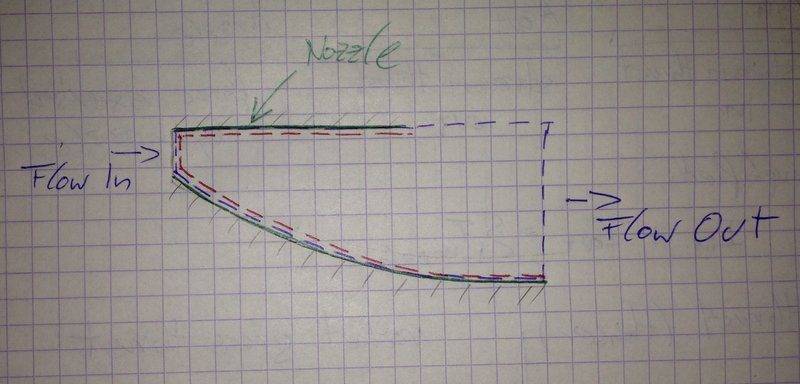
Nozzle_Sketch.jpg


Now my understanding is, that the force acting on the nozzle surface is fixed by the pressure and shear acting on it. If there is an entrainment of external air into the nozzle (e.g. due to overexpanstion), then this entrainment would change the pressure and shear distribution over the surface. Subsequently the effect of an entrainment should already be included in the surface integrals of pressure and shear. And the difference in stream thrust of an arbitrarily chosen exit control volume and the inflow stream thrust should give exactly this surface force, right?

From my CFD simulations I can easily extract the pressure and shear force that are acting on the nozzle surface and I have the inflowing momentum (stream thrust). My first thought was, to simply add up the inflowing stream thrust to the force acting on the nozzle to get the outflowing streamthrust. Subsequently I would use this exit stream thrust for the performance analysis. That worked fine.

Then I thought that if I use the control volume given in the uploaded figure (blue dashed lines) and calculate the momentum flow over the exit portion of my control volume, the difference between this exit stream thrust and my inflow stream thrust should exactly yield the force that is acting on the body of the nozzle. But the problem is, that it doesn't match...

Cheers,
Obad
 
Physics news on Phys.org
What about the contribution of the pressure difference between inlet and outlet to the momentum balance?
 
Hi,

I calculate the stream thrust in x-direction (nozzle axis) as: I = m_dot*u_x + p*A_x

So what I first did is calculating the inflow stream thrust I_in and the surface force F_nozzle. Then I can calculate the stream thrust at the outlet:
I_out = F_nozzle - I_in. In this way I don't need to make any assumptions about the control volume at the exit.

The second method that I tried (just to see if my assumption that the exit control volume can be chosen arbitrarily) was to calculate the stream thrust over my exit control volume (blue dashed) and add it to the infow stream thrust: I_in + I_out =? F_nozzle
And at this point I don't get my F_nozzle. For some NPR the difference to the integrated F_nozzle is only below 5%. For a few cases the difference is between 10-20%.

A difference of below 5% seems reasonable to me, since the calculation of I_out via the exit control volume (blue dashed) involves some interpolation that can definitely introduce some error.
 
obad said:
Hi,

I calculate the stream thrust in x-direction (nozzle axis) as: I = m_dot*u_x + p*A_x

So what I first did is calculating the inflow stream thrust I_in and the surface force F_nozzle. Then I can calculate the stream thrust at the outlet:
I_out = F_nozzle - I_in. In this way I don't need to make any assumptions about the control volume at the exit.

The second method that I tried (just to see if my assumption that the exit control volume can be chosen arbitrarily) was to calculate the stream thrust over my exit control volume (blue dashed) and add it to the infow stream thrust: I_in + I_out =? F_nozzle
And at this point I don't get my F_nozzle. For some NPR the difference to the integrated F_nozzle is only below 5%. For a few cases the difference is between 10-20%.

A difference of below 5% seems reasonable to me, since the calculation of I_out via the exit control volume (blue dashed) involves some interpolation that can definitely introduce some error.
Are you making sure you use gauge pressures, and not absolute pressures?
 
I'm using static pressure. I guess that's what you mean with gauge pressure.
 
obad said:
I'm using static pressure. I guess that's what you mean with gauge pressure.

No. Static pressure and gage pressure are difference concepts. Static pressure is the pressure you would "feel" in a fluid assuming it doesn't get disturbed by your feeling instrument. It's the pressure associated with a pressure force. What @Chestermiller is talking about is the concept of absolute and gage pressures. Absolute pressure is the true, thermodynamic pressure at some point. Gage pressure is referenced against atmosphere, i.e. it is ##p_{gage} = p_{abs} - p_{amb}##.
 
  • Like
Likes   Reactions: obad
boneh3ad said:
No. Static pressure and gage pressure are difference concepts. Static pressure is the pressure you would "feel" in a fluid assuming it doesn't get disturbed by your feeling instrument. It's the pressure associated with a pressure force. What @Chestermiller is talking about is the concept of absolute and gage pressures. Absolute pressure is the true, thermodynamic pressure at some point. Gage pressure is referenced against atmosphere, i.e. it is ##p_{gage} = p_{abs} - p_{amb}##.
Yes. As I'm sure you know, to get the correct force of the gas on the nozzle, it is preferred (and easier) to use gage pressure. That way, one does not need to account for the force of the atmosphere on the outside (back) of the nozzle.

It still isn't clear whether the OP is using gage pressure or absolute pressure in his model calculations. I'm guessing he is using absolute.
 
Chestermiller said:
Yes. As I'm sure you know, to get the correct force of the gas on the nozzle, it is preferred (and easier) to use gage pressure. That way, one does not need to account for the force of the atmosphere on the outside (back) of the nozzle.

It still isn't clear whether the OP is using gage pressure or absolute pressure in his model calculations. I'm guessing he is using absolute.

Of course. It's a lot easier to integrate an entrance and exit that are typically planar than to integrate around the the rest of the complex shape. It turns out it's a lot easier to integrate around that complex shape when the integrand is zero.
 
  • Like
Likes   Reactions: Chestermiller
boneh3ad said:
Of course. It's a lot easier to integrate an entrance and exit that are typically planar than to integrate around the the rest of the complex shape. It turns out it's a lot easier to integrate around that complex shape when the integrand is zero.
You and I are "preaching to the choir."
 
  • #10
Chestermiller said:
You and I are "preaching to the choir."

I generally get that question of absolute vs. gage pressure when working with a control volume for my students. A quick picture and some integrals and I generally have them convinced pretty quickly to abandon using absolute pressures for that application. It does introduce some cognitive dissonance when they go to study compressible flows, though, as those absolutely require absolute pressure in the equations since they are thermodynamic in nature. But that's a topic for another time.
 
  • Like
Likes   Reactions: Chestermiller
  • #11
Alright, thanks for telling me the difference ;)

In fact I calculated the inflow and outflow stream thrust as well as the nozzle surface force both with your definition of absolute pressure (my static pressure) and gauge pressure. However, in terms of error it doesn't really make a difference. Right now I'm just going to live with the error, since for most cases it's not too big and for the ones where I have a little bit of a larger error I can trace that back to a not properly converged solution.

But I can conclude that the definition of the exit control volume is not of importance for such an analysis.

Cheers!
 
  • #12
Are you including the momentum that exits through the upper horizontal part of the blue control volume that extends beyond the red physical boundary?
 
  • #13
Yes I am considering x-momentum over that part of the control volume.
 

Similar threads

  • · Replies 9 ·
Replies
9
Views
4K
  • · Replies 4 ·
Replies
4
Views
2K
  • · Replies 62 ·
3
Replies
62
Views
30K
Replies
4
Views
4K
  • · Replies 8 ·
Replies
8
Views
6K
  • · Replies 3 ·
Replies
3
Views
1K
  • · Replies 4 ·
Replies
4
Views
5K
  • · Replies 11 ·
Replies
11
Views
5K
  • · Replies 11 ·
Replies
11
Views
3K
  • · Replies 5 ·
Replies
5
Views
2K