Crane Load Problem: Understanding Tension Torque and Beam Bending

  • Thread starter Thread starter MotoPayton
  • Start date Start date
  • Tags Tags
    Crane Load
Click For Summary

Discussion Overview

The discussion revolves around understanding the mechanics of a crane load problem, specifically focusing on the concepts of tension, torque, and beam bending. Participants explore the implications of different attachment points for the cable and how these affect the analysis of forces and torques in the system.

Discussion Character

  • Exploratory
  • Technical explanation
  • Debate/contested

Main Points Raised

  • One participant questions why torque due to tension is considered from the roller instead of the end of the beam, suggesting that analyzing it from the end would complicate the problem due to additional torque from cable bending.
  • Another participant expresses uncertainty about the configuration at point B, proposing several possibilities regarding the attachment and movement of the cable, including whether it is fixed to the wall or connected by a separate line.
  • A later reply clarifies that the cable is indeed the same and that there is a roller at point B.
  • One participant notes that the force acting on the beam at B is not vertical and suggests that its line of action is at an angle, indicating a lack of expertise in the area.
  • There is a request for online resources to analyze beams and forces for verification purposes.

Areas of Agreement / Disagreement

Participants express differing views on the configuration of the cable and the implications for torque analysis. There is no consensus on the best approach to analyze the forces and torques involved.

Contextual Notes

Participants have not fully resolved the assumptions regarding the attachment points and the nature of the forces acting on the beam. The discussion reflects uncertainty about the configuration and its impact on the analysis.

MotoPayton
Messages
96
Reaction score
0
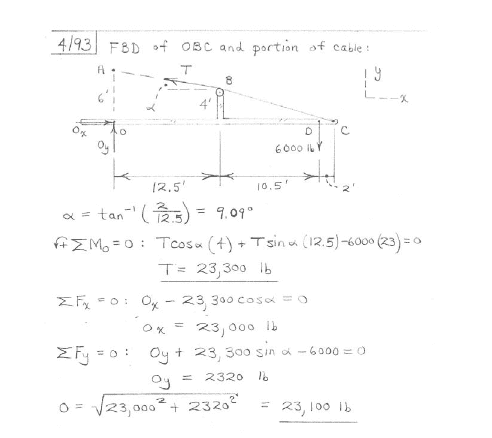
Can someone explain to me why the torque due to tension is taking from the roller instead of at the end of the beam.

If you were to take it from the end of the beam you would also need to take the torque created by the bending of the cable. This is obviously more complicated.

It just doesn't seem like the way they did it should work.
Screenshot2011-10-05at62038PM.png
 
Physics news on Phys.org
I can't figure out what is at B. Is the cable attached at C and slides over (above) a peg at B? Or is the cable attached at B, and a separate line connects B to C?

I think the cable might be fixed to the wall at A, and connected by a tensioned cable of fixed length to B. There is a separate lifting cable running from B to C that can be reeled in by a motor at B. That seems how it is analyzed, anyway.
 
It is the same cable and that is a roller at B.
 
Then it looks like the extra force acting on the beam is a not-quite-vertical force at B, its line of action being midway through angle ABC. But I'm no expert.

Are there online resources where you can analyse beams and forces, as a check?
 

Similar threads

  • · Replies 7 ·
Replies
7
Views
3K
  • · Replies 2 ·
Replies
2
Views
3K
  • · Replies 4 ·
Replies
4
Views
5K
  • · Replies 9 ·
Replies
9
Views
3K
Replies
6
Views
2K
  • · Replies 2 ·
Replies
2
Views
3K
  • · Replies 2 ·
Replies
2
Views
2K
Replies
4
Views
4K
Replies
65
Views
7K
Replies
5
Views
4K