Create a two-stage amplifier without feedback

Click For Summary

Discussion Overview

The discussion revolves around the design of a two-stage amplifier without feedback, focusing on specific requirements such as voltage gain, input resistance, lower limit frequency, linearity, stability, and power draw. Participants explore various aspects of transistor biasing, circuit design, and analysis methods relevant to achieving these specifications.

Discussion Character

  • Technical explanation
  • Debate/contested
  • Mathematical reasoning
  • Experimental/applied

Main Points Raised

  • One participant emphasizes the importance of understanding transistor biasing as a foundational topic for the assignment.
  • Another suggests starting with AC analysis to determine resistor values that achieve the desired gain of 100.
  • Questions arise regarding the purpose of specific resistors in the circuit, particularly RE18, with some participants discussing its role in AC and DC conditions.
  • A participant challenges the notion of creating an amplifier without feedback, arguing that some form of feedback is inherent in the proposed circuit design.
  • There is a suggestion to perform a DC analysis first to ensure transistors are in active mode before proceeding to AC analysis for gain calculations.
  • Participants discuss the need to select component values that minimize dependence on transistor parameters and to calculate various performance metrics like maximum signal strength and lower limit frequency.
  • One participant expresses uncertainty about their approach and seeks confirmation on whether their method of starting with AC analysis is correct.
  • Another advises beginning with reasonable DC settings and then using a small-signal model to calculate midband AC gains, suggesting a strategy for achieving the overall gain requirement.

Areas of Agreement / Disagreement

Participants exhibit a mix of agreement and disagreement, particularly regarding the role of feedback in amplifier design. While some acknowledge the necessity of feedback for stability and performance, others maintain that the task requires a design without it. The discussion remains unresolved on these points.

Contextual Notes

Participants note the importance of simplifying the task for easier execution, indicating that assumptions about component behavior and circuit performance may vary. There is also mention of using simulation tools like Orcad to verify design requirements, suggesting a reliance on computational methods for validation.

Who May Find This Useful

This discussion may be useful for students and practitioners interested in amplifier design, particularly those exploring the nuances of feedback, biasing, and component selection in transistor circuits.

bergen89
Messages
11
Reaction score
0
< Mentor Note -- thread moved to HH from the technical engineering forums, so no HH Template is shown >[/color]

Hi,

I have a task to create a two-stage amplifier without feedback.

It shall be made with these requirements;

It shall be connected to a source of internal resistance equal 2.2kΩ and a load of 1kΩ.

Create amplifier so that these requirements are met:

• Voltage Gain at medium frequencies = 100 ± 10%
• input resistance ≥ 20kΩ
• Lower limit frequency ≤ 50Hz
• Quite linear
• Working point is stable
• Power draw should be ≤ 10mAThe input signal amplitude is less than or equal to 20mV.
The supply voltage is 15V.
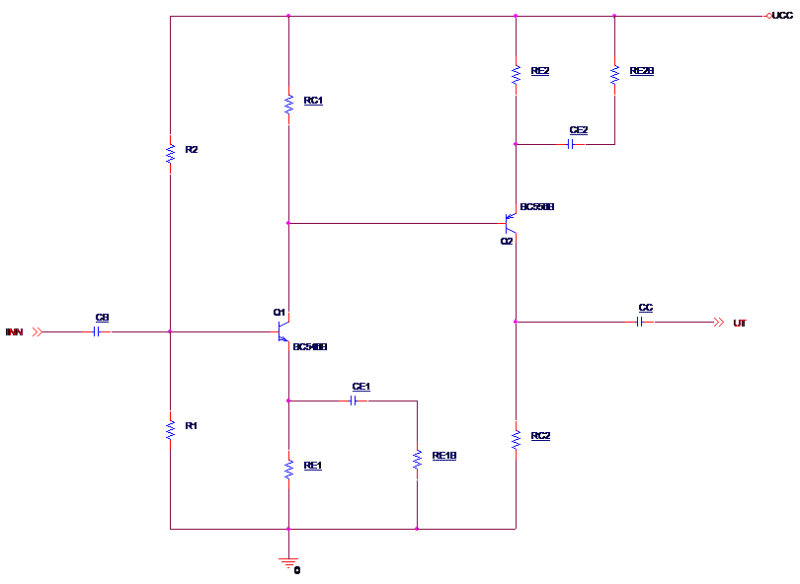
Bilde.png


As showen in the picture the type of transistor is: BC546B, so its possible to find the beta value (Typ 290).

I want to find the value of the ressistors and capacitors, to meet thise requirements above.

What is the first thing i should find out, with these requirements?

How should I start?
 
Last edited by a moderator:
Physics news on Phys.org
bergen89 said:
What is the first thing i should find out
Transistor biasing. That's a topic you should have studied before being given an assignment such as this.
 
NascentOxygen said:
Transistor biasing. That's a topic you should have studied before being given an assignment such as this.
Thanks for your answer! :)
Would the beste think to do;
1. transistor ac analysis. (Because we know that the gain should be 100)
2. Give the ressistor values, so we have the gain of 100.
 
Do you know the purpose of resistor RE18?
 
NascentOxygen said:
Do you know the purpose of resistor RE18?
No, to now I try to use the t-modell (Because of the two reisstor at Emittor).
 
NascentOxygen said:
Do you know the purpose of resistor RE18?
When the capacitor is low impedance, then RE18 parallels RE1 to create a lower emitter resistance for AC than for DC.

These resistors provide negative feedback.
 
Take a look at this paper: http://www.linearaudio.nl/linearaudio.nl/images/pdf/otala%20low%20tim%20amp.pdf
It is a detailed description of a very famous power amplifier and the included preamplifier.
 
Last edited by a moderator:
bergen89 said:
I have a task to create a two-stage amplifier without feedback.
I do not think you mean that. Without some sort of negative feedback, you would just create an oscillator. Even the circuit you proposed has feedback - the resistor in the emitter creates what we call "current feedback".

There are hundreds of circuits on the web - most of them either outdated or specialized. I sort of liked this one, even if it uses three transistors. It is quite possible to modify it to your requirements.
http://myweb.tiscali.co.uk/norcimradiocontrol/Radio15_files/image014.gif​
 
Last edited by a moderator:
Svein said:
I do not think you mean that. Without some sort of negative feedback, you would just create an oscillator. Even the circuit you proposed has feedback - the resistor in the emitter creates what we call "current feedback".

There are hundreds of circuits on the web - most of them either outdated or specialized. I sort of liked this one, even if it uses three transistors. It is quite possible to modify it to your requirements.
http://myweb.tiscali.co.uk/norcimradiocontrol/Radio15_files/image014.gif​
Thanks for you respone Svein. I am quite sure a wrote the wrong thing about negative feedback. I am quite new to this.

But if I am going to use the circuit above. What would be the first step to to. What I have read to now is that I should do a dc analysis, to find out if the transistor are in active mode. But should I just choose some ressistor values then? And after that do the AC analysis to get the wantet gain of 100.
 
Last edited by a moderator:
  • #10
bergen89 said:
But if I am going to use the circuit above. What would be the first step to to. What I have read to now is that I should do a dc analysis, to find out if the transistor are in active mode. But should I just choose some ressistor values then? And after that do the AC analysis to get the wantet gain of 100.
Some of the changes are easy, the input impedance for example. Others - the figure says that open loop gain is about 100. Can you identify the output-to-input feedback?
 
  • #11
bergen89 said:
Im quite sure a wrote the wrong thing about negative feedback.
What do the assignment specifications say about "feedback"? Can you provide a jpeg of the complete specifications? Is this circuit going to be constructed and its operation verified, or is it just a paper exercise?
 
  • #12
NascentOxygen said:
What do the assignment specifications say about "feedback"? Can you provide a jpeg of the complete specifications? Is this circuit going to be constructed and its operation verified, or is it just a paper exercise?
To goal with the taks is to:

1. Selection of working point. This choice depends on the signal strength of the output signal.
2. Selecting the component values so that the working point is very little dependent on the transistor data.
3. Calculate the gain factor, first an estimate so that one can get started and then a more accurate calculation.
4. Consider how the amplification factor can be made less dependent on the transistor parameters.
5.Calculate the maximum signal strength.
6. Calculate the lower limit frequency.

-- And one of the main thing is to do simplifications to do the task easier.

Then this requirements are given:

It shall be connected to a source of internal resistance equal 2.2kΩ and a load of 1kΩ.

Create amplifier so that these requirements are met:

• Voltage Gain at medium frequencies = 100 ± 10%
• input resistance ≥ 20kΩ
• Lower limit frequency ≤ 50Hz
• Quite linear
• Working point is stable
• Power draw should be ≤ 10mA


The input signal amplitude is less than or equal to 20mV.
The supply voltage is 15V.

Then after i have calculated the components, I am going to test it in Orcad to see if the requirements are fulfilled.
 
  • #13
Im stuck on were to begin. I have tried to do the AC analysis (T-Modell on both, because ressistor at emittor), I know the gain (100), so I hope then to find the ressistor components. But the answer does not look to good to now, but is that the right way to start?
 
  • #14
Start with DC settings. Aim for reasonable midpoint values. Then use a small-signal model to calculate the midband AC gains. Then maybe go back and fix more appropriate DC settings. You only need about x10 AC gain for the second stage and then tweak the first stage to make overall gain x100 so not particularly demanding for the high gain transistors you are using.
 

Similar threads

  • · Replies 7 ·
Replies
7
Views
2K
  • · Replies 32 ·
2
Replies
32
Views
5K
  • · Replies 21 ·
Replies
21
Views
3K
  • · Replies 5 ·
Replies
5
Views
5K
  • · Replies 20 ·
Replies
20
Views
5K
Replies
9
Views
4K