Undergrad Cross-correlations: what size to select for the matrix?

Click For Summary
The discussion centers on determining the appropriate size for the covariance matrix, C^{-1}_{AB}, when analyzing cross-correlations among three galaxy populations (BGS, LRG, ELG). There is confusion regarding whether the matrix should be 3x3 or 4x4, with arguments suggesting it is fundamentally a fourth-order structure rather than a simple matrix. Participants clarify that the covariance terms should be treated as a 6x6 matrix due to the relationships between the populations, with diagonal and off-diagonal terms reflecting these correlations. The conversation also touches on how to interpret specific covariance terms and whether certain rows/columns can be removed based on the presence of cross-correlations. Ultimately, the complexity of the relationships among the populations necessitates careful consideration of the covariance structure.
fab13
Messages
300
Reaction score
7
Hello,

I am working on Fisher's formalism in order to get constraints on cosmological parameters.

I am trying to do cross-correlation between 2 types of galaxy populations (LRG/ELG) into a total set of 3 types of population (BGS,LRG,ELG).

From the following article https://arxiv.org/pdf/0909.4544.pdf page 14, there is the following equation (63) :
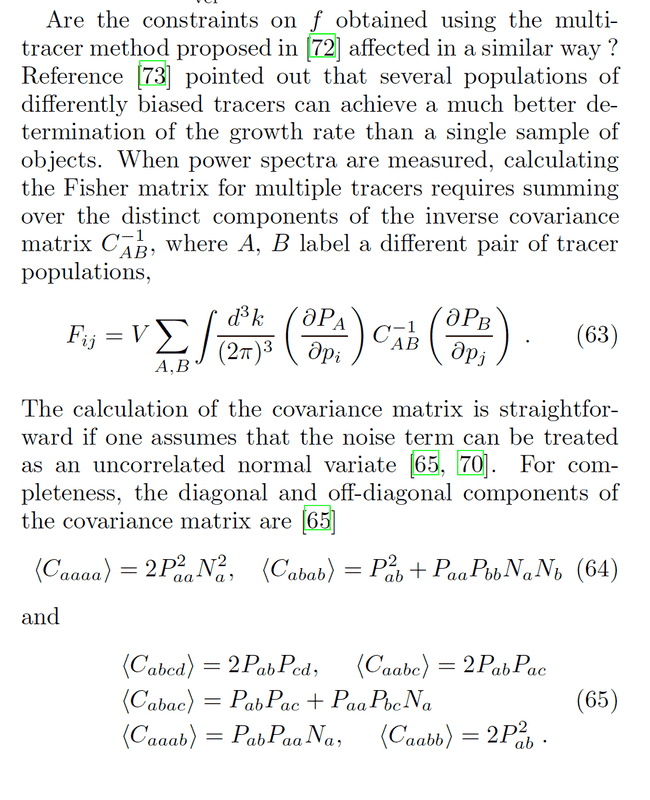
YjdLCmi.png


As you can see, into eq(63), there is a sum on every pair of population types. In my case, I have 3 populations (BGS/LRG/ELG), so the term ##C^{-1}_{AB}## should have a size of 4x4 (with ##aa=BGS\quad##, ##bb=LRG\quad##, ##cc=ELG\quad## and ##bc=LRGxELG##) like this :

--------------------------------------------------------------------------------
##BGS\quad\quad\quad\quad 0\quad\quad\quad\quad 0\quad\quad\quad\quad 0##

##0\quad LRG\quad LRG/ELG\quad LRG/LRGxELG##

##0\quad LRG/ELG\quad ELG\quad ELG/LRGxELG##

##0\quad LRG/LRGxELG\quad ELG/LRGxELG\quad LRGxELG##
--------------------------------------------------------------------------------

But If I take eq(64), eq(65) and compare it with formula eq(63), I can't find the expression of the fourth element for power spectrum factor P_A, i.e when index A=4.

Indeed, If I follow what it is said in Paper, "where A,B label different pair of tracer populations"

I could identify ##P_{A}## to power spectrum for population ##A## and same for ##P_{B}## for population ##B##.

Finally, from your point of view, what's the size of ##C^{-1}_{AB}##, i.e 3x3 or 4x4 ?

and if this size is 4x4, how to sum on the A=B=4 with a power spectrum ##P_{A}## and ##P_{B}## ##(P_{\text{population}=4})## which is unknown since I have only 3 populations ?

On another hand, I think the non-diagonal terms on a covariance matrix 4x4 will transfer informations when I invert this one, and so I can only sum ##C^{-1}_{AB}## on 3 populations for the pair (A,B). I mean their contribution will remain after inversion.

I hope you will understand my issue on this sum. Regards
 

Attachments

  • YjdLCmi.png
    YjdLCmi.png
    80.6 KB · Views: 887
Last edited:
Space news on Phys.org
fab13 said:
View attachment 239566

As you can see, into eq(63), there is a sum on every pair of population types. In my case, I have 3 populations (BGS/LRG/ELG), so the term ##C^{-1}_{AB}## should have a size of 4x4 (with ##aa=BGS\quad##, ##bb=LRG\quad##, ##cc=ELG\quad## and ##bc=LRGxELG##) like this :

--------------------------------------------------------------------------------
##BGS\quad\quad\quad\quad 0\quad\quad\quad\quad 0\quad\quad\quad\quad 0##

##0\quad LRG\quad LRG/ELG\quad LRG/LRGxELG##

##0\quad LRG/ELG\quad ELG\quad ELG/LRGxELG##

##0\quad LRG/LRGxELG\quad ELG/LRGxELG\quad LRGxELG##
--------------------------------------------------------------------------------
This doesn't make sense. You've constructed a 4x4 which has diagonal elements aa, bb, cc, bc. That last one cannot fit there.

Ultimately, they're not describing a matrix. They're describing a fourth-order structure. In your case it would be 3x3x3x3. Hopefully that helps get you started, at least.
 
kimbyd said:
This doesn't make sense. You've constructed a 4x4 which has diagonal elements aa, bb, cc, bc. That last one cannot fit there.

Ultimately, they're not describing a matrix. They're describing a fourth-order structure. In your case it would be 3x3x3x3. Hopefully that helps get you started, at least.

I am not so sure as you concerning the 4x4 covariance of the observables ##C_{AB}##. Indeed, if I follow the paper, the lines and columns of this matrix are :

"aa bb cc ab ac bc" , such that initially, I have a 6x6 matrix. Given in my case, I have only a cross-correlation between "b" and "c" population, so I get a 4x4 matrix. ( aa bb cc bc).

Caution : the product inside integral of eq(63) is not a matricial product.

My main question is to know if I can do a summation only on (A,B) with A=(1,3) and B=(1,3) and not (A=(1,4), and B=(1,4)) ?

Thanks
 
Last edited:
No, that's not right at all. It's fundamentally a fourth-order structure. They're packing that fourth-order structure into a matrix.

So instead of a 3x3x3x3, they produce a 9x9., with the diagonal elements coming from eqn 64, and the off-diagonal ones from eqn 65. They can then reduce the size of this 9x9 matrix by noting the symmetries of the system: any swap of any two populations results in the same values. This makes three of the rows/columns identical, reducing it to a 6x6. If you're going to assume that one component doesn't have any cross-correlation at all with the others then yes, you can also remove those rows/columns.

The trick is in making sure that you're respecting eqns. 64 and 65, as they aren't very simple.

Finally, as to how to use this structure, if ##P_a## is the power spectrum of population ##a##, then you have to construct a 4-vector containing the power spectrum of each of the three populations, and a fourth element with the cross-spectrum between the two populations you're assuming are correlated.
 
@kimbyd , thanks for your attention and your remarks. It seems that I make confusions.

kimbyd said:
No, that's not right at all. It's fundamentally a fourth-order structure. They're packing that fourth-order structure into a matrix.

So instead of a 3x3x3x3, they produce a 9x9., with the diagonal elements coming from eqn 64, and the off-diagonal ones from eqn 65.

If I have 3 populations (marked "a", "b" and "c"), I understand that I have ##3^{4}=81## combinations, since I have 4 digits.

QUESTION 1) But how to interpret the term : ##<C_{abab}>##, I mean why it is qualified of "diagonal term" ? the 3 diagonals terms should be ##<C_{aaaa}>##, ##<C_{bbbb}>## and ##<C_{cccc}>##, shouldn't they ?

Maybe the 3 others diagonal terms are ##<C_{abab}>##, ##<C_{acac}>##, ##<C_{bcbc}>## ? (which would make a total of 6 diagonal terms).

QUESTION 2) Similar problem for the term off-diagonal : what corresponds for example to the term ##<C_{abcd}>## since population "d" doesn't exist ?

How can I do basically the link with the definition of covariance term : ##C_{ij} = E[X_{i}\,X_{j}]-E[X_{i}]\,E[X_{j}]## ?

This makes three of the rows/columns identical, reducing it to a 6x6. If you're going to assume that one component doesn't have any cross-correlation at all with the others then yes, you can also remove those rows/columns.

QUESTION 3) In my case, I have cross-correlation between populations "b" and "c" : from your suggestion, have I got to stay into a 6x6 matrix (with aa, bb, cc, ab, ac, bc) or can I remove the lines/columns "ab", "ac" such way I work finally on 4x4 matrix (aa, bb, cc, bc) ? Sorry I didn't well grasp your reasoning and idea about this point.

The trick is in making sure that you're respecting eqns. 64 and 65, as they aren't very simple.

Finally, as to how to use this structure, if ##P_a## is the power spectrum of population ##a##, then you have to construct a 4-vector containing the power spectrum of each of the three populations, and a fourth element with the cross-spectrum between the two populations you're assuming are correlated.

Maybe I see the light about this fourth element since the matter spectrum ##P_{ab}## can be expressed as :

##P_{ij}=(b_{i}+f\mu^2)\,(b_{j}+f\mu^2)\,P_{\text{linear}}##

where ##P_{\text{linear}}## the linear spectrum and ##b_{i}## the bias of population ##i##.

With this expression, I could use the cross-spectrum between population "b" and "c" = ##P_{bc}##

Regards
 
Last edited:
I always thought it was odd that we know dark energy expands our universe, and that we know it has been increasing over time, yet no one ever expressed a "true" size of the universe (not "observable" universe, the ENTIRE universe) by just reversing the process of expansion based on our understanding of its rate through history, to the point where everything would've been in an extremely small region. The more I've looked into it recently, I've come to find that it is due to that "inflation"...

Similar threads

  • · Replies 5 ·
Replies
5
Views
2K
  • · Replies 8 ·
Replies
8
Views
2K
  • · Replies 11 ·
Replies
11
Views
2K
  • · Replies 8 ·
Replies
8
Views
1K
Replies
2
Views
2K
  • · Replies 3 ·
Replies
3
Views
3K
  • · Replies 6 ·
Replies
6
Views
2K
  • · Replies 56 ·
2
Replies
56
Views
11K
  • · Replies 39 ·
2
Replies
39
Views
13K
  • · Replies 9 ·
Replies
9
Views
3K