Current calculation of a Y-junction

Click For Summary
SUMMARY

The discussion focuses on the calculation of a Y-junction in an electrical circuit involving Delta-Y conversion. The user initially expresses confusion regarding the equation "I0=IA-IB" for current flow between nodes A and B. Participants identify circuit elements, including an inductor (Z1) and a capacitor (Z5), and emphasize the importance of using LaTeX for mathematical expressions. The correct approach involves determining the potentials at points B and C to calculate the current I0 using the formula I0 = VBC/R3.

PREREQUISITES
  • Understanding of Delta-Y conversion in electrical circuits
  • Familiarity with circuit elements such as resistors, inductors, and capacitors
  • Knowledge of electrical potential and current flow concepts
  • Proficiency in using LaTeX for mathematical equations
NEXT STEPS
  • Study the principles of Delta-Y conversion in circuit analysis
  • Learn how to calculate electrical potentials in circuits
  • Practice using LaTeX for rendering mathematical equations
  • Explore advanced circuit analysis techniques, including nodal analysis
USEFUL FOR

Electrical engineering students, circuit designers, and anyone involved in analyzing complex electrical circuits.

simphysics
Messages
7
Reaction score
0
Homework Statement
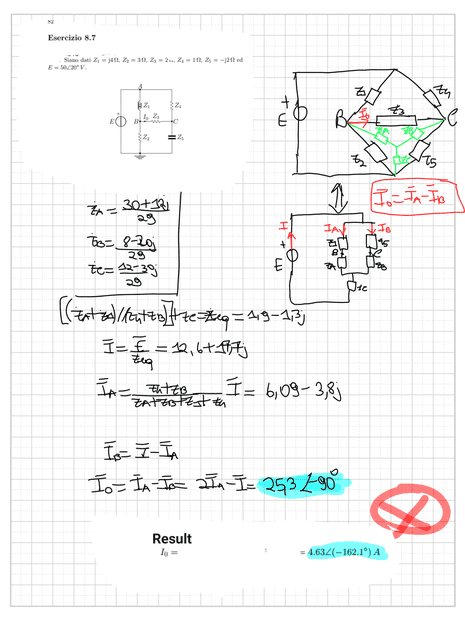
Find I0 in the following circuit
Relevant Equations
I used the delta-Y conversion
Hello everyone!
I've been trying to solve this circuit but there's something wrong. Firstly, I made a Delta-Y conversion so that1 and zA were in series, and so were z5 and zb. I really don't know if writing "I0=IA-IB" is correct, cause basically I0 is the current that flows between the nodes A and B. Can someone help me, please?
Thank you!
EXERCISE.png
 
Physics news on Phys.org
It is possible that you are getting few answers because the drawing is nearly illegible. Not all of the circuit elements seem to be resistors either. So that scares me away. I can make out (I think) ##Z_1## and ##Z_2## on the left hand side, ##Z_3## in the middle and ##Z_4## and ##Z_5## on the right.

Then in the equivalent Y layout we have some other symbols that I cannot make out.

Type in your equations. Explain what they mean and what justifies them and we can talk.
 
Thank you.
I'll try to reupload the pics.
This is the circuit:
Screenshot_2022-08-25-16-27-41-763.jpeg

I did a delta-Y conversion
Screenshot_2022-08-25-16-27-58-026.jpeg

and the new impedances are:
Screenshot_2022-08-25-16-28-14-984.jpeg

I hope that the rest is pretty legible.
Thank you, again
 
Much more legible, yes. Although the forum guidelines ask that you type in your work rather than import images.
https://www.physicsforums.com/threads/physics-forums-global-guidelines.414380/ said:
Core post content should be typed out and not solely contained in an image, PDF, or other attachment. (Exceptions at Mentor's discretion.) Use images for supporting figures. Use LaTeX to type mathematical expressions and equations. (See: Learn LaTeX for Math Equations)
[emphasis mine]
With the images made legible, I can see that ##Z_1## is an inductor and ##Z_5## is a capacitor. So this is beyond what I am competent to analyze.

I can see that you've transformed to something that might be a taus (##\dot{\tau_A}##, ##\dot{\tau_B}## and ##\dot{\tau_C}##) with bars through the symbols. But those equations would be a lot prettier if rendered in ##\LaTeX##.

See the LaTeX guide that is linked here, in the quote above and which is also linked below the edit window when you respond.
 
simphysics said:
I really don't know if writing "I0=IA-IB" is correct, cause basically I0 is the current that flows between the nodes A and B.
That doesn't seem correct (though I'm no expert). There is a junction between ##Z_A## and ##Z_B## and your equation doesn't take account of the current flowing from the junction into ##Z_C##.

I think you need to find the potentials at points B and C. This gives the potential difference between B and C (##V_{BC} = V_C - V_B##). Then ##I_0 = \frac {V_{BC}}{R_3}##.

Notes

A, B and C are the names of points in the circuit So calling the Y-impedances ##Z_A, Z_B## and ##Z_C## isn't a good idea!. Maybe something like ##Z_P, Z_Q## and ##Z_R## would be better.

Your handwriting is difficult to read. Have some sympathy for whoever is marking your work! (And if they can't read it, you may lose marks.) For posting here, you should use Latex for equations (not that hard) as already noted by @jbriggs444.
 
The book claims the answer is that all the magnitudes are the same because "the gravitational force on the penguin is the same". I'm having trouble understanding this. I thought the buoyant force was equal to the weight of the fluid displaced. Weight depends on mass which depends on density. Therefore, due to the differing densities the buoyant force will be different in each case? Is this incorrect?

Similar threads

Replies
7
Views
1K
  • · Replies 5 ·
Replies
5
Views
2K
  • · Replies 9 ·
Replies
9
Views
2K
  • · Replies 14 ·
Replies
14
Views
3K
  • · Replies 4 ·
Replies
4
Views
1K
Replies
10
Views
3K
  • · Replies 5 ·
Replies
5
Views
5K
  • · Replies 1 ·
Replies
1
Views
1K
Replies
8
Views
4K
  • · Replies 5 ·
Replies
5
Views
2K