Current flowing through the resistor

  • Thread starter Thread starter joaofbi1
  • Start date Start date
  • Tags Tags
    Current Resistor
Click For Summary
SUMMARY

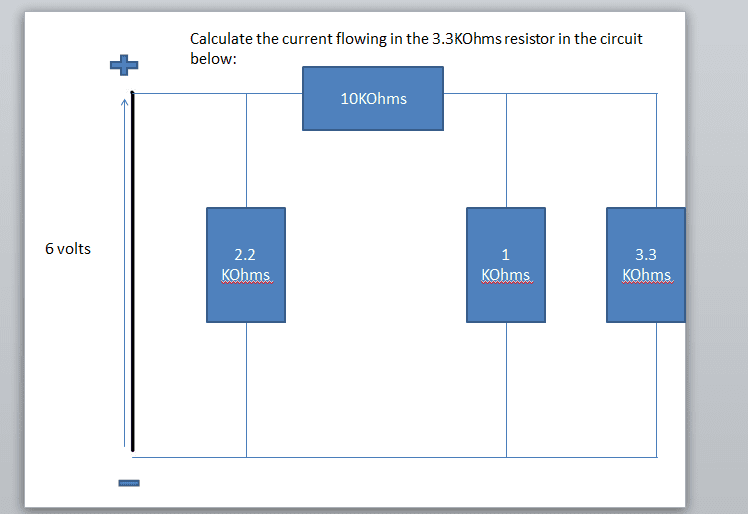
The discussion focuses on calculating current through a resistor network using mesh analysis and Ohm's Law. Participants detail the steps to derive mesh equations for a circuit with resistors of 2.2kΩ, 10kΩ, and a parallel combination of 1kΩ and 3.3kΩ. The final current through the circuit is calculated to be 3.3mA, with specific attention to the application of Kirchhoff's Voltage Law (KVL) and the proper combination of resistors in series and parallel. The importance of maintaining unit consistency throughout calculations is emphasized.

PREREQUISITES
  • Understanding of Ohm's Law (V = IR)
  • Familiarity with Kirchhoff's Voltage Law (KVL)
  • Knowledge of mesh analysis for circuit analysis
  • Ability to combine resistors in series and parallel
NEXT STEPS
  • Study the application of Kirchhoff's Current Law (KCL) in circuit analysis
  • Learn advanced techniques for solving simultaneous equations in circuit analysis
  • Explore the Delta-Y transformation for resistor networks
  • Practice drawing and analyzing circuit diagrams for complex resistor networks
USEFUL FOR

Electronics students, electrical engineers, and hobbyists seeking to deepen their understanding of circuit analysis and current flow in resistor networks.
joaofbi1
Messages
20
Reaction score
0
I'm just stuck on a question that I've been given as a quick test, it's really stumped me. I was wondering if anyone could assist me.

Here's the question:

4ENza.png


Thank you.
 
Physics news on Phys.org
Hi joaofbi1. http://img96.imageshack.us/img96/5725/red5e5etimes5e5e45e5e25.gif

Let's see your thoughts on how to solve this. Then we can see where you may be going wrong. :wink:

First step, draw in some current paths so you can see where the current is flowing.
 
Last edited by a moderator:
You can solve this via mesh analysis: write the currents I1,I2,I3 as loops passing around each of the three independent loops, the write the three mesh equations, taking proper care of the directions which you assigned (I used clockwise for all three) when summing the currents from shared resistors.

6V = 2.2k(I1-I2)
0 = 2.2k(I2-I1) + 10k(I2) + 1k(I2-I3)
0 = 1k(I3-I2) + 3.3k(I3)

Then solve the three simultaneous linear equations via your favorite method (substitution, elimination, Cramer's rule), and I3 is your answer.

I also considered a Delta-Y transform but it didn't seem to make the solution go any faster.
 
Firstly as 1KΩ and 3.3Ω are parallel I used the formula:
Rt= R1XR2 / R1 + R2 so it would've been Rt = 1x3.3 / 1 + 3.3 which gave me the answer of 0.8kΩ

After that I noticed that 2.2kΩ, 10kΩ and 0.8kΩ was kind of in a circuit, if you rearranged it, because of that I used the formula:
Rt = R1 + R2 + R3 which would have been Rt= 2.2 + 10 + 0.8 which gave me 13kΩ

After that I used the formula I= V/R - But before that I converted 13kΩ into Ω by ten to the power of -3 so I got 13x10(-3).
After that I did Voltage / Resistance -> 6/(13x10(-3)) which gave me the current of 462Amps which then I converted into mA and got 0.462mA.

That's where I got to, now I'm stuck.
 
UltrafastPED said:
You can solve this via mesh analysis: write the currents I1,I2,I3 as loops passing around each of the three independent loops, the write the three mesh equations, taking proper care of the directions which you assigned (I used clockwise for all three) when summing the currents from shared resistors.

6V = 2.2k(I1-I2)
0 = 2.2k(I2-I1) + 10k(I2) + 1k(I2-I3)
0 = 1k(I3-I2) + 3.3k(I3)

Then solve the three simultaneous linear equations via your favorite method (substitution, elimination, Cramer's rule), and I3 is your answer.

I also considered a Delta-Y transform but it didn't seem to make the solution go any faster.

I've just started the electronic course so I'm quite new to the method that you're using. So I don't quite understand it.
 
I agree that the parallel combination of 3.3k and 1k is ~0.8k (I get 0.77k). But this doesn't help you to get the current through the 3.3k resistor!

Also you cannot sum the resistors around the middle loop ... this is only valid for resistors in series; resistors in series appear 1-2-3 along the same piece of conductor without any additional branches. In this case you have an additional branch which has the 6V voltage source.

It is possible to continue the reduction of the resistor network into a single loop with the voltage source plus one resistor in series. This would provide the total current being supplied by the battery, but now you have lost track of the 3.3k resistor!

The easiest way is to apply the Kirchoff voltage law (KVL) around each loop, or the Kirchoff current law (KCL) at each node, or apply a method (like the mesh method) which is derived from those laws.
 
Are you self-study, or is this a course with an instructor?

You know Ohm's law; the next step is usually to teach KVL and KCL followed by some practice.

The mesh method is simply a faster, systematic application of KVL; nodal analysis is a faster, systematic application of KCL. In this case I used the mesh method; you can arrive at the same results via KVL or KCL though the equations may have a different appearance ... but the three currents will be the same.
 
I've not learned KVL nor KCL yet, and yes this course is with an instructor. I've been told that I have to find the current around the whole circuit before calculating the current through the given resistor hence the reason why I have attempted to calculate the total resistance across the whole circuit.

Is this not possible to do with Ohm's law? If it is then could you help me out using Ohm's law please?
 
Yes, you solve for the total current by reducing the resistor network to an equivalent single resistor. You have already started on this by combining the two resistors that were in parallel.

If you now redraw the circuit with the reduction (using the 0.8 kOhm resistor) you should see that there is now a series combination of two resistors which can be combined; do this, and redraw the circuit.

This time you should see two resistors in parallel with the battery. You can combine the two resistors and use Ohm's law to find the total current.

Do that, keeping all of the circuit diagrams ... then you can start solving backwards, but first things first!
 
  • Like
Likes 1 person
  • #10
So firstly I do this:

4EOZm.png


then it turns into this:

4EOZF.png


Right? Then what shall I do, this is the bit where I get confused on what to do with the two resistors.
 
  • #11
I suggested that you should draw some current paths, to help with the analysis, for a good reason.

Keep it as 3 resistors, 2.2, 10 and 0.8. Draw some current paths, these being shown as closed loops.
 
  • #12
NascentOxygen said:
I suggested that you should draw some current paths, to help with the analysis, for a good reason.

Keep it as 3 resistors, 2.2, 10 and 0.8. Draw some current paths, these being shown as closed loops.

What do you mean by draw circuit paths?
 
  • #13
The 10k and 0.8k resistors are in series; the 2.2k is NOT in parallel with the 0.8k resistor because there is something on the upper bus between them: the 10k resistor.

So combine the 10k with the 0.8k in series: 10.8k, and then you are left with two resistors in parallel, the 2.2k and the 10.8k. Combine them and then solve for the total current.
 
  • #14
UltrafastPED said:
The 10k and 0.8k resistors are in series; the 2.2k is NOT in parallel with the 0.8k resistor because there is something on the upper bus between them: the 10k resistor.

So combine the 10k with the 0.8k in series: 10.8k, and then you are left with two resistors in parallel, the 2.2k and the 10.8k. Combine them and then solve for the total current.

Oh I understand what you mean now, so once I've found the total current what formula do I use to find the current going through the resistor?
 
  • #15
Now you will have to use your sequence of diagrams in reverse, solving for the current flow through each branch.

For the first step you will have two resistors in parallel; part of the total current will pass through each branch.

Since one of the resistors is the 2.2k resistor from the original circuit, you can go back and label both the total current drawn from the battery, and the current passing through the 2.2k resistor. The remaining current must pass through the 10k resistor.

What will then happen to this part of the current?
 
  • #16
I got the total current across the whole circuit of 3.3. So the voltage across the 2.2 resistor would be 3.3 X 2.2? But how would that help me find the 3.3 value?
 
  • #17
You have two resistors in parallel on this diagram ... the next to last circuit ... one is 2.2k, the other is 10.8k.

They both see the same voltage: 6 volts. So you can calculate the current through each of these two paths via Ohm's law. You need to do this so that you know the current going through the 10.8k equivalent resistor.

You will use that current for the next step.

I get 1.98k (2k) for the total equivalent resistance, which means that the total current is
I=6v/2k Ohms=3 mAmps. You should always keep track of your units.

Correction: I get 1.83 kOhms for the equivalent resistance, and 3.3 mAmps for the total current - so your total current is correct.
 
Last edited:
  • #18
So once I've calculated the current through the 2.2 and 10 resistor then what calculation would I use?
 
  • #19
You want the current through the 2.2k and the 10.8k ohm resistors. They should sum to 3.3mA.

The current through the 10.8 kOhm resistor will then be the same as the current through the 10 kOhm resistor in the original circuit: it will then divide as it goes through the original two parallel resistors, the 1k and the 3.3k ohm resistors.

You have two ways to solve this final step.
 
  • #20
So once I get the current for the 10.8 resistor do I divide that current by 1and 3.3
 
  • #21
joaofbi1 said:
So once I get the current for the 10.8 resistor do I divide that current by 1and 3.3
Not exactly.

But you could determine how much of the battery's voltage is "lost" because of the 10kΩ resistor, so the remainder is what appears across the pair of parallel resistors.
 
  • #22
Im quite confused, what calculations would I need to perform?
 
  • #23
joaofbi1 said:
Im quite confused, what calculations would I need to perform?
How many volts are lost across the 10k resistor? Use Ohms Law.
 
  • #24
Im not at home yet so I cannot answer that. But after I see how much current the 10ohms resistor takes then do I use the current amount of current I have after the 10kohmd resistor and use the same calculation on the 3.3 resistor?
 
  • #25
Ok so I'm home, so this is what was calculated 3.3A x 10KOhms = 33Volts through the 10kOhms resistor. Then what do I do after that operation?
 
  • #26
It should be 3.3 mA through 10k ohms. Pay attention to your units!

And that is the total current; we previously calculated the current for this branch - what is it?
 
Last edited:
  • #27
So how do I calculate how much mA I've lost through the resistor? What formula?
 
  • #28
The second to last circuit had two parallel resistors: 2.2k and 10.8 k. Each sees 6 V, so you can apply Ohm's law to each resistor.

I1 = 6 V/2.2k ohms = 2.73 mA; I2 = 6 V/10.8 k ohms = 0.55 mA. These add up to 3.3 mA total current which we obtained from the final circuit.

So the current through the 10 k ohm resistor will be I2 = 0.55 mA.

This is the current that will be available to the parallel resistors 1 k and 3.3 k ohm; when they were combined they provided the addition 0.8 k ohms that was combined with the 10 k resistor in series to obtain the 10.8 k ohm equivalent resistor.

This process of working backwards, and marking the resulting currents on each as we walked backwards up the circuits has provided all of the information needed.
 
  • #29
UltrafastPED said:
It should be 3.3 mA through 10k ohms. Pay attention to your units!

And that is the total current; we previously calculated the current for this branch - what is it?

So how do I Calculate how much mA I have lost through the resistor?
 
  • #30
Note that the voltage seen by these parallel resistors is the same, and can be found as V= 6 V - 10k Ohm x 0.55 mA = 6 - 5.5 [V] = 0.5 V.

Or we could have solved from the equivalent resistance of the parallel resistors which was 770 Ohms, with a current of 0.55 mA gives V = 0.770 kOhms x 0.55 mA = 0.44 [V]

These voltages are close (0.5, 0.44) but we should get the same answer both ways ... this indicates that there is an error earlier in the calculations which you should recheck.

Assuming that 0.5 V is correct you can use Ohm's law to get the current I3 = 0.5 V / 3.3 k Ohms = 0.15 mA.
 

Similar threads

  • · Replies 11 ·
Replies
11
Views
1K
  • · Replies 1 ·
Replies
1
Views
2K
  • · Replies 2 ·
Replies
2
Views
1K
  • · Replies 8 ·
Replies
8
Views
1K
Replies
3
Views
2K
  • · Replies 3 ·
Replies
3
Views
2K
Replies
2
Views
1K
Replies
2
Views
2K
  • · Replies 1 ·
Replies
1
Views
2K
  • · Replies 6 ·
Replies
6
Views
2K