De broglies wavlength and energy

  • Thread starter Thread starter SpartanG345
  • Start date Start date
  • Tags Tags
    Energy
Click For Summary
SUMMARY

The discussion centers on the relationship between de Broglie's wavelength and energy, specifically addressing the equation E=hf and its application. Participants clarify that E=hf, which calculates energy, is primarily applicable to massless particles like photons. The conversation highlights that de Broglie's equation, λ = h/p, indicates that particles possess wavelength based on their momentum, leading to the conclusion that the energy derived from E=hf may not equate to the kinetic energy of massive particles, as demonstrated in practical examples.

PREREQUISITES
  • Understanding of quantum mechanics principles
  • Familiarity with de Broglie's wavelength equation
  • Knowledge of the relationship between energy and frequency (E=hf)
  • Basic concepts of particle momentum (p = h/λ)
NEXT STEPS
  • Study the implications of de Broglie's hypothesis on wave-particle duality
  • Explore the differences between kinetic energy and energy calculated using E=hf
  • Investigate the role of momentum in quantum mechanics
  • Learn about the applications of de Broglie's equation in modern physics
USEFUL FOR

Students of physics, educators, and anyone interested in the foundational concepts of quantum mechanics and wave-particle duality.

SpartanG345
Messages
69
Reaction score
1
I am having a little trouble understanding de Broglies equation and wavelength and it relation ship with energy
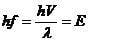
Eq1.jpg


by E=hf and debroglies equation the above equation will get the energy of the particle
i did an example and i found this energy does not = the Kinetic energy of the particle, infact it was smaller

why is this

I thought E = hf only applies to zero mass particles?
 
Physics news on Phys.org
My understanding is from high school physics (I finished my physics degree 30 some years ago). De Broglie's insight, found while drinking beer in a pub, was that perhaps waves have momentum p = h/λ and particles have wavelength λ = h/p. I don't think E=hf applies to anything other than photons.
 

Similar threads

  • · Replies 5 ·
Replies
5
Views
2K
  • · Replies 35 ·
2
Replies
35
Views
4K
Replies
1
Views
5K
  • · Replies 21 ·
Replies
21
Views
5K
  • · Replies 3 ·
Replies
3
Views
1K
  • · Replies 13 ·
Replies
13
Views
1K
  • · Replies 19 ·
Replies
19
Views
4K
  • · Replies 11 ·
Replies
11
Views
3K
  • · Replies 5 ·
Replies
5
Views
3K
  • · Replies 3 ·
Replies
3
Views
3K