Decoding Miller Code: Understanding the High and Low Signals

  • Thread starter Thread starter Peter_Newman
  • Start date Start date
  • Tags Tags
    Code Coding
Click For Summary

Discussion Overview

The discussion revolves around the Miller Code, focusing on its signal representation, particularly the transitions between high and low states in relation to binary sequences. Participants explore the implications of starting signals, the correctness of diagrams, and the interpretation of specific cases within the code. The scope includes technical explanations and conceptual clarifications related to signal encoding and decoding.

Discussion Character

  • Technical explanation
  • Conceptual clarification
  • Debate/contested

Main Points Raised

  • Some participants question why the first signal in the Miller Code starts high when the binary sequence begins with 0, suggesting it may be incorrect.
  • Others propose that the transition in the Miller bit stream for a specific binary sequence should occur earlier, indicating a potential error in the diagram.
  • There is a suggestion that the original diagram may not represent standard Miller Code but rather a Modified Miller Code, which could affect interpretations.
  • Some participants assert that a Miller code signal can start high or low, emphasizing that the critical aspect is where transitions occur within the signal.
  • Concerns are raised about how to represent consecutive ones in the Miller Code, with participants seeking clarification on the drawing of such sequences.
  • One participant notes that a string of logical ones results in a square wave at half the data rate, highlighting the bandwidth reduction advantage of Miller Code.

Areas of Agreement / Disagreement

Participants express differing views on the correctness of the diagrams and the interpretation of the starting signals in the Miller Code. There is no consensus on the accuracy of the original diagram or the implications of starting high or low.

Contextual Notes

Some discussions reference specific diagrams and external links for context, but there are unresolved questions regarding the accuracy and definitions of the signals depicted.

Peter_Newman
Messages
155
Reaction score
11
Hello,
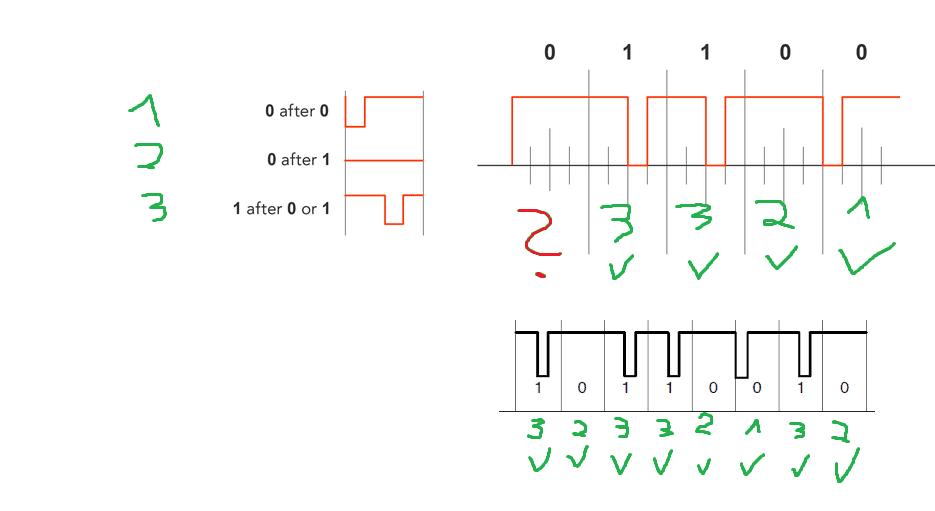
I have some questions about the Miller Code. So I googled something and found some helpful pictures. See, for example, Figure 1:
miller.png


My first question on picture 1 is, why is 0 set to high in the first signal (I marked this with a red question mark)? With the second signal in the first picture the bit sequence starts with 1, this case is clearly defined (case 3, from picture 1).

Note: Under the signal or the bit I have written the corresponding cases (they picture edge).
 
Engineering news on Phys.org
Peter_Newman said:
So I googled something and found some helpful pictures. See, for example, Figure 1:
It will certainly be interesting if there is an error in the original diagram.
We need some context for the something diagrams. Can you please post the link.

See also; https://epxx.co/artigos/baseband_miller.html
 
I believe the red step up at the start of the Miller bit stream for binary 01100 is incorrect and should have occurred one quarter of a bit earlier as the sequence must be 101100.
 
I believe the red step up at the start of the Miller bit stream for binary 01100 is incorrect and should have occurred one quarter of a bit earlier as the sequence must be 101100.

I completely agree with that! If the first sign, that is not mentioned in the picture would have been a 1, everything is fine! But we don't know?!

Here are some links:
https://blog.atlasrfidstore.com/uhf-rfid-tag-communications-protocols-standardshttps://www.electronics-notes.com/a...ation/physical-layer-rf-signal-modulation.php
It will certainly be interesting if there is an error in the original diagram.
We need some context for the something diagrams. Can you please post the link.

See also; https://epxx.co/artigos/baseband_miller.html

I'm not sure if this explanation at this page is right, see what I mean in the picture below:

mil.PNG
I am of the opinion that according to the rules (at least that also in this black picture stand) the transition from 1 to 1 would have to be different ...

However, the question arises here, how to get to the beginning, there is a 0 then set to high ...
 
A Miller code signal can start high or low, it is where the transitions occur that is important. If you invert the Miller code signal it regenerates the same input binary sequence.

The diagram in your first post was not standard Miller code but of Modified Miller Code, you cut the title from the image.
 
  • Like
Likes   Reactions: Peter_Newman
Ok, but there is still the question how the Miller Code in the black Picture was created, see the blue question mark?
 
Peter_Newman said:
Ok, but there is still the question how the Miller Code in the black Picture was created, see the blue question mark?
I see no problem. The Miller code signal switches state in the middle of a one input, and between any two consecutive zeros input.
 
Ok, so actually two things confused me:
Firstly, why start with high at the first bit (the zero). But if it does not matter if you start with a 0 with high or low, because the following sequences are important, then that is understandable ...

On the other hand, kich has confused this "middle of the bit". But the middle between the sequence 1 and 1 (in the black picture) is marked red, so actually also understandable.

I think then I have that, but once as a further question, taken on three ones follow each other, how would you draw that?
 
A string of logical ones will become a square wave at a frequency of half the data rate, with the transitions in the middle of the input bits.

A string of logical zeros will become a square wave at a frequency of half the data rate, with the transitions between the zero input bits.

The advantage of an NRZ or Miller code is the divide by two reduction in bandwidth.

It is necessary to continuously decode the Miller code stream and keep synchronised with the clock.
 
  • Like
Likes   Reactions: Peter_Newman

Similar threads

  • · Replies 15 ·
Replies
15
Views
4K
Replies
8
Views
2K
  • · Replies 4 ·
Replies
4
Views
2K
  • · Replies 14 ·
Replies
14
Views
2K
Replies
8
Views
2K
  • · Replies 9 ·
Replies
9
Views
2K
  • · Replies 2 ·
Replies
2
Views
2K
  • · Replies 30 ·
2
Replies
30
Views
5K
Replies
1
Views
2K
  • · Replies 6 ·
Replies
6
Views
2K