Decomposing velocity vectors into polar axis

Click For Summary

Homework Help Overview

The discussion revolves around decomposing velocity vectors into polar coordinates, specifically in the context of a particle moving towards a radar with a given velocity. The original poster is attempting to understand how to properly decompose the velocity vector when the angle involved is 60°.

Discussion Character

  • Exploratory, Conceptual clarification, Assumption checking

Approaches and Questions Raised

  • Participants discuss the relationship between the radial and angular components of velocity, with some questioning how to accurately represent these components in relation to the velocity vector. There is also confusion about the directionality of the angular component.

Discussion Status

Participants are actively engaging with the problem, offering insights about the perpendicular nature of the angular and radial components. Some guidance has been provided regarding the decomposition of the velocity vector, but there remains a lack of consensus on the specifics of the representation.

Contextual Notes

The original poster expresses uncertainty about the decomposition process and mentions a potential visual aid, indicating that a diagram might clarify the relationships between the components.

Like Tony Stark
Messages
182
Reaction score
6
Homework Statement
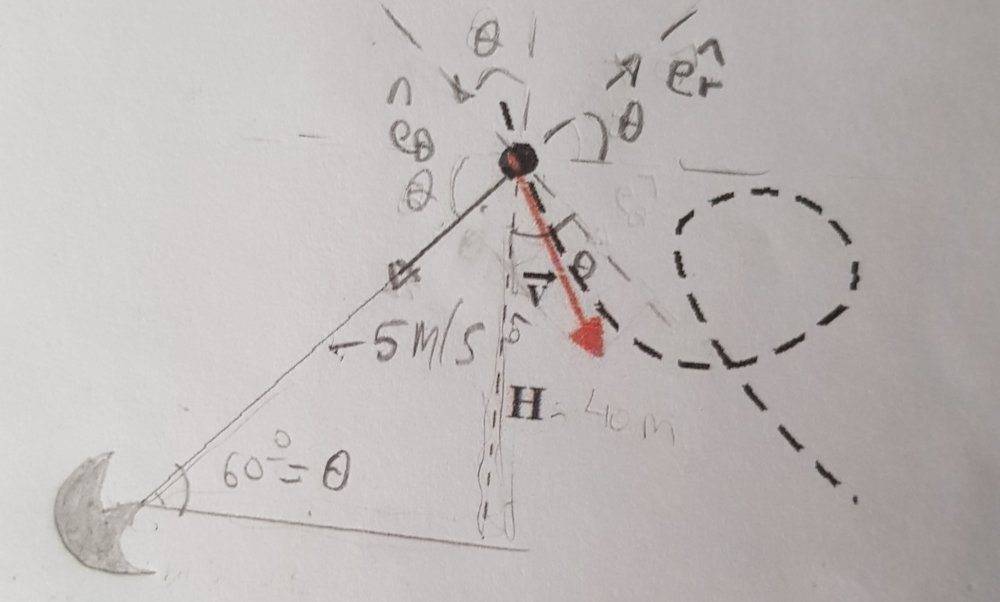
A particle moves along a trajectory with velocity whose modulus is constant. At a certain time it is at a point of the trajectory whose radius of curvature is 15 m. At this moment, the modulus of the acceleration is 10 m/s^2. A radar detects that the particle, located 40 m above the ground, moves towards it with velocity v=5 m/s. The radius vector that goes from the radar to the particle forms an angle of 60° with the ground.
Find the angle formed by the velocity and the angular coordinate.
Relevant Equations
v=(dot r; r dot theta) in polar coordinates
Well, I drew the polar and standard axis centered in the particle and wrote which angles were equal to 60° so I could decompose the velocity. The problem says "moves towards it (the radar) with velocity v=5 m/s, so that's one of the components. But I realized that the velocity "cuts" the angle, so I don't know how I should decompose the velocity. Maybe it's a silly question, but it confuses me.
20190831_1633232.jpg
 

Attachments

  • 20190831_163323.jpg
    20190831_163323.jpg
    34.3 KB · Views: 240
Physics news on Phys.org
The angular component is perpendicular to the radial component, so draw it at a right angle from the head of the radial component toward the velocity vector.
 
tnich said:
The angular component is perpendicular to the radial component, so draw it at a right angle from the head of the radial component toward the velocity vector.

So the velocity would have the same direction that the angular component?
 
  • Like
Likes   Reactions: tnich
No, that would just be the way to draw than angular component. The angular velocity component is perpendicular to the radial component (radial with respect to the radar's positions). Their vector sum is the velocity vector.
 
Last edited:
tnich said:
No, that would just be the way to draw than angular component. The angular velocity component is perpendicular to the radial component (radial with respect to the radar's positions). Their vector sum is the velocity vector.
It looks like you are stuck on this part. You need to decompose the velocity vector into two perpendicular components, one pointing toward the radar. Maybe a picture would help.
homework.png
 

Similar threads

Replies
1
Views
1K
  • · Replies 6 ·
Replies
6
Views
2K
  • · Replies 25 ·
Replies
25
Views
4K
  • · Replies 13 ·
Replies
13
Views
2K
Replies
67
Views
5K
Replies
11
Views
2K
Replies
25
Views
2K
  • · Replies 18 ·
Replies
18
Views
2K
  • · Replies 5 ·
Replies
5
Views
2K
Replies
2
Views
1K