@Ibix thanks for addressing each way I was trying to ask the question. I’d love to dig more into why we can’t define gravitational potentials of objects in the early universe.
@kimbyd awesome examples! The ‘pressure’ box is wild and makes the imagination race. Evidenced by multiple replies to that point.
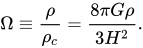
@Chronos thanks for bringing in the math. Is there an analogous stellar object that is a comparable density to, say, the CMB?
@Orodruin I had never heard of the Sach-Wolfe effect. Thank you. I’ve got some reading to do.
@andrew s 1905 I enjoy this out of the box thinking.
Essentially with this question I am trying to understand how a densely packed universe, full of energy, does not warp spacetime any more than the one we see today. (
@Chronos looking at you for the actually density numbers)
I assumed (likely incorrectly) that the light emitted at the CMB was at a lower gravitational potential than when it finally reaches us now.
Okay, now I’m going to embarrass myself with some diagrams drawn up in photoshop. (
@Ibix I’m going to go for the GR counter point, don’t hold your breath)
Figure 1 shows the early universe. Matter is closely packed. The gravity wells of said matter are also packed together. Space-time is, on average, pretty flat within this soup of matter. If the universe was finite, and had an edge where this dense matter gave way to ‘empty’ space, the gravitational well would be pretty sever.
Figure 2 shows the current universe. Matter is spread out. Gravity wells plateau to increasing smaller curvature over the large distances, more closely approximating/reaching idealized ‘empty’ space. Space-time is, on average, pretty flat within this spread out matter.
Figure 3 shows the two states in relation. Making the 'empty' space-time curvature of a theoretically finite universe commonality. Though both states have an on average flatness, the early universe exists at a much lower gravitational potential than the current universe. The finite universe line is not really important, but does illustrate the idea better graphically.
I read about early galaxies being better at making stars, potentially because of the higher density of the early universe, which sent me down this line of questioning.
https://mcdonaldobservatory.org/news/releases/20151119
Ok, rip it up team.
I’m not out to prove anything. Just want to get my thoughts straight. Thanks for bearing with me, I really appreciate this community... even if I don't always understand it.


 Not sure what I read that I misunderstood so badly.